
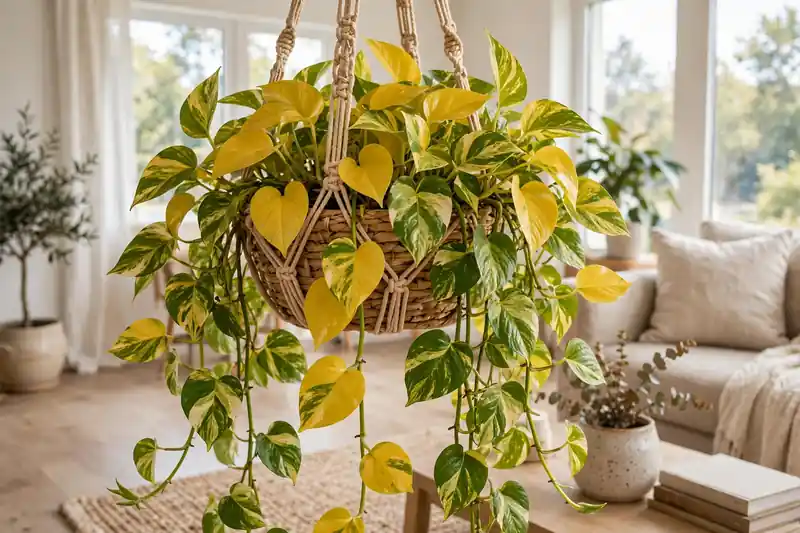
The Complete Pothos Care Guide: Light, Water, Soil, Pruning & Propagation
If you own exactly one houseplant, there’s a fair chance it’s a pothos — and if you’ve owned a pothos for a while, there’s an equally fair chance it’s the plant that taught you houseplants could survive you. Pothos (Epipremnum aureum), also called devil’s ivy, tolerates the dim corner, the forgotten watering, the repot you put off for two years. It is, genuinely, the most forgiving foliage plant most of us will ever grow.
But there’s a gap between a pothos that survives and a pothos that’s lush — full at the crown, leaves glossy and closely spaced, vines that look like they mean it. That gap isn’t talent or a green thumb. It’s about five ordinary decisions made reasonably well: the light it actually gets, a watering rhythm instead of a watering schedule, a mix with some air in it, the occasional trim, and a decision about whether it trails or climbs. This guide walks through all of them, the way I’d explain it to a friend standing in my kitchen holding a slightly sad-looking golden pothos.
One honest note up front, because everything else hangs on it: pothos almost never die of neglect in the dramatic sense. They die wet. Overwatering — roots sitting in soggy mix until they rot — is the one mistake this plant can’t shrug off, and it threads through half the problems in the troubleshooting section at the end. Get watering right and pothos care is mostly pleasure.
Quick-Start Summary: The Essentials at a Glance
| Need | What to do |
|---|---|
| Light | Bright indirect for lush growth; tolerates medium and low light, just slower and plainer |
| Water | When the top 2 inches of soil are dry — then soak thoroughly and drain fully |
| Soil | Chunky, airy mix (recipe below); pot must have drainage holes |
| Feeding | Half-strength balanced fertilizer, monthly in spring and summer; none in winter |
| Temperature | 65–85°F is home; keep above about 55°F and away from drafts and vents |
| Humidity | Ordinary room air is fine — no humidifier required |
| Growth habit | Trail it from a shelf, or climb it up a pole for bigger leaves |
| Pets | Toxic if chewed — hang it or shelve it out of reach |
Keep that table and you can keep a pothos. The rest of this guide is the why, the how, and the fixes for when it still complains.
Light: What “Bright Indirect” Actually Means in a Real Home
“Bright indirect light” is the most repeated and least explained phrase in houseplant care, so let’s translate it into rooms. Bright indirect light is what you get a few feet back from a south or west window, right up against an east window, or on a bright windowsill behind a sheer curtain: the room is properly lit, you could read comfortably all day, but the sun’s rays aren’t landing on the leaves for hours at a stretch. An hour or two of gentle morning sun is fine — even welcome. Hard midday sun through glass will scorch pale patches into the leaves, and a scorched patch never heals.
Here’s the honest version of the low-light reputation. A pothos will tolerate a dim hallway, a bathroom with a small window, an office lit by fluorescents — it will sit there, alive, for a very long time. What it won’t do there is thrive. In low light the vines grow slowly, the gaps between leaves stretch out (that’s the plant reaching for light), and variegated types quietly give up on their patterns: a golden pothos turns plainer green, a marble queen washes toward green, because white and yellow tissue doesn’t photosynthesize and the plant stops paying for decoration it can’t afford. Move it brighter and the new growth comes back patterned — but note the direction: it’s the new leaves that improve. Leaves that already reverted stay green.
The practical rule I use: if you want the plant you saw in the shop — full, fast, patterned — give it the brightest spot you have that isn’t a sunbeam. If it has to live in the dim spot, it will, and it will simply be a slower, greener plant. Both are fine choices. Just make them on purpose.
Watering: A Rhythm, Not a Schedule
Forget “water every Sunday.” A pothos in a bright kitchen in June and a pothos in a dim bedroom in January are living different lives, and the same calendar will drown one and parch the other. Water by the soil, which takes five seconds to check: push a finger two inches into the mix. Dry down there? Water. Still cool and damp? Walk away and check again in a few days. In most homes that works out to roughly every one to two weeks in the growing season and every three or four in winter — but the finger, not the math, makes the call.
When you do water, do it properly. Take the pot to the sink (or water in place with a saucer you actually empty), soak the mix until water runs freely from the drainage holes, let it drain completely, and put it back. The half-cup dribble from a mug wets the top inch, trains the roots to stay shallow, and leaves the bottom of the pot dusty. If the mix has dried out so hard that water sheets straight down the sides without soaking in — it happens after vacations — set the pot in a basin of water for half an hour and let it drink from below, then drain it.
The droop signal, with its limit. A thirsty pothos wilts — the leaves go soft and hang, unmistakable once you’ve seen it — and perks up within hours of a drink. It’s a useful alarm, but don’t run the plant on it. A pothos that wilts hard between every watering is being stressed on repeat: leaves yellow and drop at the base, growth stalls. Use the droop as the backup warning, not the routine. The finger check, a few days before you’d expect the droop, is the routine.
And the other direction, the one that matters more: a pothos that stays wet is a pothos in danger. Roots in constantly soggy mix suffocate, rot organisms move in, and the plant’s first visible complaint — yellow leaves — looks confusingly like thirst. If the soil is wet and the plant looks wilted, it is not asking for water. It is asking for air. That’s why the check comes before the can, every time.
Soil & Potting: The Mix That Prevents Most Problems
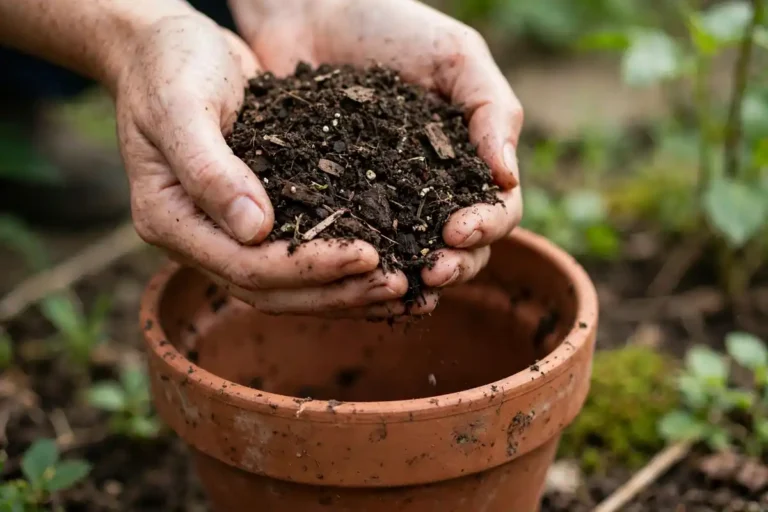
In the wild, pothos is a climbing rainforest plant whose roots run through bark, leaf litter, and air gaps — never through anything like the dense peat brick most of us pot it in. You don’t need to replicate a rainforest floor, but a mix with some structure in it is the single best insurance against the rot problem above. Here’s the recipe I pot all my aroids in:
- 2 parts regular houseplant potting mix (the base — holds some moisture, carries the roots)
- 1 part orchid bark (creates the air pockets roots actually breathe through)
- 1 part perlite or pumice (keeps the mix from compacting back down over time)
Shake it together and it should look visibly chunky, not like soil from a bag of topsoil. Water should run through it in seconds, not pool on top. If all you have is plain potting mix, a generous handful of perlite stirred through a pot’s worth does most of the job — don’t let the perfect recipe stop you from improving the adequate one.
The pot rules are simpler than the soil rules. Drainage holes: non-negotiable. A pothos in a sealed decorative pot is a pothos sitting in its own runoff, and that’s the rot story again. Keep it in its nursery pot inside the pretty cachepot if you like the look, and lift it out to water, or empty the cachepot every time. Size: go one size up when you repot — an inch or two wider, no more. A small plant swimming in a big pot has a sea of wet mix around a modest root ball, and wet mix with no roots in it just sits there getting sour. Terracotta is the forgiving choice for anyone who over-waters, because it breathes and dries faster; plastic holds moisture longer, which suits the forgetful waterer. Neither is wrong. Know which kind of keeper you are.
When is a repot actually due? Not on a birthday — on evidence: roots poking out of the drainage holes or circling the surface, water running straight through a root-filled pot and the plant wilting again two days later, growth stalled despite good light. That usually means every year or two for a fast grower in bright light, and every two to three for a slow one in a dim room. Spring is the kindest moment to do it. And a myth worth retiring here: pothos do not like being rootbound. They tolerate it, the way they tolerate everything, but a plant whose pot is mostly root will grow faster and complain less once it’s given room.
Feeding: Less Than You Think
Pothos are light feeders living in a pot of mix that starts with almost no food in it, so the right amount is “some, occasionally” — not none, and definitely not full-strength every week. My routine: a balanced liquid houseplant fertilizer at half the label strength, once a month in spring and summer, and nothing from fall through winter, when the plant isn’t growing and can’t use it. Slow-release pellets in spring are a perfectly good substitute if monthly mixing sounds like a chore you’ll abandon by July.
Two feeding mistakes cause most of the trouble I see. The first is feeding a stressed plant — a yellowing, wilting, or freshly repotted pothos gets plain water until it’s growing again; fertilizer on damaged roots is salt on a wound. The second is never flushing. Mineral salts from fertilizer (and from hard tap water) accumulate in a pot over months, and the plant’s complaint — brown, crispy leaf tips and edges — looks like half a dozen other things. Once or twice a year, run plain water through the pot slowly, several pot-volumes’ worth, draining freely, and you wash the bank of salts out the bottom. Cheap insurance, five minutes, done in the sink.
If your plant is growing steadily, putting out new leaves, and holding its color, it is not hungry. Pale, slow, small new growth on a plant that hasn’t been fed in a couple of years is the real deficiency picture — and it’s rarer than the fertilizer aisle wants you to believe.
Humidity & Temperature: The Honest Version
You’ll read that pothos “loves high humidity.” Here’s the calibration: pothos comes from humid forests, and it will grow a little faster and a little lusher in humid air — but it is completely at home in the ordinary 30–50% humidity of a heated or air-conditioned house, and I have never seen a pothos fail because its owner didn’t buy a humidifier. Brown edges blamed on dry air are, in real homes, almost always water or salts (see Feeding). If your winter air is truly desert-dry and the plant sits beside a blasting vent, moving it a few feet helps more than any pebble tray — and the vent draft was probably the problem anyway.
Temperature is equally undramatic. A pothos is happy in the same range you are: 65–85°F suits it perfectly. It sulks below about 55°F, takes real damage from cold glass on freezing nights and from sitting in an air-conditioning blast, and otherwise asks only to be kept in the climate-controlled zone you already maintain for yourself. Warm room, no drafts, no radiator contact — that’s the whole temperature section, and any guide that makes it longer is padding.
Training & Pruning: Trail It or Climb It
This is the decision that changes what your pothos becomes, and most owners never realize they made it. A pothos left to trail from a shelf will trail forever, leaves staying the familiar hand-sized juvenile shape all the way down the vine. The same plant given something to climb does what it evolved to do: its aerial roots grip, the stem thickens, and the leaves grow progressively larger and more mature-looking — on some types, dramatically larger. It’s not a different plant. It’s the same plant finally allowed to grow up.
If you let it trail
Nothing to build, nothing to maintain — put it on a shelf or in a hanging basket and let gravity style it. Trailing vines eventually thin out near the pot (the oldest stem sections carry fewer leaves over time), which is what the pruning and planting-back tricks below are for. Expect a well-lit trailing pothos to add a foot or more of vine in a good growing season, and don’t be alarmed by the plant looking a little sparse in winter; spring fixes it.
If you give it a pole
A moss pole, a coco-fiber pole, or even a rough plank works — what matters is a surface the aerial roots can attach to and draw moisture from. The setup:
- Install the pole when you repot, not after — sink it deep into the pot, right against the stems, and firm the mix around its base so it doesn’t wobble. A wobbling pole teaches the plant nothing.
- Tie the vines up loosely with soft plant ties or clips, stems resting against the pole, aerial roots (the brown nubs along the stem) facing it.
- Keep the pole damp. This is the step everyone skips and the one that makes it work: mist the pole or pour a little water down it at watering time. Roots attach to a moist pole; against a permanently dry one, the vine just leans.
- Guide new growth upward as it comes — a tie every few inches — and the plant does the rest, rooting in as it climbs.
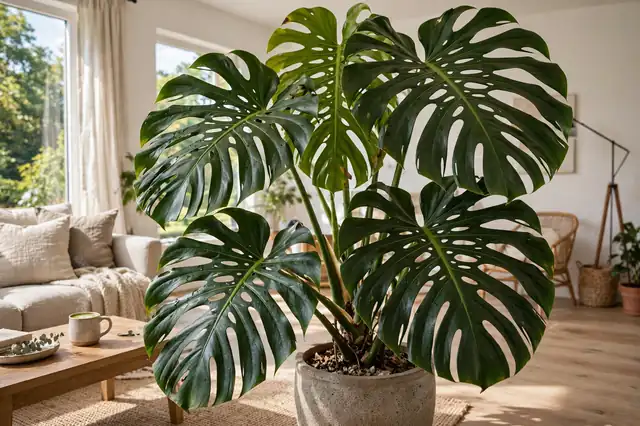
Within a season or two the leaves sizing up will tell you it’s working. It’s the same family trick our monstera pulls — our Monstera Deliciosa Care Guide covers that plant’s even more dramatic version of climbing and leaf change.
Pruning for fullness
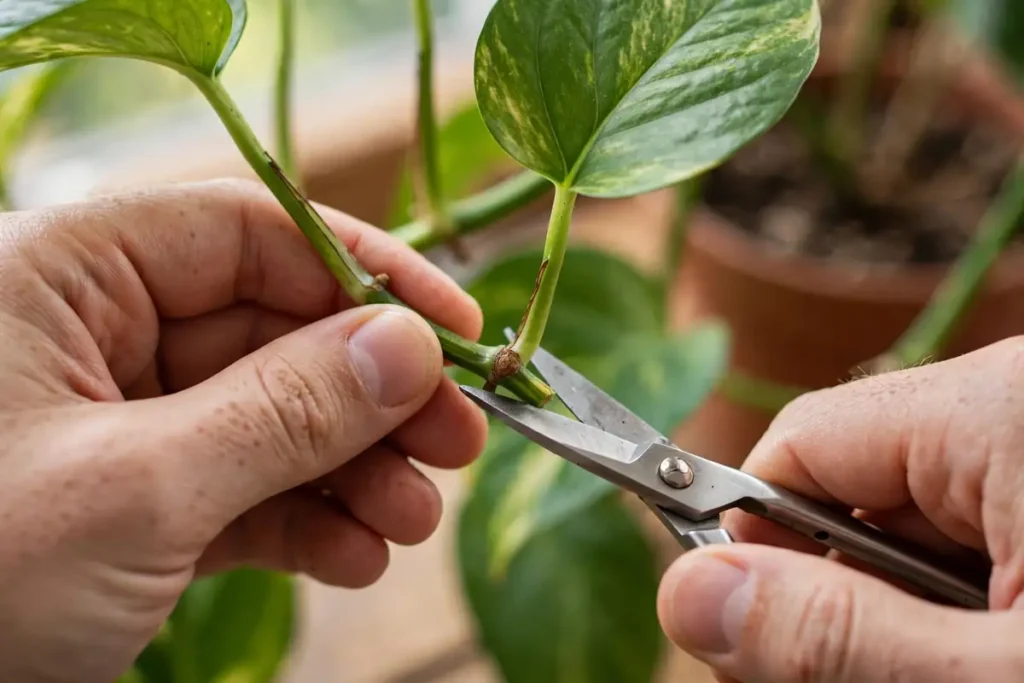
A pothos vine grows from its tip, which means an unpruned vine is one long line with leaves. Pruning is how you turn lines into a plant. The mechanics are simple: cut the stem just above a leaf node (the bump where a leaf joins the stem), and the plant responds by pushing new growth from the nodes just below your cut — often two shoots where there was one. Take cuttings of four to six inches for propagation (next section), and never remove more than about a third of the plant’s leaves in one session; it needs its green to fund the regrowth.
Prune whenever a vine outgrows its welcome, whenever the top of the pot looks bald (cut the longest vines back and let the branching happen near the crown), and in spring if you want the strongest response. Sterilize nothing fancy — clean, sharp scissors are fine; pothos is not precious about it. What comes off goes in a jar of water, not the compost. Which brings us to the plant’s best party trick.
Propagation: The Plant That Copies Itself
If pothos has a superpower, this is it: any piece of stem with a node on it can become a new plant, and the failure rate is close to zero. It’s how a single grocery-store pothos becomes a houseful — and how you fix a bald one.
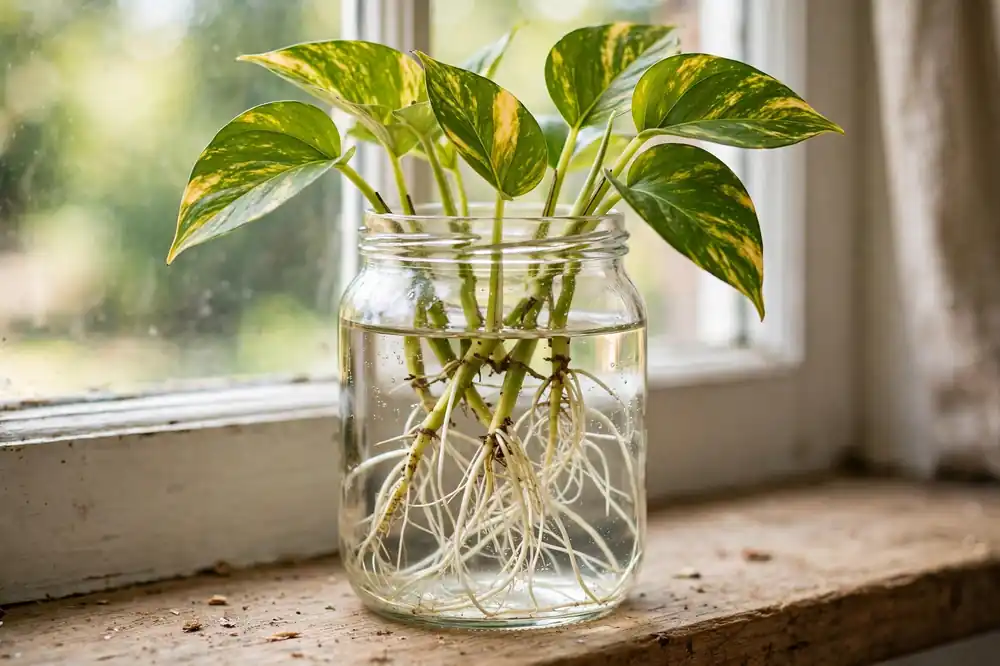
In water (the classic). Cut a four-to-six-inch piece of vine just below a node — the knobbly joint where a leaf attaches, usually with a small brown aerial-root nub already waiting there. Strip the lowest leaf or two so no foliage sits underwater, set the cutting in a jar of plain tap water on a bright sill, and wait. In the growing season, white roots typically appear in one to two weeks (winter cuttings can take a month and are nobody’s failure). Change the water weekly so it stays fresh and oxygenated. Pot the cutting up when the roots are two to three inches long and branching — that root system is big enough to drink from soil.
In soil (the shortcut). The same cutting can go straight into a small pot of the chunky mix, node buried, kept evenly moist — not wet — for the first few weeks while roots form. No jar, no transplant shock later, but no window into what’s happening either. I root special cuttings in water where I can watch them, and bulk cuttings for filling pots straight in soil.
The fullness trick. Remember the bald crown from the trailing section? Here’s the fix the nurseries use: take your rooted cuttings and plant them back into the mother plant’s pot, filling the bare top. A shelf pothos that looks lush and bushy is usually not one plant — it’s a crowd. Do this in spring, keep the soil a touch more moist than usual for a month while the new roots establish, and the pot knits together into one full plant.
Keeping a pothos in water permanently is possible — plenty of jars of pothos live on windowsills for years — with two honest caveats. Water holds no food, so a long-term water plant needs a drop of dilute fertilizer every month or so, and it will always grow more slowly than its soil-grown siblings. It’s a look, not an upgrade.
Cuttings also make the best gifts in the plant world: free, fast, and almost unkillable in transit. Half the pothos in America are probably grandchildren of one another.
Transitioning water → soil: pot cuttings when their roots are 2–3 inches long, and keep the soil consistently moist (not soggy) for the first 2 weeks while the water roots adapt to life in soil — then switch to the normal let-it-dry routine. Some leaf wilt during the transition is normal; the cutting is rebuilding its root tips, not dying.
Water culture or soil, for the long term? A pothos can live in a jar of water for years, and plenty of people keep one that way on purpose. Here’s the honest comparison:
| Water culture | Soil | |
|---|---|---|
| Growth speed | Slower | Faster, bigger leaves |
| Maintenance | Change water weekly; add dilute fertilizer monthly | Water when top 1–2 inches dry |
| Root health | Risk of rot if water stagnates | Risk of rot if overwatered |
| Lifespan | Years, but the plant stays smaller | Decades, full size |
| Best for | Propagation, decoration, cuttings | Long-term thriving |
Varieties at a Glance
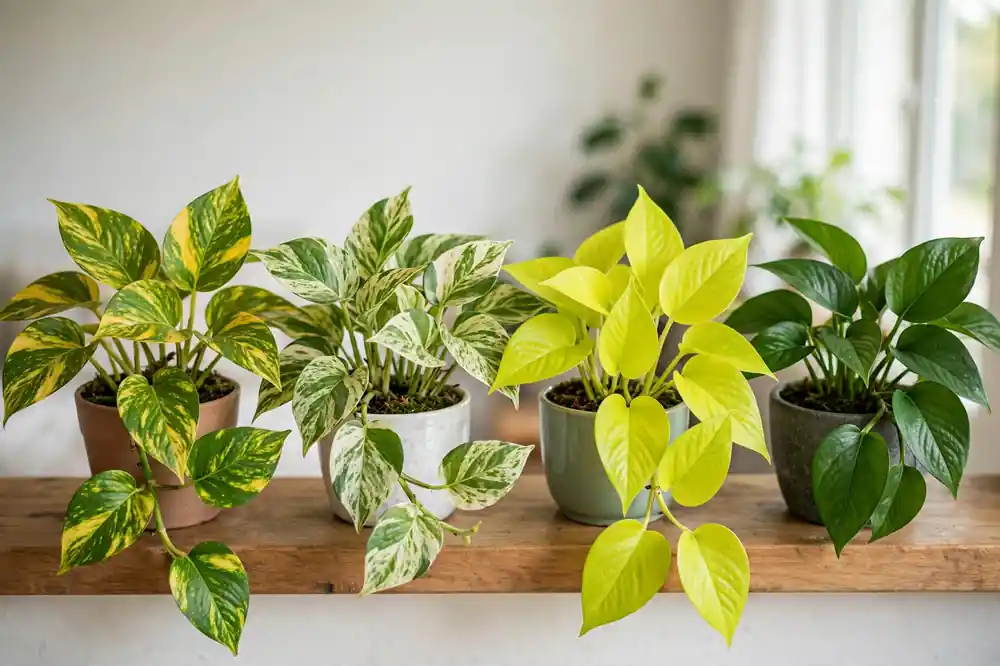
All of these are the same species with the same basic care — what changes is how much light their coloring costs them. White and cream tissue can’t photosynthesize, so the paler the variety, the more light it needs and the slower it grows. In rough order from toughest to most light-hungry:
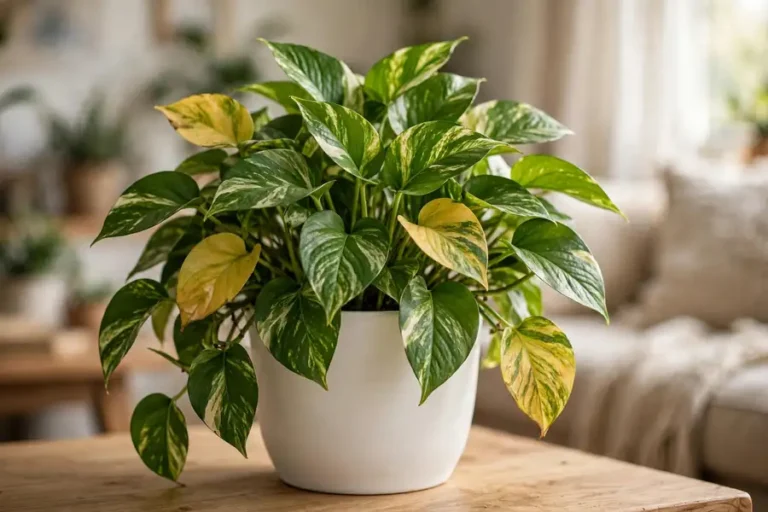
Golden pothos is the default and the benchmark: green leaves splashed with gold, the fastest grower of the family, and the most forgiving of dim rooms and missed waterings. If a care tip in this guide ever conflicts with your golden’s behavior, believe the golden.
Jade pothos is the same plant with the pattern switched off — solid deep green leaves. With no variegation to maintain, it’s the best pothos for genuinely low light, and a wall of jade in a dim room looks lush rather than deprived.
Neon pothos wears its color all over: electric chartreuse leaves that read almost yellow in bright light. The color is the leaf, so it holds its look in medium light better than the white-variegated types — a neon in a north window still glows. Dull, greenish neon means it wants more light.
Marble queen is heavily marbled in white and green, and she’s the first variety to teach you the light tax: she grows noticeably slower than golden, needs the brightest indirect spot you have to keep her white crisp, and reverts toward plain green faster than any other if she’s underlit. Prune out fully green shoots on sight — left alone, the vigorous green growth outcompetes the white and takes over the plant.
Manjula has broad, wavy-edged leaves brushed with cream, white, and several greens — the showpiece of the common varieties, and the most light-demanding of the five. Give her marble queen’s spot or brighter, expect a gentle pace, and don’t panic at the occasional mostly-white leaf; it contributes nothing and the plant knows it, but a stem of them in a row means the light needs to go up.
The collector types beyond these — pearls and jade, N’Joy, cebu blue, the big climbing Epipremnum pinnatum forms — all run on this same care sheet with the same single adjustment: the paler it is, the brighter it goes. For the botanical and cultivar background beyond a care guide’s scope, Clemson Extension’s pothos factsheet is a solid, no-drama reference.
N’Joy and Pearls and Jade — the white-variegated pair — play by the Marble Queen rules with the volume turned up: the more white in the leaf, the more light they need and the slower they grow. Give them your brightest indirect spot, expect a relaxed pace, and don’t judge their thirst by a green pothos’s rhythm.
Common Problems Preview: The Short Answers
Start with the symptom — then read the short answer below it:
| Symptom | Likely cause |
|---|---|
| Yellow leaves | Overwatering |
| Brown, crispy tips | Underwatering or salt buildup |
| Leggy, sparse vines | Too little light |
| Small new leaves | Low light, or needs feeding |
| Wilting despite wet soil | Root rot — check the roots |
| Tiny flies around the pot | Fungus gnats — soil staying too wet |
This is a care guide, so these are the honest short versions — each with the door to the full diagnosis where the site keeps it.
Yellow leaves. One or two at the base of an otherwise happy plant is retirement, not illness — pothos shed their oldest leaves their whole lives. Yellow spreading across the plant, especially with soil that’s still wet, is overwatering until proven otherwise: check the roots’ living conditions before anything else. The full pattern-by-pattern diagnosis lives in our guide to why pothos leaves turn yellow.
Brown, crispy tips and edges. The plant’s complaint about what’s in its water or air: accumulated fertilizer salts and hard-water minerals are the usual story, with chronic underwatering behind them. Flush the pot, review your feeding strength, and remember the verdict from the spider plant’s version of this fight — our spider plant brown tips guide works through the same water-chemistry logic in depth.
Leggy vines and a bald top. Long bare stems with a tuft of leaves at the end means the plant has been reaching for light it can’t find. The leaves that are gone from a bare section don’t grow back on that section — but cutting the vine back forces branching from lower nodes, and the cut pieces become the cuttings you plant into the crown. More light, a honest cutback, a fuller pot: that’s the whole cure.
Pests. Pothos are relatively untroubled, but three visitors recur. Mealybugs — white cottony tufts in the leaf joints — dab off with a rubbing-alcohol cotton swab. Scale — immobile brown bumps along stems and midribs — scrape and swab the same way. Spider mites — fine stippling and webbing in dry rooms — wash off in the shower, then treat. And if tiny black flies rise from the soil when you water, those are fungus gnats: harmless to the plant, damning evidence the mix stays wet too long — our fungus gnats guide has the full eviction, traps to Bti.
Pet Safety: Pretty, Popular, and Not a Snack
Pothos contains calcium oxalate crystals — the same needle-like crystals found across its plant family — and that makes every part of it an irritant if chewed. Honest calibration, because this gets exaggerated in both directions: a pet that bites a pothos leaf typically gets an immediate mouthful of burning irritation, drooling, and pawing at the face, which is miserable but self-limiting in most cases and is precisely why serious poisonings are rare — the plant defends itself on the first bite. It is not a plant to panic about having in the house; it is a plant to place with respect.
Placement is the whole solution, and pothos makes it easy: hang it, shelve it high, trail it down a bookcase — the vines look their best elevated anyway, which keeps them out of reach of cats, dogs, and toddlers in one move. If a pet does chew a real mouthful and the drooling or vomiting doesn’t settle, call your vet; bring a leaf for identification. And keep pruned cuttings and fallen leaves picked up — the jar of cuttings rooting at dog height on the windowsill is the one pothos most likely to get tasted.
Frequently Asked Questions
How often should I water my pothos? Whenever the top two inches of soil have dried out — in most homes every one to two weeks in spring and summer, and every three to four weeks in winter. Push a finger in and let the soil decide; the calendar version of this answer is how pothos get drowned.
Why is my pothos barely growing? Light, almost always. A pothos in a dim spot is in survival mode: alive, but adding an inch a month and calling it progress. Move it to the brightest indirect spot you have and growth resumes within weeks. The other two suspects are a pot that’s all roots (check the drainage holes) and a plant that hasn’t been fed in years — but check the light first, because it’s usually the light.
Why did my variegated pothos turn plain green? Because it couldn’t afford the pattern. White and gold tissue doesn’t make food, so in low light the plant builds cheaper all-green leaves instead. The reverted leaves won’t re-pattern, but new growth will once the plant is brighter — and if a whole shoot has gone solid green on a marble queen or manjula, prune that shoot out entirely, because vigorous green growth will outgrow and swamp the variegated stems.
How do I make the top of my pothos full instead of bald? Plant cuttings into it. Root a handful of four-to-six-inch cuttings in water until their roots are two or three inches long, then plant them into the bare crown of the mother pot in spring. It’s the nursery trick behind every lush shelf pothos, and it works better than any fertilizer promise.
Is pothos the same plant as heartleaf philodendron? No — they’re cousins so lookalike they’re sold under each other’s names constantly. Pothos leaves are thicker and waxier with a more textured surface; heartleaf philodendron leaves are thinner, softer, and more perfectly heart-shaped, with papery sheaths on the new growth. The care is nearly identical, happily, and the confusion runs both ways — our philodendron yellow leaves guide covers the other cousin’s most common complaint.
Can I keep a pothos in water forever? Yes, with modest expectations. A jar-grown pothos stays alive and attractive for years if you change the water weekly and add a drop of dilute fertilizer monthly — water alone has no food in it. It will grow more slowly than a soil-grown plant and rarely gets truly lush, but as a windowsill arrangement it’s one of the most reliable there is.
When does a pothos need a bigger pot? When the evidence says so: roots escaping the drainage holes or circling on the surface, water running straight through and the plant wilting again within days, growth stalled in good light. Move up just one size — an inch or two wider — into the chunky mix, ideally in spring. A pothos tolerates being rootbound, but tolerating isn’t thriving.
My pothos has long bare vines with leaves only at the ends. Can it be saved? Completely — it’s the most fixable look a pothos can have. Cut the bare vines back to a few inches from the pot (or to a healthy node), root the leafy tips as cuttings, and give the plant real light. The cut stems push fresh branching growth from their nodes, the rooted tips go back into the crown, and within a growing season you have a full plant again. The bare stems themselves were never going to re-leaf along their length; the rebuild comes from the nodes and the cuttings, and a pothos forgives the whole operation in weeks.
Why is my pothos not trailing? It’s young, the light is low, or it was recently pruned. Trailing is what pothos does once the stems get length — give it bright indirect light and time. If it still won’t, check whether it’s actually a philodendron: the two are sold interchangeably, and a heartleaf philodendron trails on its own slightly different schedule.
A pothos asks for so little that it’s easy to give it even less — the dim corner, the random watering, the pot it outgrew in 2023. Give it the five things in the quick-start table and the occasional haircut, and it stops being the plant that merely survives your house and becomes the one trailing gloriously over it: greener every spring, longer every year, and quietly ready to be cut into a dozen new plants whenever you want them. That’s the real care guide, and it’s about ten minutes a month.
3 Comments