The Complete Fiddle Leaf Fig Care Guide: Light, Water, Pruning & Shaping
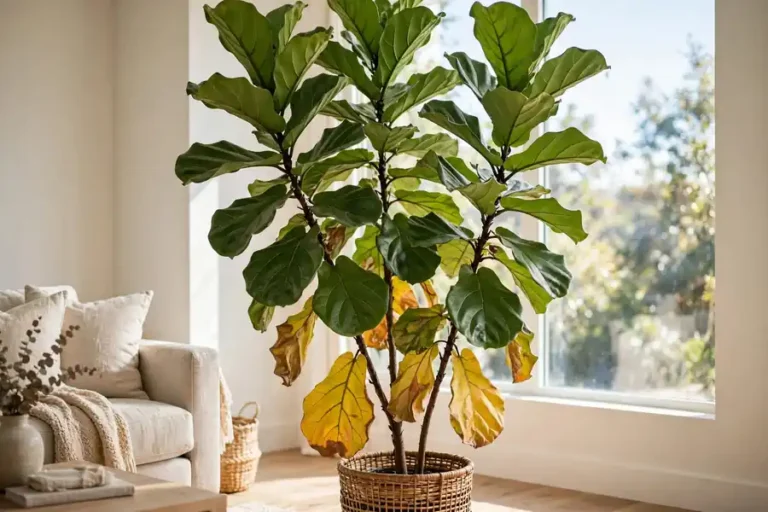
The fiddle leaf fig has a reputation problem, and I’d like to start by retiring it. This plant is not a diva. It doesn’t drop leaves to spite you, and it doesn’t need a humidity shrine, a special food with its name on the bottle, or a support group. What a fiddle leaf fig (Ficus lyrata) actually is, underneath the magazine photos, is a West African canopy tree with exactly one non-negotiable demand: consistency. Give it a bright spot, a steady watering rhythm, and time to settle — and then mostly leave it alone — and it will grow into the most architectural plant in your house. Change its world every few weeks, and it will tell you about it in the only language it has: leaves on the floor.
That’s the whole secret, and everything in this guide hangs off it. The light, the watering, the soil, the pruning — all of it is in service of setting up an environment once and then keeping it steady. Read the quick-start table and you can keep this plant alive. Read the rest and you’ll understand why it’s behaving the way it is, which is the part that actually ends the drama.
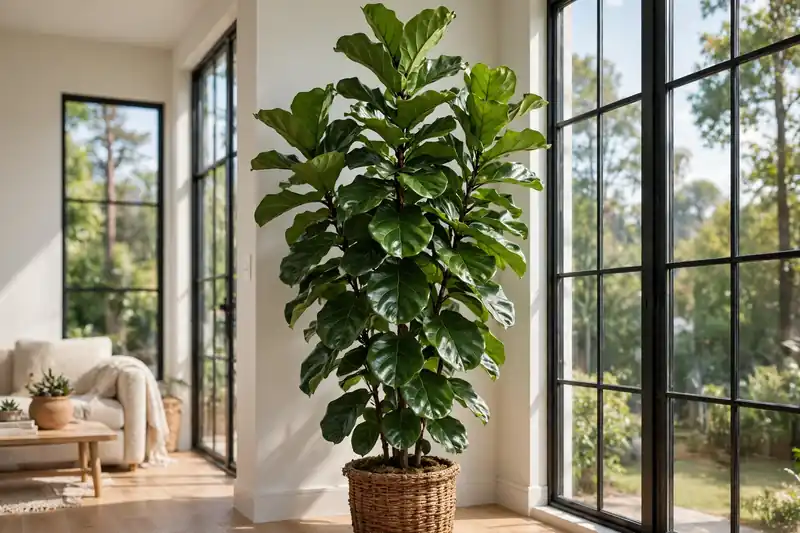
One honest note before we start: a fiddle leaf fig grows. Indoors it becomes a small tree — several feet of one — with leaves the size of dinner plates. That’s the point of the plant, so plan the corner for the tree it’s becoming, not the tabletop plant it arrives as.
Quick-Start Summary: The Essentials at a Glance
| Need | What to do |
|---|---|
| Light | The brightest spot you have: 6+ hours of bright indirect light; gentle morning sun is welcome |
| Water | When the top 2–3 inches of soil are dry — then soak thoroughly and drain fully |
| Soil | Chunky, well-draining mix that still holds a little moisture; pot must have drainage holes |
| Feeding | Half-strength balanced fertilizer, monthly in spring and summer while it’s growing; none in winter |
| Temperature | 65–85°F is home; keep it out of cold drafts, heating vents, and AC blasts |
| Humidity | Ordinary room air is fine — drafts are the enemy, not dry air |
| Support | Stake loosely once it’s tall and top-heavy; prune to branch, not to shrink |
| Pets | Toxic if chewed — place out of nibbling reach; wear gloves when pruning |
Keep that table and you can keep a fiddle leaf fig. The rest of this guide is the why, the how, and the fixes for when it protests anyway.
Light: The Brightest Corner You Own
If this guide could only keep one section, it would be this one. A fiddle leaf fig is the most light-hungry of the common houseplants — a tree that in its native West Africa grows up into the canopy — and nearly every problem people write to me about (small leaves, bare stems, dropping foliage, soggy soil that never dries) starts as a light problem wearing a disguise.
What it actually needs: six or more hours of bright indirect light a day, and more is better. In furniture terms, that’s right up against an east-facing window (the classic best spot — gentle direct morning sun, bright light the rest of the day), a foot or two back from a south-facing window, or a few feet back from a west window where the harshest late-afternoon sun is softened by distance or a sheer curtain. A fiddle leaf can take real direct sun, even hours of it — but only sun it has been acclimated to, which brings up the rule below.
The acclimation rule. A leaf is built for the light it grew in. A plant that spent months in a dim garden-center aisle and gets parked in a blazing south window will scorch — bleached, papery patches on the leaves facing the glass — not because sun is bad for it, but because it was moved too fast. Move any fiddle leaf toward stronger light in steps: a few feet closer to the window every few days over one to two weeks, morning sun before afternoon sun. Do that and the new leaves it builds will be sun leaves, thicker and tougher, and the plant will thank you with the fastest growth it can make.
The signs it’s not getting enough are worth memorizing, because they’re slow and easy to misread as other problems. New leaves coming in smaller than the ones below them. Long stretches of bare stem between leaves, as the plant reaches. A pronounced lean toward the window. And the subtle one: soil that stays wet for a week and a half after watering, because a plant in low light is barely drinking. That wet soil then gets blamed for root rot that started, really, as a light shortage. If your fiddle leaf is more than about six feet from a decent window and there’s no grow light involved, assume light is part of whatever is wrong.
Two habits help more than any product. Rotate the pot a quarter turn every week or so — fiddle leaves grow toward the light, and an unrotated plant becomes a one-sided plant leaning out of its pot. And pick the spot before you bring the plant home if you can, because the second-best light decision is the one you don’t have to move the plant out of later. This plant’s smaller, nimbler cousin in the light-hunger department is the monstera — our monstera deliciosa care guide covers the same “brightest spot wins” logic for a plant that climbs instead of trunks.
Watering: Deep Drinks on an Even Rhythm
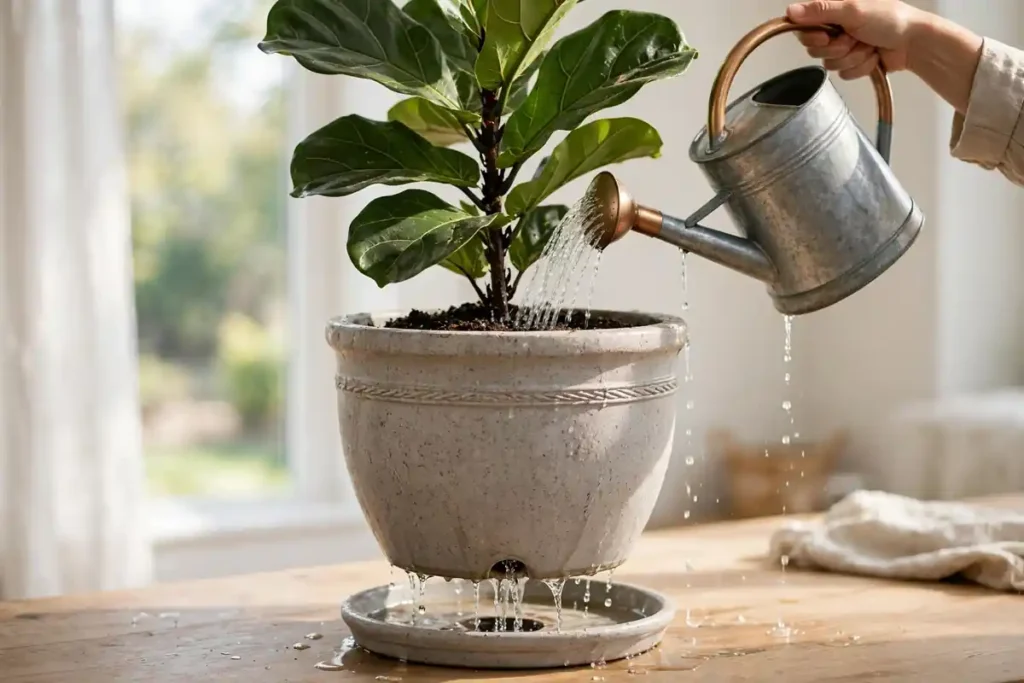
A fiddle leaf fig wants its water the way it wants everything: thoroughly, and then predictably. The working rule is to water when the top two to three inches of soil have dried out, and then to water properly — soak the whole root ball slowly until water runs freely from the drainage holes, let it drain completely, and empty the saucer or cachepot every time. In a bright room in the growing season that usually lands around once a week; in winter, or in a dimmer spot, every two to three weeks is common. The soil decides; the calendar just reminds you to check.
Check properly, because the surface lies on this plant. Three ways, in ascending order of reliability. The finger test: push a finger in two to three inches — dry and crumbly means water, cool and damp means wait. The skewer test: a wooden skewer pushed most of the way down reads the deeper pot; damp mix clings and darkens it. And the pot-weight check, the one experienced growers end up trusting most: lift the pot right after a full watering and memorize the heaviness, then lift it before watering. A thirsty fiddle leaf pot is startlingly lighter, and after a few cycles your arm becomes the best moisture meter you own.
Consistency is the real skill here, and it matters for a specific reason. A fiddle leaf that swings between bone-dry neglect and panic-flooding is the one that develops edema (the red-brown speckles covered in the problems section below — they’re a watering-rhythm symptom, not a disease), crispy leaf edges, and a general air of grievance. Roots that are watered on an even rhythm — dry a few inches down, then a thorough soak, over and over — simply work better than roots on a roller coaster. If you take one sentence from this section, take that one.
The two ways to get it wrong are mirror images. Too often: the pot never dries, roots suffocate in airless wet mix, and the plant answers with dark spots on the lower leaves and then a drop — overwatering is the way most indoor fiddle leaf figs actually die. Too rarely and too hard: the plant wilts, edges crisp, and it sheds leaves it can’t afford to hydrate. Between them sits the rhythm above. And one corollary that saves plants every winter: water use follows growth, and growth follows light — so when the days shorten and the plant slows down, stretch the interval and let the deeper dry-down happen. Winter watering is summer watering with patience added.
A small practical note: water the soil, not the leaves. Wet foliage sitting in still indoor air is an invitation to the bacterial leaf spot described below, and misting does nothing for humidity that lasts longer than a few minutes. The soak-and-drain at the base is the whole job.
Soil & Potting: Drainage With a Little Hold
Fiddle leaf fig roots want two things that sound contradictory and aren’t: water that passes through, and enough moisture held that the plant isn’t thirsty again in two days. Dense, peat-heavy mix straight from a bargain bag fails the first test — it compacts, stays wet for a week, and starves the roots of air. Pure bark fails the second. The recipe I use threads the needle:
- 3 parts good-quality indoor potting mix (the moisture-holding base)
- 1 part pine bark fines or orchid bark (structure and air pockets)
- 1 part perlite or pumice (keeps it from compacting back down)
It should look visibly chunky — like mix with bits in it, not like garden soil. Water should run through in seconds, and the pot should feel noticeably lighter three or four days later. A bagged mix labeled for aroids or “chunky” houseplant blends is a fair shortcut; ordinary mix with a generous handful of perlite stirred through is a decent one.
The pot rules are where fiddle leaf figs are won and lost. Drainage holes: non-negotiable, full stop — keep it in a nursery pot inside the decorative cachepot if you like the look, and lift it out to water or empty the cachepot every time. Size: this is the rule people break with love. A fiddle leaf should go into a pot no more than about two inches wider than its root ball. An oversized pot surrounds a modest root system with a sea of wet mix that no roots are drinking from; that mix sits sour and airless, and the roots at its edge rot quietly while the top of the pot looks fine. “Plenty of room to grow” is how this plant gets root rot in a bright room with an attentive owner. Snug is safe. Terracotta is the forgiving choice for anyone with a generous watering hand — it breathes, dries faster, and its weight helps stabilize a top-heavy tree. Plastic holds moisture longer, which suits drier homes and forgetful waterers.
Repotting is due on evidence, not anniversaries: roots circling the surface or pushing out of the drainage holes, water running straight through a root-packed pot so the plant is thirsty again in days, or growth stalling in good light. For a healthy grower that’s typically every year and a half to two years, in spring. And learn the one-change-at-a-time rule now, because it recurs throughout this guide: don’t repot the plant and move it to a new room and prune it in the same week. Each is a stress it has to adjust to; stacked together they’re the classic recipe for a leaf-drop episode that gets blamed on whichever one happened last. And expect a sulk after any repot — two to four weeks of stillness, sometimes a dropped leaf or two. That’s adjustment, not decline; hold the routine steady and let it pass.
Feeding: Steady, Light, and Only While Growing
A fiddle leaf fig in active growth is building big leaves out of something, so it does want feeding — but on the plant’s terms, not the fertilizer bottle’s marketing schedule. My routine: a balanced liquid houseplant fertilizer (a 3-1-2 ratio is the classic fig recommendation, but any balanced feed works) at half the label strength, once a month in spring and summer, while the plant is visibly pushing new leaves. When growth pauses in fall and winter, stop — a resting plant can’t spend what you give it, and unspent fertilizer doesn’t disappear, it accumulates in the mix as salts.
Those salts are the main feeding risk, and their calling card is specific: brown, crispy edges and tips on otherwise healthy leaves, worst on the oldest foliage. Prevention is cheap — once or twice a year, flush the pot by running plain water through it slowly, several pot-volumes’ worth, draining freely. And two rules that prevent most of the rest: never feed a stressed plant — not a freshly moved one, not a wilting one, not one you suspect has root trouble, because fertilizer on damaged roots is salt on a wound — and never feed your way out of a light problem. A fiddle leaf in a dim corner that isn’t growing isn’t hungry; it’s dark. Feed supports growth the light is already funding. It cannot substitute for the light.
The honest hunger picture, for completeness: new leaves arriving smaller and paler than they should in genuinely bright light, on a plant that hasn’t been fed in a year or more. That’s real, and a monthly half-strength feed through the growing season fixes it. If your plant is pushing big, deep-green leaves on schedule, it is not hungry, whatever the shelf at the garden center suggests.
Humidity & Temperature: Rooms Are Fine — Drafts Are the Enemy
You’ll read that fiddle leaf figs need 50 or 60 percent humidity, a pebble tray, and a humidifier humming beside them. Here is the honest calibration from growing them in ordinary houses: a fiddle leaf fig is perfectly at home in the normal 30–50% humidity of a heated or air-conditioned home, and I have never seen one fail because its owner didn’t buy a humidifier. It comes from humid forests and will grow a touch faster and glossier in moist air — a bright bathroom is a genuinely happy fiddle leaf address — but “appreciates” is not “requires.” Brown edges blamed on dry air are, in real homes, usually fertilizer salts or a watering roller coaster wearing a disguise.
Temperature is the same story with one hard edge. The comfort zone overlaps yours: 65–85°F suits it perfectly. It sulks as you approach 55°F and takes real damage from genuine cold — a plant left against freezing window glass in a hard cold snap comes away with dark, water-soaked patches that die back. Keep it off cold glass in deep winter and it’ll never test you on temperature.
What actually earns this section is the thing almost nobody names: moving air. A fiddle leaf fig beside a frequently opened exterior door, under an air-conditioning vent, or in the blast path of a heating vent lives under a small, repeated weather event — cold or hot blasts, humidity swinging by the hour, conditions changing faster than leaves can adapt to. The recognizable pattern is lower-leaf drop that is worst on the side of the plant facing the door or vent, and worst of all in winter when the door lets in real cold and the heat runs constantly. If your plant is shedding from one side, don’t reach for the fertilizer. Walk the room, find the draft or the vent, and move the plant a few feet. Drafts, not dry air, are the usual explanation — and unlike humidity, this one you can fix for free in five minutes.
Leaf Drop & Relocation Shock: The Plant’s Protest Language
Every fiddle leaf fig owner meets this eventually, usually in the first month: the plant comes home from the shop looking perfect, and within two weeks the floor around it is littered with leaves. It gets called drama. It’s actually information, and once you understand the mechanism it stops being frightening.
Here is what’s happening. A fiddle leaf builds each leaf for the conditions it’s growing in — its thickness, its water plumbing, its light machinery are all calibrated to the light, temperature, and humidity of the weeks when the leaf formed. A hardened leaf cannot rebuild itself. Now move the plant: new room, different light, different air, maybe a repot and a ride in a cold car trunk on the way. Every leaf on the plant is suddenly wrong for its environment, and the roots are still running the old routine. A tree can’t walk back to its old spot, so it does the tree thing: it cuts its losses and sheds the leaves it can’t support, then builds new ones calibrated to the new home. Leaf drop after a move is not the plant dying. It’s the plant renegotiating.
Recovery expectations, with numbers, because that’s what you actually need at 11 p.m. with six leaves on the floor. Losing a handful of leaves — say three to eight, mostly lower and older ones — spread over the first two to three weeks after a move, a repot, or a big light change is the normal adjustment tax for this plant, and it stops on its own. The recovery protocol is boring, which is the point: put it in the brightest steady spot you have, resume the normal watering rhythm, and change nothing else. Do not repot it again “to check the roots,” do not fertilize it “to help,” do not move it to a third room to see if it likes that one better. Every new change restarts the negotiation. Given steadiness, most plants push fresh growth from the top within a month or two, and the new leaves arrive built for your room. A plant that lost some lower leaves and is growing clean new ones at the top is a plant that has settled, even if it looks a little leggy in the middle — the shaping section below deals with that.
When it is NOT relocation shock: leaf drop that starts weeks after any change, or that keeps accelerating past the three-week mark, or that comes with dark mushy spots on the leaves or a sour smell from the soil. That’s not protest; that’s a roots or light problem in progress, and it needs the diagnosis in the problems section, not patience. The distinction matters because the treatments are opposites: shock asks you to do nothing extra, while root trouble asks you to act promptly. The same shedding alarm rings for this plant’s rubbery cousin — our guide to a rubber plant dropping leaves works through the pattern-by-pattern read for that fellow Ficus, and the logic transfers.
Edema vs. Disease: Reading Spots Calmly
More fiddle leaf figs get misdiagnosed at this exact point than anywhere else in their care, so let’s do it slowly. Spots on a fiddle leaf leaf (forgive me) come in three main kinds, they look confusingly alike in a panic, and each one has a different cause and a different response.
Edema — the harmless one, and the most common. Fine red-brown to burgundy speckling, sometimes slightly raised, scattered across the newest leaves — often worst on a leaf that has just unfurled. Edema is a plumbing hiccup: the roots took up water faster than the young leaf’s cells could expand to hold it, a few cell walls burst, and the speckles are the tiny scars. It is strongly associated with inconsistent watering — a long dry spell followed by a drench is the classic trigger. It is not a disease, it is not contagious, and it does not need treatment. The speckled leaf keeps its marks (they fade considerably as the leaf matures and darkens, sometimes to near-invisibility), and the fix is entirely in the watering rhythm: even it out, and the next leaves come in clean. That’s all. Half the “sick” fiddle leaf figs on the internet have edema and a worried owner, in that order.
Root-rot spotting — the one that matters most. Dark brown to black patches that begin at the edges and along the veins of the lower, older leaves, on a plant whose pot stays heavy and wet, often accompanied by leaf drop and a sour smell from the mix. This is the above-ground shadow of roots suffocating and rotting in wet soil. The response is below ground, not on the leaf: check the roots, cut away anything brown and mushy back to firm tissue, repot into fresh chunky mix, and rebuild the watering rhythm. Sprays and leaf treatments do nothing for this one, because the leaf isn’t where the problem lives.
Bacterial leaf spot — the contagious one. Spots that are often angular or water-soaked-looking, frequently ringed with a yellow halo, appearing on leaves of any age and spreading — new spots on previously clean leaves week over week, worst where foliage stays wet. This one is a genuine infection, and the response is sanitation: isolate the plant, remove the worst-affected leaves with clean scissors (and clean the scissors after), stop wetting the foliage entirely, improve the air around the plant, and don’t mist. Leaves already spotted won’t heal; the goal is a clean next set.
The calm summary: speckles only on brand-new leaves, plant otherwise thriving → edema, fix the rhythm and relax. Dark patches low on the plant plus a pot that’s always wet → check the roots today. Spots with yellow halos that keep appearing on new leaves → isolate and sanitize. Learn those three reads and you will never again treat a healthy plant for a disease it doesn’t have — or watch a sick one get worse while you call it edema.
Pruning & Shaping: Making a Tree, Not a Stick
Left entirely alone, a fiddle leaf fig grows the way it arrives: one straight stem, straight up, leaves along it — a green exclamation point. The branched, tree-shaped plant in the photographs is not a different variety; it’s a pruned one. Shaping a fiddle leaf is genuinely satisfying work, but the techniques have very different reliability, and this is the section where I’ll grade them honestly, because the internet grades them all “works great!”
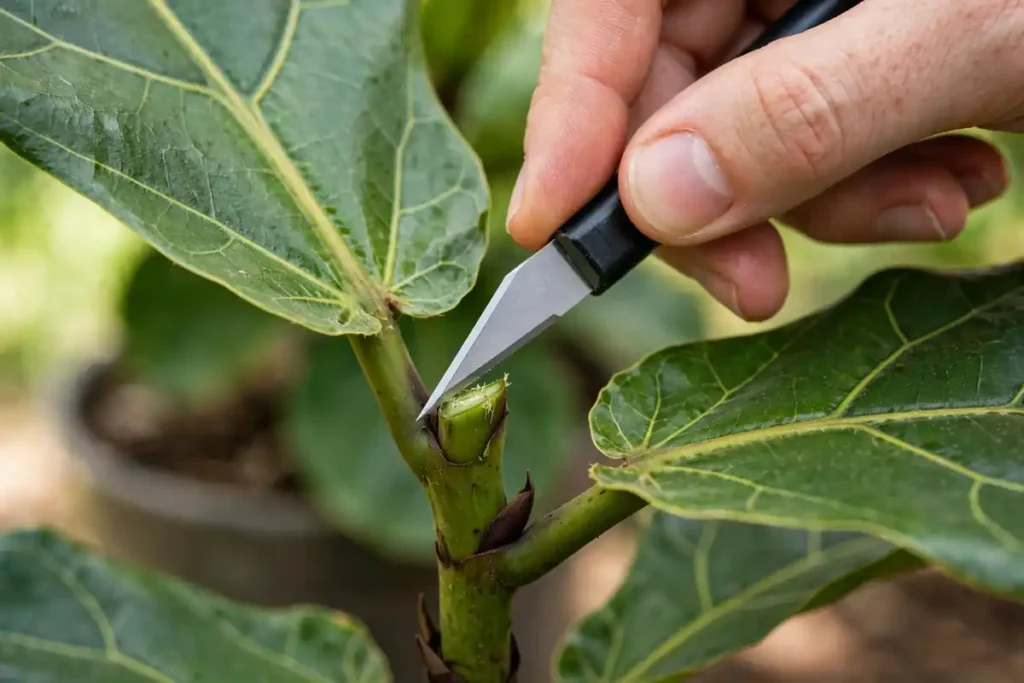
First, the mechanism, in one sentence: the growing tip of a stem suppresses the buds below it (that dominance is why the plant grows up instead of out), so removing or interrupting the tip is what releases those buds — every shaping technique is just a different way of doing that. Wear gloves when you cut: the milky sap that bleeds from every cut is an irritant to skin, and wash it off your hands and tools when you’re done. Do your shaping in spring or early summer, when the plant is growing hard and can fund the response.
Pinching — reliable, gentle, for young plants. On a young, still-green stem, simply pinch or snip out the soft growing tip at the very top. The plant responds by pushing one or two new growing points from the topmost buds. It costs the plant almost nothing, sets no height record back, and done early and repeatedly it’s how you build a bushy young tree instead of a pole. If you do only one shaping technique, learn this one.
The pruning cut — the reliable way to branch a taller plant. Cut the main stem back to the height where you want the branching to begin, making the cut just above a leaf node with clean, sharp pruners. Over the following weeks — expect the first swellings in two to four weeks in good light, and be patient through six — the plant typically pushes one to three new branches from the buds just below the cut. This is the technique that actually built every branched fiddle leaf you’ve admired, and its reliability is exactly why: you’ve completely removed the dominant tip, so the buds below get an unambiguous signal. The severed top is not waste, either — it’s your best propagation material (see below), or it can be rooted and planted back in the same pot for a fuller, multi-stem look.
Notching — occasionally works; a supplement, not a strategy. Notching means cutting a shallow notch into the woody stem just above a sleeping bud, without removing the top, in the hope of waking that one bud. You’ll find it presented online as a reliable trick, sometimes with paste products sold alongside. My honest grade: it works sometimes — a bud that was close to waking anyway may push, and plenty of carefully cut notches do absolutely nothing, because the intact growing tip above is still suppressing the bud you just invited. If you enjoy experimenting, notch a few buds in spring and count any branch that results as a bonus. If you actually want a branch at a specific place, cut the top. That’s the unglamorous truth of it.
Trunk thickening, and the shaking question. A stout trunk comes from the same budget as everything else on this plant: light, time, and growth. Two practical helps: stake a young tree loosely — a trunk tied rigidly to a stick never has to hold itself up and stays thinner for it — and let the plant keep a good head of leaves, since the foliage funds the wood. You’ll also meet the popular advice to shake or wiggle the trunk for a minute a day, mimicking wind (the underlying phenomenon, plants thickening in response to movement, is real — it’s why outdoor trees are sturdier than greenhouse ones). The honest grade: a gentle wiggle is harmless and the logic is plausible, but the evidence that a daily household shake meaningfully thickens an indoor trunk is thin, and vigorous shaking can disturb the root ball of a plant that dislikes disturbance. My ranking of what actually builds trunk: years of good light first, adequate pot size second, loose staking third, gentle movement a distant fourth. Spend your effort in that order.
Height control, plainly: a fiddle leaf fig cannot be kept small by trimming its leaves or pinching forever; a happy one grows up. When it approaches the ceiling, your honest options are the pruning cut (reset it to a lower branching point), air-layering the top off (next section), or giving it a taller room. All three are normal chapters in a long-lived tree’s life, not emergencies.
Tree form or bush form? Nurseries sell both, and the choice is partly yours to remake. Tree form — a single trunk with the canopy on top — is the classic look, but it’s top-heavy: stake young trees before they lean. Bush form — several stems — is fuller and inherently more stable. And you can convert between them: pruning the top of a tree-form plant encourages lower branching toward a bushier shape, while patiently removing the lower leaves of a bush as its main trunk thickens builds a tree. Decide early; both directions are slow.
Cleaning the Leaves: Dust Is a Light Tax
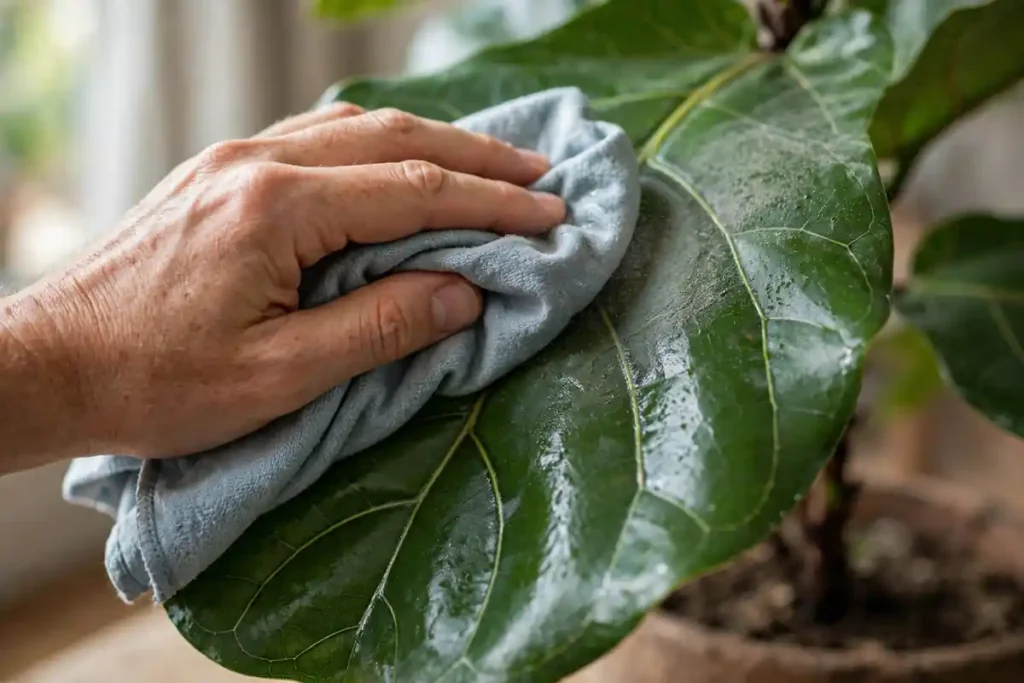
This takes five minutes a month and it is not cosmetic fussiness — on this plant, cleaning is a light intervention. Those big, flat, horizontal leaves are perfectly designed dust shelves, and a dusty leaf is a leaf behind a screen: measurably less of the light you’re working so hard to give it reaches the machinery. On the most light-hungry plant in the house, that tax is worth refusing to pay.
The method matters a little. Use a soft cloth dampened with plain water, support each leaf from underneath with one hand while you wipe with the other — a fiddle leaf’s midrib will crack if you press down on an unsupported leaf, and a cracked leaf is a permanent scar. Wipe both sides; the undersides are where you’ll also find the first signs of the pests in the problems section, which makes cleaning your monthly inspection round as well. Plain water is genuinely enough. Skip the commercial leaf-shine products: they coat the leaf’s pores with oil or silicone to fake a gloss the plant never asked for, and several are actively unhelpful on a plant that breathes through those leaves. If a leaf is truly grimy, a drop of mild soap in the water, wiped off with a clean damp pass afterward, is the whole upgrade. Clean, matte, dust-free leaves are what a healthy fiddle leaf actually looks like.
Growth Expectations: How Big, How Fast, How Top-Heavy
Set your expectations by the tree, not the tag. NC State Extension’s Ficus lyrata profile puts the indoor height at 2 to 10 feet — that ten is not a typo, it’s what a happy, unpruned plant in a bright room does over years, with leaves up to a foot and a half long. (The same tree outdoors in the tropics passes 60 feet, which puts the living-room version in perspective: your pot is the only thing negotiating.) In genuinely good light expect roughly one to two feet of height a year, in bursts through spring and summer; in average apartment light, a few inches and a handful of leaves a year is a normal, healthy pace, and winter stillness is not a problem to solve.
The shape of the growth creates one predictable management job: a fiddle leaf is top-heavy by design. All that leaf area sits at the top of a narrowing trunk, in a pot that didn’t get the memo. Practical answers, in order: a heavy pot (terracotta earns its keep here) or a weighty cachepot; a stake once the tree passes about four feet or starts to lean, tied loosely in two places; and the quarter-turn rotation habit from the light section, which prevents the lean toward the window that makes the top-heaviness one-sided. A plant that leans hard and can’t be straightened by rotation anymore is telling you it wants the pruning cut — which, conveniently, is also how it becomes a branched tree instead of a falling one.
And the long view, because nobody says it at the garden center: this is a decade-plus plant. The decisions that feel small now — the two-inch pot rule, the spot you chose, the first pinch — are the ones that decide whether, in six years, you own a magnificent small tree or a leggy apology touching the ceiling. Fiddle leaf figs reward the long game more than almost any plant I grow.
Propagation: Air-Layer First, Cuttings Second
You will find fiddle leaf propagation described elsewhere as easy. It is not easy; it is doable, with the methods ranked very differently than the cheerful summaries suggest, and with timelines measured in months rather than the days a pothos has spoiled you with. Here is the honest ranking.
Air-layering — the realistic route, and the one I recommend. Air-layering roots a section of stem while it’s still attached to and fed by the mother plant, which removes the entire gamble of a severed cutting trying to root before it starves. Choose the section you want as your new plant — the top of a too-tall tree is the classic candidate. At the point where the new plant’s “roots” should be, wound the stem (a shallow upward cut or a thin ring of bark removed), dust it, wrap that spot in a ball of damp sphagnum moss, and enclose the ball in plastic wrap tied at both ends. Keep the moss damp. Over six to ten weeks, roots grow into the moss; when you can see a healthy root mass through the plastic, cut the stem below the ball and pot up a new plant that never spent a single day unrooted. The success rate is high, the new plant starts at whatever size you layered, and the mother plant responds to losing her top by branching — two improvements from one operation.
Stem cuttings — the slower gamble. The top you pruned off, or a healthy stem section, can root in water or in chunky mix — but go in with real expectations. Take a section with at least two or three leaves and a woody-ish stem (very soft green tips are the most failure-prone; a bare leaf with a bit of petiole and no stem node will sometimes root and will never grow into a plant — a node is non-negotiable). Strip the lowest leaf, expect the cut to bleed milky sap, and set it in clean water on a bright sill (change the water weekly) or in the chunky mix kept evenly moist. Roots, when they come, take four to eight weeks; a cutting that does nothing visible for a month and then roots is behaving normally, and some cuttings simply never take. Spring cuttings root far more willingly than winter ones. This is a perfectly good use of pruning waste — expectations set at “bonus plants,” it never disappoints.
Division, seed, and the rest: not applicable here — a fiddle leaf doesn’t pup, and indoor plants essentially never flower or fruit (extension sources note it rarely does either in a house), so the two routes above are the whole propagation story. Fortunately, air-layering alone covers most of what anyone needs.
Varieties at a Glance
All of these run on exactly the care in this guide. What changes is size, price, and how much light their looks cost them.
Standard lyrata is the benchmark: the big violin leaves, the full tree ambitions, the plant every photograph means. If a care tip in this guide ever conflicts with your standard lyrata’s behavior, believe the plant.
‘Bambino’ (sold alongside similar dwarfs as ‘Compacta’ or Little Fiddle) is the same species selected small: noticeably smaller, more closely spaced leaves on a plant that tops out around two to three feet and grows more slowly and more densely than the standard. It’s the honest answer for small rooms and desks — a real fiddle leaf silhouette that won’t claim the corner. Care is identical in every particular; the only adjustment is expectations, downward, happily.
Variegated fiddle leaf fig — cream-and-white marbled lyrata — exists, and here is the whole honest paragraph it deserves: it is rare, genuinely expensive (priced like a collector plant, because it is one), slow, and the most light-demanding form of an already light-demanding plant, because all that white tissue does no photosynthesis. It is not a beginner’s plant and not a bargain-hunter’s plant; if you buy one, it goes in your single brightest spot and gets the most consistent version of everything in this guide. For everyone else, the deep green of the standard plant is the look that made it famous anyway.
The Year at a Glance: A Seasonal Care Calendar
| Season | Light | Water | Feed | Notes |
|---|---|---|---|---|
| Spring | Bright indirect; acclimate gradually to stronger sun | Resume the normal rhythm as growth starts | Start half-strength monthly | Best time to repot, prune, and shape |
| Summer | Protect from harsh afternoon sun through glass | Most frequent watering; check the soil often | Continue monthly | Growth peak — a foot or more a year is possible in great light |
| Fall | Move closer to windows as days shorten | Reduce as growth slows | Last feed in early fall | Watch for cold drafts from windows |
| Winter | Brightest spot you have; a grow light is a legitimate help | Least frequent — the soil dries slowly | Stop completely | Expect little or no growth; don’t try to “fix” dormancy |
Winter warning: the combination that kills fiddle leaf figs in winter is low light + normal watering + cold drafts. Cut the water, maximize the light, stabilize the temperature — and accept the quiet season as seasonal.
Common Problems Preview: The Short Answers
Start with the symptom — then read the short answer below it:
| Symptom | Likely cause |
|---|---|
| Yellow leaves | Overwatering, low light, or hunger — diagnose by pattern |
| Dropping leaves | Relocation shock, drafts, or a sudden change |
| Brown tips | Underwatering or salt buildup — dry air is a minor player |
| Brown spots with yellow halos | Bacterial spot — a leaf-level infection |
| Dark spots on lower leaves | Root rot until proven otherwise — check the roots |
| No growth | Winter dormancy, too dark, or rootbound |
| Leaning | Reaching for light — rotate regularly |
This guide’s companion problem articles carry the full diagnoses; here are the honest short versions and where each fight is properly fought.
Yellow leaves. One or two oldest leaves yellowing slowly on an otherwise growing plant is retirement. Yellow spreading across the plant — especially with soil that’s staying wet — is overwatering until proven otherwise, and the pattern-by-pattern read (which leaves, in what order, with what edges) is in our guide to fiddle leaf fig yellow leaves. Check the roots’ living conditions before you feed anything.
Drooping leaves. Ask first what changed: a move, a repot, a season change, a new draft — relocation shock is the usual story and the section above covers its timeline. Dropping with no change in circumstances, or accelerating past three weeks, graduates to a roots-or-light investigation.
Brown spots. Run the three-way read from the edema section: speckles on the newest leaves only (edema — rhythm, harmless), dark patches starting at the edges of lower leaves (roots — act now), spots with yellow halos that spread (bacterial — isolate, sanitize, keep foliage dry).
Brown, crispy edges. The far end of the leaf complains about what has been building up in the pot: fertilizer salts and hard-water minerals, concentrated by long dry spells. Flush the pot, review your feeding strength, even out the rhythm. The same salt logic, worked through in depth on a thinner-skinned victim, is in our dracaena brown tips guide.
Pests. The regulars are scale (immobile brown bumps along stems and midribs — scrape off, swab with rubbing alcohol), mealybugs (cottony tufts in the leaf joints — alcohol swab, repeat weekly), and spider mites (fine stippling and webbing in dry, still air — a hard shower first, then treat). Your monthly leaf-cleaning is the inspection that catches all three while they’re still a nuisance instead of an infestation. Quarantine new plants for a few weeks; nearly every indoor infestation arrives as a gift on a new leaf.
Pet Safety: Beautiful, and Not a Snack
Fiddle leaf fig is toxic to cats and dogs if chewed — the leaves and stems carry the ficus family’s milky sap, loaded with irritating compounds and calcium oxalate crystals, and the honest calibration matters because this gets exaggerated in both directions. A pet that bites a fiddle leaf typically gets an immediate mouthful of burning irritation, drooling, and pawing at the face, sometimes vomiting — miserable, but usually self-limiting, and the very unpleasantness of the first bite is why serious cases are rare: the plant defends itself effectively. It is not a plant to panic about owning; it is a plant to place with respect. The sap is also a skin irritant for people, which is why the pruning sections above keep mentioning gloves.
Placement is the whole solution, and this plant’s architecture helps: a fiddle leaf lives as a floor tree or on a sturdy stand, its foliage mostly above casual chewing height, so keeping it out of a determined puppy’s reach is usually a matter of choosing the corner well rather than building barriers. Pick up fallen leaves promptly — a dropped leaf on the floor is at exactly pet height — and keep rooted cuttings and air-layer prunings on a counter, not the floor. If a pet does chew a real quantity and the drooling or vomiting doesn’t settle, call your vet and bring a leaf for identification.
Frequently Asked Questions
How often should I water a fiddle leaf fig? Whenever the top two to three inches of soil have dried out — in a bright room in the growing season, roughly once a week; in winter or a dimmer spot, every two to three weeks. Check with a finger, a skewer, or the pot’s weight, and let the soil decide. The calendar version of this answer, applied blindly, is how fiddle leaf figs get drowned.
Why is my fiddle leaf fig dropping leaves? Ask what changed first. A move, a repot, a shift in light, a new draft — leaf drop is this plant’s protest against sudden change, and a handful of leaves over the first two or three weeks after a change is the normal adjustment tax. Keep the routine steady and it stops. Dropping that starts for no reason, or keeps accelerating, means check the roots and the light instead — that’s a different problem with a different fix.
Does a fiddle leaf fig need direct sunlight? It needs a lot of light — six or more hours of bright indirect light daily — and it can take direct sun, particularly gentle morning sun, once it has been acclimated to it. Move it into stronger light gradually over a week or two and the new leaves will be built for it. The scorch stories come from plants moved overnight from dim conditions into blazing afternoon sun.
What are the red spots on my fiddle leaf fig’s new leaves? Almost certainly edema: fine red-brown speckling on the newest leaves, caused by the roots taking up water faster than the young leaf cells can expand — usually after inconsistent watering, a dry spell followed by a drench. It’s harmless, it’s not a disease, and it fades as the leaf matures. Even out your watering rhythm and the next leaves will come in clean. (Dark spots on the lower leaves or spots ringed with yellow are different stories — see the edema vs. disease section above.)
Can I cut the top off my fiddle leaf fig? Yes — it’s the most reliable way to make it branch. In spring, cut the main stem just above a leaf node at the height where you want branches to start, wearing gloves against the milky sap. The plant will typically push one to three new branches from below the cut over the following weeks, and the top you removed can be rooted or air-layered into a second plant.
Does notching a fiddle leaf fig actually work? Sometimes. A notch cut above a sleeping bud occasionally wakes it, but the intact growing tip above is still suppressing that bud, and many notches do nothing at all. Treat notching as an experiment with bonus potential, not a strategy: if you truly want a branch at a given height, the pruning cut is the dependable route.
How big will my fiddle leaf fig get indoors? Plan on a small tree. Given bright light and years to work with, indoor plants commonly reach six feet and can approach the 2-to-10-foot range extension sources give the species — with dinner-plate leaves to match. In average light it will stay much smaller and slower. ‘Bambino’ and the other dwarf forms are the choice if you want the look in two to three feet instead.
Is a fiddle leaf fig safe around cats and dogs? No — it’s toxic if chewed. The milky sap irritates the mouth and stomach, typically causing drooling, pawing at the face, and sometimes vomiting; it’s rarely serious, because the first bite is so unpleasant that most pets stop there. Place the tree out of chewing reach, pick up fallen leaves, and call your vet if a pet eats a real amount and symptoms don’t settle.
Why are the edges of my fiddle leaf fig’s leaves turning brown? Usually what’s been accumulating in the pot: fertilizer salts and hard-water minerals, concentrated at the leaf tips — the far end of the plant’s plumbing — and made worse by boom-and-bust watering. Flush the soil thoroughly with plain water, feed at half strength or less, and even out the rhythm. Browned tissue never re-greens, so judge success by the new leaves, and trim damaged edges within the brown if you tidy them at all.
Can I put my fiddle leaf fig outside? In summer, yes — bright shade, acclimated gradually over a week or two (a plant moved straight into outdoor sun scorches, same as indoors). Bring it back in before nights drop below about 55°F, and expect the move itself to cost a leaf or two each way; that’s the relocation tax this plant always charges.
Should I mist my fiddle leaf fig? No — misting barely raises humidity for more than a few minutes, and it leaves water sitting on those big leaves, which is an invitation to fungal trouble. If your air is genuinely desert-dry, a humidifier running in the room is the real fix. For most homes, ordinary room air is fine and the spray bottle can retire.
Give a fiddle leaf fig the brightest corner you have, a drink when the top of the soil dries, and an environment you then leave alone, and the famous difficulty of this plant mostly evaporates. What remains is the pleasure of it: a plant that grows in visible chapters, leaf by enormous leaf, into a tree you shaped — one that will outlive the sofa it’s standing next to. Consistency is the whole secret, and now it’s yours.
One Comment