Why Is My Monstera Not Splitting? Causes, Fixes & an Honest Timeline
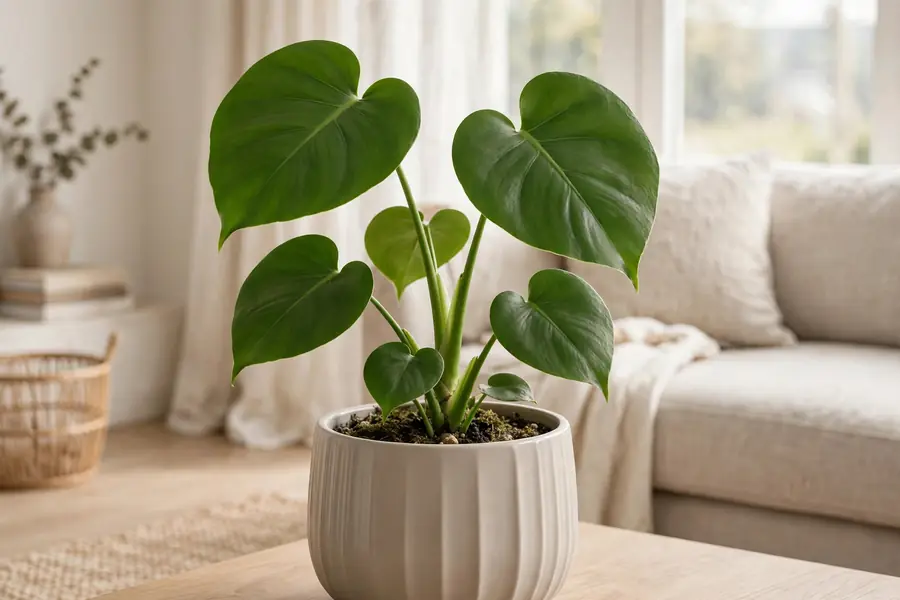
You bought the plant in every apartment photo on the internet — the one with the big, dramatic, split-and-holey leaves — and what you actually have is a pot of plain green hearts. The plant looks healthy enough. It grows. It just refuses to do the one thing you bought it for, and every month of solid leaves makes you a little more sure you’re doing something wrong.
Here’s the fast answer, and it will sort most readers in about ten seconds. Monstera splits (fenestrations) appear only on new leaves, and only once a plant is mature enough, well enough lit, and ideally climbing. A leaf that has already opened up solid will stay solid for its entire life — nothing you do to it now will change it. So “why is my monstera not splitting?” is really two questions: is your plant the kind that splits at all, and if it is, has it reached the stage and the conditions where new leaves come out fenestrated? This guide walks those questions in the order you should actually check them, because fixing the wrong one first is how people end up fertilizing a plant that simply needed to be two years older.
One reassurance before we start: an unsplit monstera is almost never a sick monstera. Solid leaves are the plant’s natural juvenile form, not a symptom. Splitting is a look, tied to maturity — health is a separate question, and we’ll flag the few places where the two genuinely overlap.
First, Run the Checks in This Order
Don’t change anything yet. Work through these five checks top to bottom; the first one that fits is very likely your answer, and the order matters because the early checks make the later fixes pointless if they’re the real story.
Check 1 — Is it actually a Monstera deliciosa? Look at the plant tag if you kept it, and at the leaves themselves. Several plants are sold as “monstera” that will never produce the classic big split-and-holed leaf: Monstera standleyana, Monstera karstenianum (sold as ‘Monstera peru’), the “mini monstera” (which isn’t a monstera at all), and the split-leaf philodendron, whose leaves are deeply lobed but never grow the inner holes. Cause 1 below helps you tell them apart. If this is your plant, you can stop troubleshooting today — nothing is wrong.
Check 2 — How old, and how big, is it really? Count the leaves on your biggest stem and measure the newest one. A monstera that is under about two years old, with a stem still thinner than your little finger and leaves under 8 inches across, is a juvenile, and juveniles don’t split — full stop. Most store plants are well under that age, and most store pots hold several young plants together, each on its own clock. Cause 2 covers the benchmarks.
Check 3 — Do the light audit honestly. Where does the plant actually sit, and what reaches it? Long, stretched-out spaces between leaves, new leaves coming in smaller than the ones before, and a plant leaning hard toward the window are the classic signatures of a plant that is growing in dimmer light than it wants. Light is the most common fixable cause, and Cause 3 gives you a way to judge your spot without buying a meter or believing the internet’s wildly conflicting numbers.
Check 4 — Is it climbing, or sprawling? In the wild this plant climbs trees, and its leaves get bigger and more fenestrated as it goes up. A monstera trailing sideways off a shelf or flopping around a bare stake is still living the ground-dwelling juvenile lifestyle. Cause 4 explains what a moss pole actually does — and what it doesn’t.
Check 5 — Is the plant actually growing? A plant that hasn’t pushed a new leaf in months can’t produce mature leaves, because it isn’t producing leaves at all. If growth has stalled — or leaves are yellowing, or the soil stays wet for weeks — the problem is below the rim of the pot: roots, water, or the pot itself. That’s Cause 5. (And if the plant was recently cut back or propagated, skip to Cause 6 — that’s a reset, not a failure.)
A Quick Word on How Splits Actually Happen
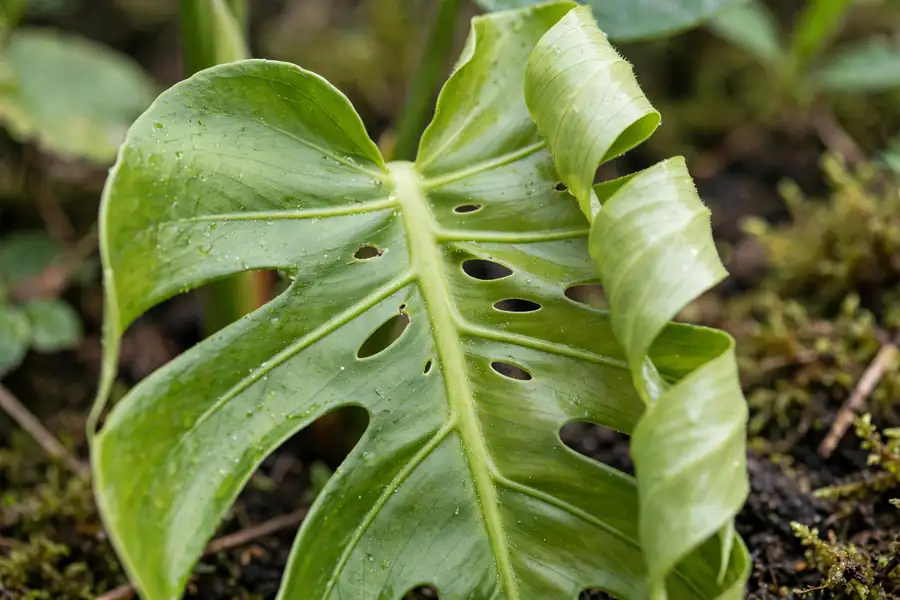
Understanding one bit of biology will save you money and months of false hope, so here it is in plain English. A monstera leaf’s pattern is decided while the leaf is still forming, rolled up inside its sheath, long before you ever see it. The holes are made by a process botanists call programmed cell death — small patches of tissue deliberately die off as the leaf develops, leaving the windows behind. The New York Botanical Garden’s plant information service describes the same process when readers ask about exactly this problem.
Two consequences follow, and they govern every timeline in this article:
- An open leaf is finished. If it unfurled solid, it is solid forever. There is no spray, feed, or ritual that adds splits to an existing leaf, and anyone selling one is selling you a story.
- Your only lever is the next leaf. Every fix below works by changing the conditions the next leaf forms under. Judge a fix by the new growth that follows it — usually over the next two to four leaves — never by the leaves that were already open when you made the change.
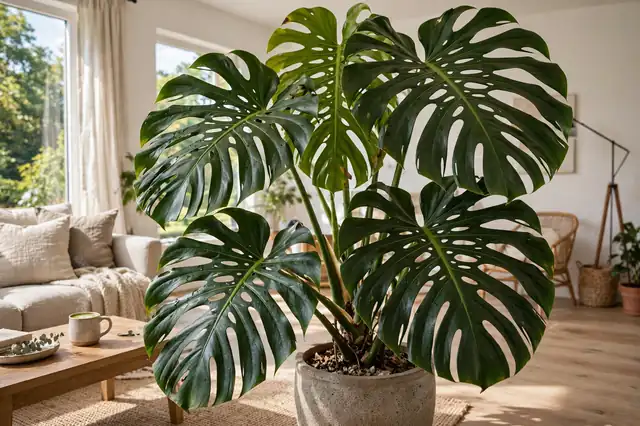
There’s a second piece of biology worth knowing: a monstera’s life has two acts. Young plants hug the ground with small, solid, heart-shaped leaves. As the plant finds support and climbs toward brighter light, each new leaf comes in larger, and fenestrations start — first a few shallow splits at the edges, then deeper splits, then, on big leaves of mature plants, the inner holes as well. Indoors, our job is to convince the plant it has reached act two.
Cause 1: It Might Not Be a Monstera Deliciosa at All
This is the cause nobody wants and everybody should check first, because no amount of light or patience fixes a label. Nurseries and big-box stores are loose with the word “monstera,” and a few of the plants sold under it will never give you the look you’re waiting for.
How to tell them apart:
- Monstera standleyana — sold as a monstera, and it is one, but its leaves stay narrow, lance-shaped and solid for life, sometimes with cream or yellow variegation. No splits, ever, no matter how well you grow it.
- Monstera karstenianum (‘Monstera peru’) — thick, quilted, puckered leaves with a texture like seersucker fabric. A beautiful plant that essentially never fenestrates indoors.
- Monstera adansonii — the other “Swiss cheese plant.” This one does fenestrate, but in its own way: smaller leaves (usually under a foot) with enclosed oval holes scattered across the blade, rather than deep splits from the edges. If your plant has holes but no splits, it may be an adansonii doing exactly what it should.
- “Mini monstera” — actually Rhaphidophora tetrasperma — not a monstera at all, despite the label it is almost always sold under. Its leaves stay small (rarely over 6–8 inches), and when it matures on a support it produces deep, feathery splits quite young — pretty, but never the big deliciosa look.
- Split-leaf philodendron (Thaumatophyllum bipinnatifidum) — the classic mix-up. It doesn’t climb; it grows into a self-supporting shrub, and its big leaves are deeply lobed, like fingers, with no enclosed holes. Garden centers still sell it as “split-leaf monstera” or “split-leaf philodendron” interchangeably.
- The fast-growing form of deliciosa, often sold as ‘Borsigiana’ — this one is a deliciosa and will split, but it grows faster, with thinner stems, longer spaces between leaves and somewhat smaller leaves than the large form, and its fenestration tends to arrive later and less dramatically. If your plant races upward with modest leaves, this may be why your timeline feels slow.
The fix: There isn’t one, and that’s genuinely good news if your plant is on this list — you’ve been troubleshooting a healthy plant. Grow the plant you actually own (a peru and a standleyana are lovely things), and if the classic split-leaf look is what your heart is set on, buy a Monstera deliciosa that already has at least one fenestrated leaf on it. A plant showing a split has proven it’s a deliciosa of splitting age; a pot of solid hearts is a promise, not a proof.
Realistic expectation: Immediate clarity, which is worth more than it sounds. If your plant IS a deliciosa, move on to Check 2.
Cause 2: The Plant Is Simply Too Young
This is the single most common answer, and the least satisfying: most monsteras that aren’t splitting are just not old enough yet. A deliciosa grown from seed typically starts fenestrating at around two to three years old, and the first splits are usually modest — a notch or two on one side of a leaf — building up over the following leaves. Cuttings taken from a mature plant get there faster, because the tissue is already mature, but a rooted cutting still spends its first several leaves re-establishing and often opens them solid or nearly so.
How to tell it’s just youth:
- The plant came from a store within the last year or two, in a 4-, 6- or 8-inch pot.
- Stems are thin and flexible, and the leaves are small hearts — most under 8 inches.
- The pot holds several stems — nurseries routinely pot three to five seedlings together so the pot looks full on the shelf. Each stem is an individual plant maturing on its own schedule, which is why “the plant” can look bushy and vigorous while not one stem on it is old enough to split.
- Growth is steady and the new leaves are the same size as, or a little bigger than, the last. Nothing is declining; it’s just young.
The fix: There is no shortcut, but there is a fast lane and a slow lane, and they’re the subjects of the next two causes: bright light and something to climb genuinely do speed up how quickly a young plant reaches mature leaf form, because maturity in this plant is partly about size and vigor, not just birthdays. Feed lightly in the growing season (a balanced houseplant fertilizer at half strength, monthly, in spring and summer), water consistently, and let it grow. Also, set the pot somewhere it can stay for a while — a plant that keeps being moved to dimmer corners keeps having its progress interrupted.
A rough ruler for where your plant stands:
| Leaf size | Approximate stage | Splits? |
|---|---|---|
| Under 4 inches | Seedling or recent cutting | No — normal |
| 4–10 inches | Juvenile, approaching maturity | First small notches may appear |
| 10 inches and up | Maturing | Splits deepen; interior holes begin |
| 14 inches and up, on a thick stem | Mature | Full fenestration |
Realistic expectation: Judge by leaf size, not by the calendar. When new leaves start passing roughly 8–10 inches across on a thickening stem in good light, the first splits are usually not far behind — often within the next handful of leaves. If your plant is a year old, think in terms of next year, and let this year’s job be growing it big and healthy.
Cause 3: Not Enough Light — the Big One for Grown Plants
If your plant is old enough and still not splitting, light is the cause to suspect first, and it isn’t close. A monstera decides whether its next leaf fenestrates based heavily on how much light it’s getting: in dim conditions it keeps producing the small, solid, shade-form leaves of its juvenile stage, because that is the sensible leaf for a dark forest floor. Give it real light and the same plant starts building the big split leaves it uses up in the canopy.
How to tell it’s light:
- The newest leaves are smaller than the older ones, or the same modest size month after month.
- There are long, bare stretches of stem between leaves — the plant is reaching, not building.
- A plant that used to split has started opening solid leaves again. This “reversion” is the clearest tell of all: the plant was getting enough light before and isn’t now (a move, a new apartment, a tree outside leafing out, or simply winter).
- The plant lives more than a few feet from a window, or in a room whose only window faces north, or behind a heavy curtain that never opens.
Judging your light without a meter: You will find numbers online for how much light a monstera “needs,” and they contradict each other wildly — I’ve seen minimums quoted that differ by a factor of ten, sometimes measured in different units on the same page. Ignore the spreadsheet war and use the plant-based tests. At midday, hold your hand a foot above the leaves: a sharp, well-defined hand shadow means bright light; a fuzzy shadow means medium; barely any shadow means your plant is in the dark, whatever the room feels like to you. Human eyes are terrible light meters — a room that reads “bright” to us is a cave to a plant, because we adjust and it can’t. As a rule of thumb, most monsteras fenestrate happily within a couple of feet of an east window, or a few feet back from a south or west window with the harshest midday sun softened by a sheer curtain. A little gentle direct sun in the morning is fine and often helps; harsh afternoon sun straight through glass can scorch leaves, so pull the plant back rather than pressing it to the pane.
The fix, in order:
- Move the plant to the brightest spot it can take without scorching — near an east window is the easiest win in most US homes. If it has been in deep shade for months, walk it brighter over a week or two so the existing leaves can adjust.
- If no window qualifies, add a grow light. A decent full-spectrum LED run 12–14 hours a day, kept a foot or two above the plant, substitutes perfectly well. This is also the honest answer for north-facing apartments.
- Clean the leaves. A season of household dust on big leaves is a real light tax. Wipe them with a damp cloth every month or so.
- Rotate the pot a quarter turn every week or two so the plant grows evenly instead of leaning its whole budget toward the glass.
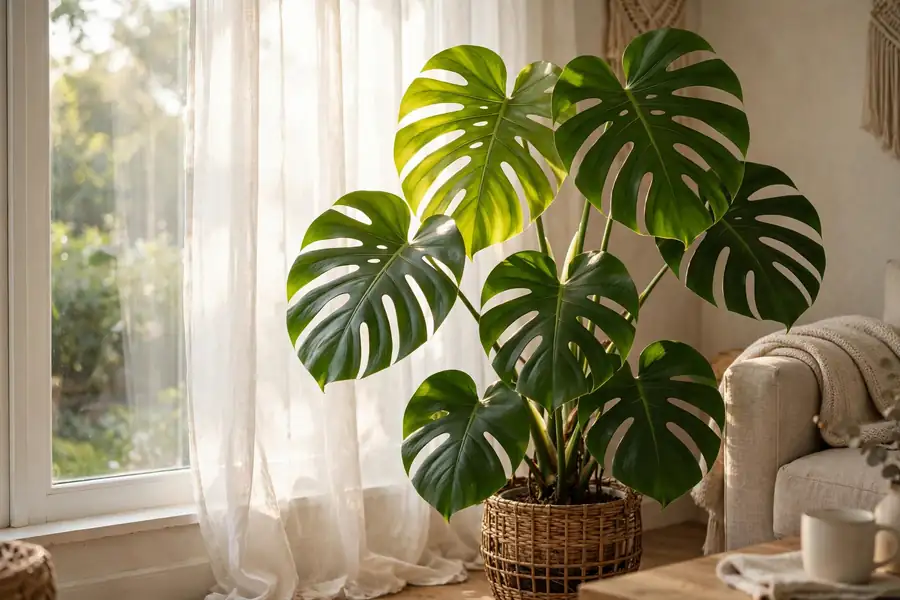
Realistic expectation: In the growing season, a mature-enough plant moved into genuinely bright light typically shows its first splits within the next two to four new leaves — for a healthy plant putting out a leaf every four to eight weeks, that’s one to three months. The change is gradual: first a shallow notch, then deeper splits. If four new leaves in good light are all still solid, light probably wasn’t the whole story — check the plant’s age and the species question again.
Cause 4: Nothing to Climb
Left to itself on the forest floor, a monstera stays in its juvenile form — that’s the form built for creeping around in the shade looking for a tree. The mature, fenestrated form is the climbing form. Indoors, a monstera with nothing to climb often keeps making tidy, solid, medium leaves for years: not unhealthy, just unconvinced that it has anywhere to go.
How to tell it’s support:
- The plant sprawls — stems flop sideways, drape over the pot edge, or lean on the wall and furniture.
- Leaves have stayed the same size for a long time even in decent light; there’s no leaf-over-leaf increase.
- Aerial roots (the thick brown roots that emerge from the stem at each leaf joint) are wandering into the air or across the soil instead of gripping anything.
The fix:
- Give it a real support: a sphagnum moss pole is the gold standard, because aerial roots will actually grow into damp moss and anchor the plant; a coir pole, cedar plank, or sturdy trellis also works for tying up, though roots grip them less eagerly.
- Tie the stems, not the leaf stalks. Use soft plant ties or Velcro tape to attach the main stem to the pole at each node. The long leaf stalks (petioles) need to move freely to angle the leaves toward light — never tie those.
- Keep a moss pole slightly damp. A bone-dry pole is just a stick; roots ignore it. Mist or water the pole when you water the plant so the aerial roots get the message.
- Guide new growth upward as it comes, tying in each new section of stem while it’s still flexible.
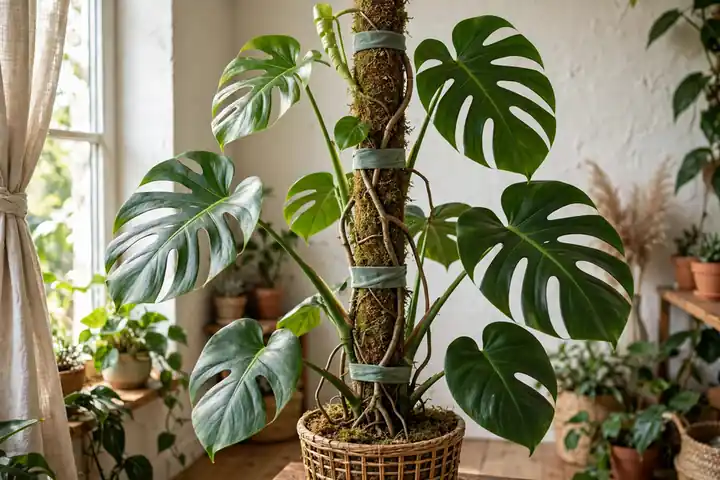
Realistic expectation — and a necessary honesty check: A pole is not a magic wand, and it does not override age or darkness. What it does, combined with good light, is let each new leaf come in bigger than the last — and bigger, climbing leaves are the ones that fenestrate. Expect the effect to build over several leaves across a growing season, not on the first leaf after you install the pole. If you do only one thing from this whole article, do light; if you do two, do light and a pole.
Cause 5: Growth Has Stalled — Roots, Water and the Pot
Fenestration is something a plant does with surplus energy while it’s growing well. A monstera whose growth has quietly stalled — no new leaf in months during spring and summer, or growth that crawls — will not produce mature leaves, because it is not producing much of anything. The stall almost always traces back below the soil line.
How to tell it’s a stall, and which kind:
- Rootbound: Roots are circling out of the drainage holes, poking above the soil surface, or the pot dries out again a day or two after watering because there is more root than soil. Slide the plant out of its pot (easiest when the soil is on the dry side): a solid mat of roots in the pot’s shape, with barely any soil visible, settles the question.
- Too wet, too big a pot: The soil stays soggy for weeks, because an oversized pot holds far more water than a small root system can drink. Soggy soil suffocates roots slowly, and the plant stalls. Fellow travelers give it away: white mold growing on the soil surface or fungus gnats drifting up when you tap the pot both mean soil that never really dries.
- Too dry for too long: A plant left bone-dry for months at a time survives — monsteras are tougher than their reputation — but it rations, and rationing means small, slow, solid leaves.
The fix:
- Repot if rootbound — in spring if you can choose — going just one size up (about 2 inches wider), into a chunky, free-draining mix: a good potting soil with extra perlite and some orchid bark folded through is the classic monstera recipe. Tease the circling roots apart gently first.
- If the pot is oversized, go back down to a size that fits the roots with an inch or two to spare. This feels like a demotion; it’s a treatment.
- Reset the watering rhythm: water thoroughly until it drains, then don’t water again until the top two inches of soil are dry. Empty the saucer every time — roots standing in a puddle inside a decorative pot are the most common sequel to “I barely water it and it’s still wet.”
Realistic expectation: Once the roots have room and a sane watering rhythm, a stalled plant usually pushes a new leaf within a few weeks in the growing season, and leaf size starts climbing again over the following two or three leaves. Only then does the splitting question become relevant again — fix the stall first, and judge fenestration a season later.
Cause 6: It Was Recently Cut Back or Propagated
This one blindsides people, because it follows a success. You take a top cutting from a beautifully fenestrated mother plant, root it, pot it up… and it starts making small, solid, heart-shaped leaves, as if it forgot everything it knew. The mother plant, meanwhile, pushes new growth from a lower node that also comes in plain. Nobody broke anything. Growth that restarts from a cutting or a cut-back stem rebuilds before it resumes — the plant spends its first several new leaves re-establishing size and root support, and those leaves frequently open solid or with only token splits, even though the tissue is genetically mature.
How to tell it’s a reset: The timing gives it away — the solid leaves started right after a chop, a move to a new pot as a rooted cutting, or a hard prune. Before that, the same stem was producing fenestrated leaves.
The fix: Nothing new — give the restarted plant the best version of the basics (bright light, a pole from day one so the new stem climbs immediately, steady watering) and don’t judge it by cutting-day standards. Keeping the cutting on a pole from the start is the one genuine shortcut here, because a climbing cutting rebuilds leaf size faster than a sprawling one.
One deliberate exception to just waiting: the leggy reset. If a plant has gone leggy — long, bare stems carrying small, plain leaves — and the stem itself is thick, mature tissue, deliberately cutting back to a healthy node on that thick stem can genuinely speed things up: regrowth from mature tissue usually fenestrates sooner than growth from a young plant. Be clear about what this is, though: it is cutting the stem back to a node, which redirects the plant’s growth. It is a completely different thing from cutting notches into leaves, which just wounds them (see the myths section below).
Realistic expectation: A rooted top cutting in bright light commonly works back up to fenestrated leaves within roughly three to six new leaves — a growing season, give or take. Growth from lower nodes on a chopped mother plant can take longer. This is also worth knowing before you buy: a fresh, unrooted-or-just-rooted cutting sold with a photo of the mother’s split leaves is a picture of its future, not its present.
Cause 7: It’s Winter (or the Season Changed)
Monsteras in most US homes grow in a strong seasonal rhythm: fast, big leaves from spring through early fall, then a marked slowdown as the days shorten. The winter slowdown has a leaf-quality side effect that worries people every year: new leaves produced in low winter light are often smaller and solid, even on a plant that fenestrated beautifully in July. The plant isn’t broken and it hasn’t forgotten how; it’s making shade leaves for a dim season, the same trade it would make on a dark forest floor.
How to tell it’s the season: The solid leaves coincide with the short days (roughly November through February in most of the US), growth has slowed across the plant, and nothing else has changed. Cold makes it worse — a plant parked against a frosty window or in the path of a heating vent is dealing with chilly roots and dry blasts on top of the dark.
The fix: If you want mature leaves year-round, the only real answer is more light in winter — move the plant to your brightest window for the season (winter sun is weak enough that a south window, too strong in July, is often perfect in January), or put it under a grow light for 12–14 hours. Keep it out of cold drafts and away from heating vents, and ease off the fertilizer until spring; feeding a resting plant mostly just loads the soil with salts.
Realistic expectation: Plenty of healthy monsteras simply don’t fenestrate new leaves in winter, and they resume in spring as if nothing happened. Judge your plant on its spring-to-fall growth. A solid leaf or two in January is weather, not a verdict.
The Honest Timeline: When Will My Monstera Split?
Collecting the threads, here is what realistic actually looks like — offered as ranges tied to growth, because anyone who gives you an exact date is guessing at your house, your windows and your plant.
- From seed or a small store plant: first splits most often appear around age two to three, once the plant is climbing in good light and new leaves are reaching roughly 8–10 inches. The first fenestrated leaf is usually shy — a split or two on one side. Deeper splits, and then the inner holes, build over the leaves that follow.
- After a light fix on a mature plant: watch the next two to four new leaves. In the growing season that’s usually one to three months.
- After adding a pole: leaf size should start increasing leaf over leaf within a season; fenestration follows size.
- After a cutting or chop: three to six new leaves to get back to split form, in good conditions.
- In winter: all clocks slow down. Count leaves, not weeks.
And the two hard truths, one more time, because everything else is commentary. Existing leaves never split after they open. And no product — no spray, tonic, or special fertilizer — triggers fenestration. Light, maturity, support and steady growth are the whole recipe; the rest is packaging.
Myths That Waste Money
- “Cut notches in the leaves to encourage/train them.” Cutting a leaf makes a cut leaf. The plant cannot learn from it, the next leaf forms from the same genetic program regardless, and open cuts are an invitation to infection. Please don’t scissor your monstera.
- “Fenestration booster” sprays and special fertilizers. Fenestration isn’t a nutrient deficiency. A balanced fertilizer in the growing season supports healthy growth, full stop; no formula contains “split.” Beware especially of feeding harder and harder — excess fertilizer salts the soil and can burn roots, which stalls the very growth you’re trying to encourage.
- “Misting raises humidity, and humidity makes leaves split.” Misting wets leaves for a few minutes and raises room humidity for barely longer. Humidity in general plays a supporting role — monsteras grow faster and unfurl more cleanly in reasonably humid air than in bone-dry air — but it is not the trigger. Plants split in ordinary 40–50% household humidity when light and maturity are right, and refuse in steamy bathrooms that are too dark. Fix light first.
- “Strip off the small solid leaves to force big ones.” Advice you’ll occasionally hear, even from experts in magazines. Leaves are the plant’s solar panels and pantry; removing healthy ones removes the energy that builds the next, bigger leaf. Remove leaves that are dead or mostly yellow — otherwise, leave the plant its paycheck.
- “A bigger pot will make it mature faster.” An oversized pot mostly makes wet soil (see Cause 5). Maturity comes from leaves and climbing, not from real estate.
When It’s Normal vs. When It’s Worth Acting
Probably normal — no intervention needed:
- A plant under two years old making solid leaves while growing steadily.
- One or two solid leaves in the middle of winter on a plant that split in summer.
- The first several leaves after a cutting, a chop, or a repot.
- A recently bought plant of a non-splitting species (Cause 1) that is otherwise thriving — nothing to fix at all.
Worth acting on this month:
- A mature plant (2+ years, good size) that has never split and lives more than a few feet from a real window: that’s light — Cause 3.
- A sprawling older plant in decent light whose leaves stopped getting bigger: that’s support — Cause 4.
- No new leaf at all through the growing season: that’s a stall — unpot and look (Cause 5).
Act promptly — these are health problems, not splitting problems:
- Stems turning mushy or black at the base, a sour smell from the soil, or leaves yellowing and collapsing: root rot. Unpot the same week, cut away everything soft and brown, repot into fresh mix.
- Webbing, stippled leaves, or cottony clusters: pests. Splits are never an emergency — but a plant losing leaves to rot or pests won’t be producing mature ones either, so health always outranks looks.
Prevention: Habits That Keep Split Leaves Coming
Once your plant starts fenestrating, keeping them coming is mostly about not interrupting the conditions that started it:
- Hold the light steady. The most common way mature plants revert is a well-meant rearrangement into a dimmer spot. If you must move the plant, trade up in light, not down.
- Keep it climbing. Tie in new stem growth as it appears, extend the pole before the plant outgrows it, and keep a moss pole lightly moist so aerial roots stay attached.
- Water on the plant’s schedule, thoroughly when the top two inches are dry, and always let the pot drain fully.
- Feed modestly in spring and summer — balanced fertilizer at half strength about monthly — and stop in fall and winter.
- Repot one size up when roots circle, into a chunky, airy mix, rather than letting the plant stall in a root mat.
- Follow the full routine in our Monstera Deliciosa Care Guide — light levels, watering, feeding, repotting and propagation in one place — and this diagnosis article becomes the page you hopefully won’t need again.
Frequently Asked Questions
Will the leaves my monstera already has split later? No — and this is the answer that saves the most heartache. A leaf’s splits and holes are formed while the leaf is still developing, rolled inside its sheath. Once a leaf has unfurled solid, it will stay solid for the rest of its life. Everything you do — more light, a moss pole, better watering — is aimed at the leaves the plant hasn’t made yet.
How long does it take for a monstera to start splitting? Grown from seed, most Monstera deliciosa plants start producing their first lightly split leaves at around two to three years old, once they’re climbing in bright light and new leaves are reaching 8–10 inches across. Cuttings from a mature plant usually get there faster, but still open their first few leaves solid while they re-establish. Store-bought plants are usually much younger than they look, which is why “I’ve had it a year and nothing” is so common — and so normal.
Does a moss pole really make a monstera split? It helps, but it isn’t the trigger. Climbing is how this plant matures in the wild, and a plant whose aerial roots have gripped a damp moss pole produces bigger leaves, faster — and big climbing leaves are the ones that fenestrate. But a pole in a dark corner does nothing. Light first, pole second; together they work noticeably better than either alone.
My monstera used to split, and now the new leaves are solid. What happened? The plant is telling you conditions got worse, most often light: a move to a dimmer spot, a new home, a growing tree outside the window, or simply winter arriving. Growth stalls and repotting shock can cause a temporary step back too. Restore the brightest light you can, check that growth is actually moving, and the split leaves normally resume within a few new leaves once the growing season is underway.
Can I cut or notch the leaves myself to help them split? Please don’t. A cut leaf is just an injured leaf — the plant doesn’t take the hint, the next leaf’s pattern is set by maturity and light, and open wounds invite infection. Fenestration can’t be faked or trained in; it can only be grown into.
Do all monstera species split? No. Monstera deliciosa is the classic split-and-holes species. Monstera adansonii develops enclosed holes rather than edge splits. Monstera standleyana and Monstera karstenianum (‘peru’) essentially never fenestrate at all — and the popular “mini monstera” is actually Rhaphidophora tetrasperma, a different genus that splits in its own smaller, feathery way. If your plant is one of the non-splitters, solid leaves are its finished form, not a problem.
Will more fertilizer or higher humidity make my monstera split? Neither one triggers splits. Fertilizer supports growth in spring and summer, but fenestration is not a deficiency symptom, and overfeeding can salt the soil and burn roots — the opposite of what you want. Humidity helps leaves unfurl cleanly and supports steady growth, but monsteras fenestrate in ordinary living-room humidity when they’re mature and well lit, and refuse in humid rooms that are too dark. Spend the effort on light and a pole first.
A monstera that isn’t splitting is rarely a plant in trouble — it’s a plant being honest about its age, its label, or its light. Run the checks in order, fix the first one that fits, and then do the hardest part of monstera care, which is waiting while you watch the new leaves instead of the old ones. When that first split finally unfurls, you’ll know exactly which change earned it.
One Comment