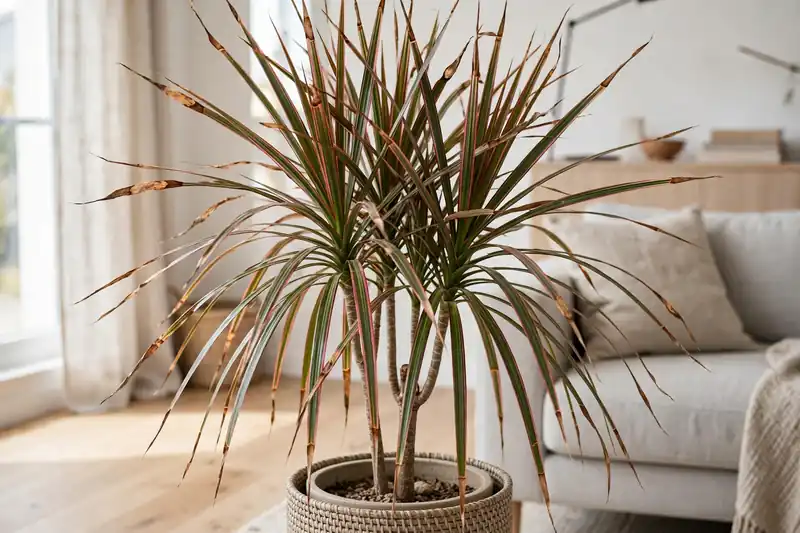
Dracaena Brown Tips: What Your Water Is Doing — and How to Fix It
If your dracaena’s leaves are crisping at the ends, take the first bit of good news before anything else: brown tips almost never mean a dying dracaena. They are the single most common complaint this plant makes, and dracaenas go on making it — while growing perfectly well — for years. A tipped leaf is not an emergency. It’s a message.
Here’s the fast answer. A dracaena’s leaf tips are where its water supply ends. Everything the roots drink travels the full length of the leaf and gets dropped off, so to speak, at the tip — which means anything dissolved in that water (fluoride, salts) piles up exactly there, and any shortfall in supply (erratic watering) shows up there first too. So brown tips are really two families of complaint: what’s in the water and the watering rhythm itself. The rest of the leaf — its color, its firmness, which leaves are affected and which aren’t — tells you which family you’re dealing with. This guide teaches you to read that pattern, walks the causes in the order they actually occur, and covers the trimming technique that tidies the plant up without restarting the browning.
One more reassurance, because most people who land here are quietly convinced they’ve killed a “beginner-proof” plant: you haven’t. I’ve kept dracaenas in apartments with fluoridated city water, radiators, and a keeper who forgot them for a month at a time. They complained at the tips and carried on. Yours will too, once you know what it’s complaining about.
First, Read the Pattern: The Rest of the Leaf Is the Witness
Before you change anything — water, light, scissors — spend two minutes just looking. Four things to read:
Where is the brown? Just the last quarter-inch of the tip is the mildest message. Brown that wraps a tip and creeps down both edges is a complaint with more history behind it. Brown patches in the middle of a leaf are a different story altogether (more often a scorch or a spot, not classic tip burn).
Is there a yellow band? Look closely at the border between brown and green. A thin yellow or pale straw-colored halo sitting between the dead tip and the healthy leaf is the classic signature of dissolved minerals — fluoride and salts — accumulating in the tissue. Clean brown that stops sharply at green, with no halo, leans more toward plain thirst or dry air.
Which leaves are doing it? This is the most underused clue in the whole diagnosis. If only the oldest, lowest leaves have brown tips while the newest leaves up top are coming in clean and green, the cause is probably already behind you — old leaves carry the longest exposure history. If the brand-new growth is tipping too, the cause is current and active: whatever is in the water or the routine right now is still doing it. That one observation — old leaves only, or new growth too — separates “history” from “ongoing problem” better than any test you can buy.
How much of the plant? A few tipped leaves on a plant that’s otherwise pushing out new growth is a cosmetic issue. Most leaves affected, plus yellowing, leaf drop, or a slowing plant, means the complaint has company — read the triage at the end.
| Pattern | Most likely story | Start at |
|---|---|---|
| Tips only, thin yellow halo, worst on oldest leaves | Fluoride / dissolved minerals in the water | Cause 1 |
| Tips plus white crust on the soil surface or pot rim | Salt buildup (water + fertilizer) | Causes 1 & 3 |
| Crispy tips, no halo, whole leaf a little limp or curled | Underwatering / erratic rhythm | Cause 2 |
| Tips browning AND whole leaves yellowing, dropping, soft cane base | Overwatering / root trouble | Cause 4 |
| Tips crisping mainly in midwinter, plant by a vent or radiator | Very dry heated air on a stressed plant | Cause 5 |
| Pale, bleached, or one-sided patches (not just tips) | Direct sun scorch / cold glass | Cause 6 |
| New growth tipping as fast as old leaves | Cause is current — water or routine, right now | The Checks |
The Checks: Five Minutes Before You Change Anything
Diagnosis first, treatment second — because the two main fixes (change the water vs. change the rhythm) are opposites, and guessing wrong just gives the plant a second problem.
Check 1 — The soil, deep. Push a finger or a wooden skewer all the way to the bottom of the pot. The top inch dries first and lies to you. What you want to know: is the mix at root depth bone dry, evenly moist, or still soggy a week after watering? Bone dry + crispy tips is the thirst pattern. Soggy + yellowing leaves is the root pattern. Nicely in between, on a plant that’s still tipping, points the finger at the water itself.
Check 2 — The pot’s weight. Lift it. A dracaena pot that’s due for water is surprisingly light; a waterlogged one is heavy. Your arm learns this faster than any moisture meter, and it takes two seconds.
Check 3 — Your water’s biography. Sit down and actually answer this: What have you been watering with — city tap, well water, or a home water softener? Has the plant always had it, or did the browning start a few months after a move? How long has the plant been on this water? Fluoride and salt damage are cumulative — a plant can look fine for months on tap water and then tip all at once when the buildup crosses a line, which fools people into blaming whatever changed last week. Also check your fertilizer: how often, how strong, and is it a superphosphate-heavy formula? (More on that hidden fluoride source in Cause 1.)
Check 4 — The crust test. Run a finger around the soil surface, the inside of the pot rim, and the drainage holes. A white or off-white crusty deposit is mineral residue — visible proof that dissolved solids have been arriving faster than they leave. No crust doesn’t clear the water (fluoride doesn’t need much company to do its damage), but crust present is salts signing their work.
Check 5 — The cane squeeze. On cane-type dracaenas (corn plant and friends), squeeze the trunk low, near the soil. Firm is healthy. Soft, spongy, or wrinkled-and-hollow means the problem is down in the roots and stem, and the brown tips are the least urgent symptom — go to Cause 4 and the triage.
If checks 1, 2, and 5 come back fine and the halo pattern is present, you have Cause 1 until proven otherwise. It’s the most common story this plant tells.
The Causes, One by One
1. Water chemistry — fluoride, chlorine, and chloramine (the classic cause)
This is the cause dracaenas are famous for, and the fame is earned: dracaenas are among the most fluoride-sensitive houseplants in the average home, a point North Carolina State Extension’s Dracaena profile makes in so many words — these plants “are sensitive to tap water that contains salts, chlorine, and fluoride,” which “can cause browning of the leaf tips.” The spider plant in your other room is fighting the same battle, by the way; our guide to spider plant brown tips covers that plant’s version of it.
How it works. The plant can’t refuse what’s dissolved in its water. Fluoride rides the water stream up the leaf and gets left behind at the far end — the tip and the margins — because that’s where the water evaporates out. It accumulates there over weeks and months, and past a certain concentration the tissue dies: brown tip, often with that thin yellow halo where the damage is advancing. The plant cannot move fluoride back out of the leaf once it’s deposited, which is why the damage never heals and why the oldest leaves — longest exposure — always look worst. US cities commonly fluoridate to around 0.7 ppm for dental health, a level people tolerate easily and dracaenas, over time, do not.
The three chemicals are not the same problem, and this is where most advice goes wrong:
- Chlorine is the easy one. Free chlorine is a gas dissolved in water, and it leaves on its own: fill a jug, leave it uncovered on the counter for about 24 hours, and most of the chlorine has off-gassed before you water. Aging tap water genuinely works — for chlorine only.
- Chloramine is chlorine bonded to ammonia, used by many cities precisely because it doesn’t evaporate. Standing overnight does essentially nothing to it. It takes an aquarium-style water conditioner, or carbon filtration (catalytic carbon does the better job), to break it down. If your city uses chloramine — your water utility’s annual report will say — the jug-on-the-counter trick is not helping this chemical at all.
- Fluoride is the stubborn one. It does not evaporate, ever. A standard pitcher filter (the carbon kind in most fridges) does not remove it — carbon barely touches fluoride. Boiling is worse than useless: fluoride stays while water leaves, so a boiled kettle is slightly more concentrated. The only household methods that actually remove fluoride are distillation, reverse osmosis, and activated-alumina filtration — or not using tap water at all (rainwater).
Two traps to avoid. First, never water a dracaena with softened water. A home softener swaps calcium and magnesium for sodium, and sodium burns dracaena leaf tips at least as reliably as fluoride does — people switch to the softener tap thinking “treated water” and make the plant worse. Use the unsoftened outdoor tap or kitchen cold line if you must use tap. Second, check your fertilizer for superphosphate. It’s manufactured from phosphate rock that naturally carries fluoride, and it’s a documented hidden fluoride source for sensitive plants — you can fix the water and keep dosing the leaves from the fertilizer bag.
The fix. Switch the plant to a low-fluoride water from the ladder below, flush the soil once to clear what’s already stored in the pot (Cause 3 has the method), and then be patient — the verdict section below explains why the improvement shows up slowly and where to look for it. If only a few leaves are mildly tipped and the plant is otherwise thriving, also know that plenty of people simply accept a little tip burn and keep using tap water. That’s a legitimate choice. The plant won’t die of it; it just won’t ever look pristine.
The water-options ladder, honestly ranked
| Water | Removes fluoride? | Removes chlorine / chloramine? | The honest trade-offs |
|---|---|---|---|
| Distilled | Yes, completely | Yes | The reliable reset button. Essentially mineral-free, so pair it with light feeding (the plant still needs some minerals). Cheap by the gallon; a chore to haul for a big collection. |
| Rainwater | Yes (it’s nature’s distilled) | Yes | Free and plants love it. Collect from a clean roof into a covered container; use it reasonably fresh. Not practical for everyone in winter or apartments. |
| Reverse osmosis | Yes (~90%+) | Yes | The best set-and-forget filtration, but it’s a unit to buy and install. Also mineral-free — same light-feeding note as distilled. |
| Fluoride-rated filter (activated alumina / bone char) | Yes, that’s its job | Mostly | Works, but verify the rating actually says fluoride — and replace cartridges on schedule; exhausted alumina quietly stops working. |
| Standard pitcher filter (carbon) | No | Chlorine yes; chloramine partly/slowly | Improves taste and chlorine. Does not solve a fluoride problem, whatever the box implies. |
| Tap water, aged 24 hours uncovered | No | Chlorine yes; chloramine no | A fine habit if your supply is chlorine-only and low-fluoride. Useless against the two chemicals people usually blame. |
| Plain tap water | No | No | Fine for many plants; the usual suspect for this one. |
| Softened water | No — adds sodium | No | Never for dracaena. The one water worse than tap. |
Check your actual water. Before you reorganize your routine, find out what you’re working with: your utility publishes an annual Consumer Confidence Report — search “[your city] water quality report” and look up the fluoride level in ppm. Any fluoridated supply carries enough fluoride to tip a sensitive dracaena over months of waterings; your number tells you whether the full water switch is worth it, or whether a periodic flush will do.
2. Underwatering — the erratic rhythm
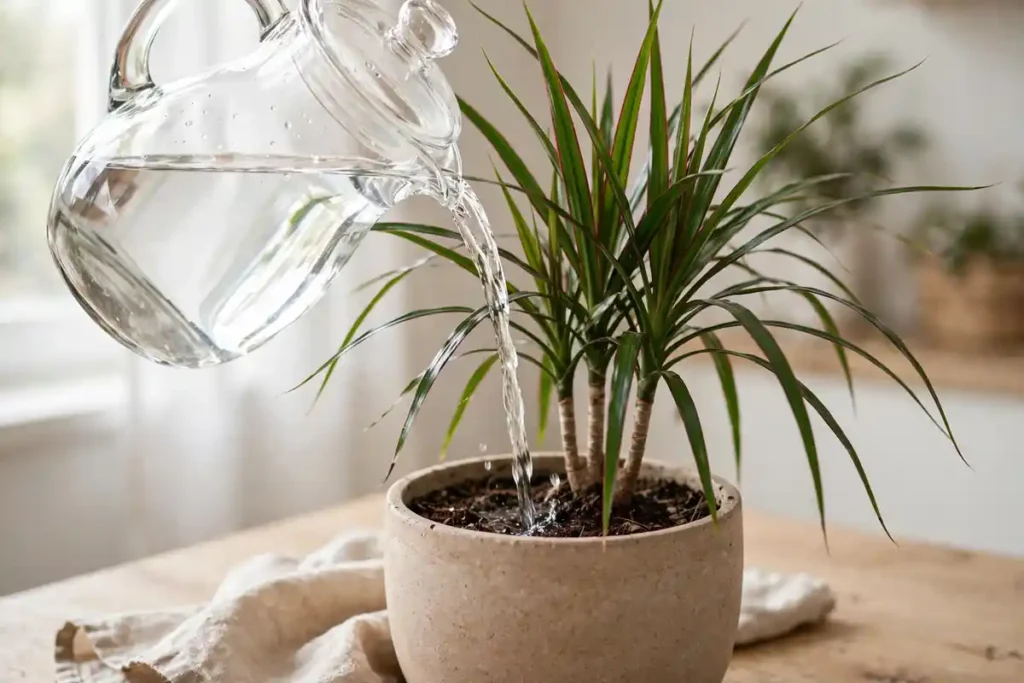
Tips are also the first tissue a thirsty plant abandons, so plain inconsistent watering is a genuine second cause. The pattern differs from fluoride, though, and the difference is your diagnosis: thirsty tips usually arrive without the yellow halo, the whole leaf looks a little dull, limp, or curled under, the soil has shrunk and pulled away from the pot’s edges, and the pot is feather-light. Fluoride browns the tips of a plant that otherwise looks well-watered, because it is well-watered — that’s the cruel part.
Dracaenas store water in their canes and tolerate a proper dry-down between waterings — they prefer it. What they don’t tolerate gracefully is the feast-and-famine pattern: bone dry for three weeks, drowned, forgotten again. The fine root tips die back in each drought, supply to the leaf tips gets unreliable, and the ends crisp.
The fix is rhythm, not volume: water thoroughly until it drains from the bottom, empty the saucer, and then don’t water again until the top couple of inches are dry and the pot feels light — for most homes that’s every one to three weeks depending on light and season, less in winter. If the soil has gone so dry it shrinks from the pot and water sheets straight down the gap, set the pot in a basin for half an hour to rewet the mix properly, then drain it.
3. Fertilizer salt buildup — the slow crust
Every feeding leaves mineral salts behind, and every watering with mineral-bearing water adds a few more. In a pot, there’s nowhere for them to go. Over a year or two they concentrate in the mix, and the leaf tips — the far end of the plumbing again — burn from the buildup just as they do from fluoride. The two causes are cousins, and they often arrive together: tap water plus regular full-strength feeding is the classic double dose.
The signs: the white crust from Check 4, tips browning with halos, a plant that’s fed “faithfully” and looks worse for it. Dracaenas are light feeders in the first place — a slow-growing plant in a pot uses very little — so the fix is mostly subtraction.
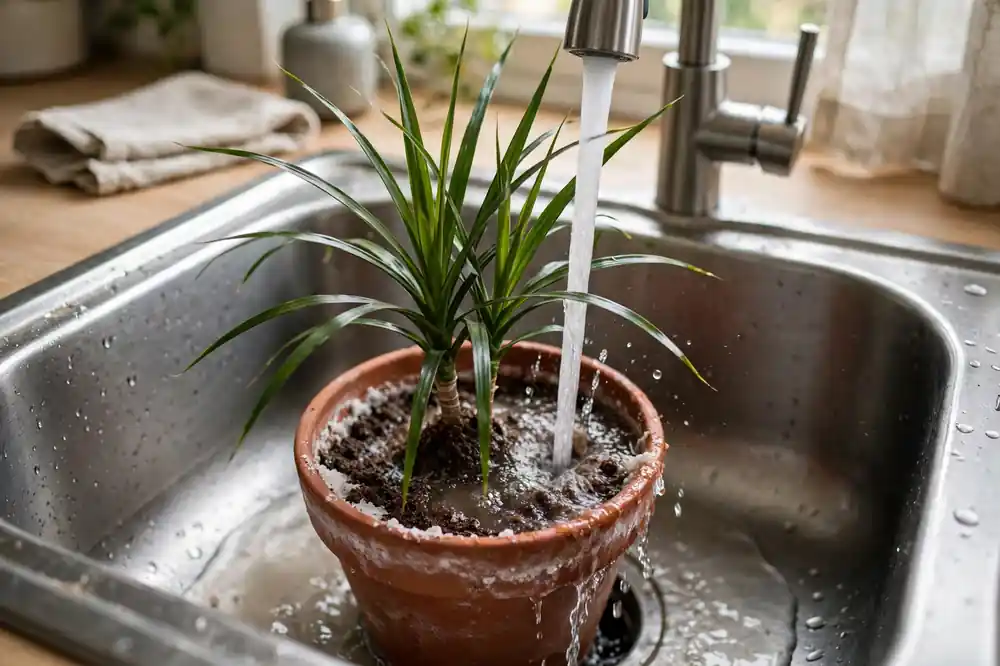
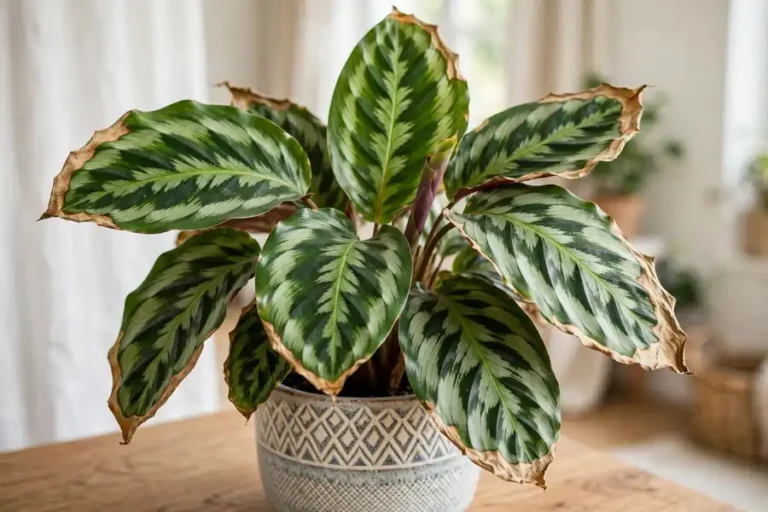
The fix — flush the pot. Take the plant to a sink or tub. Slowly pour plain water through the soil — use your best low-mineral water if you have it — until you’ve run roughly three to four times the pot’s volume through it, letting it drain freely the whole time. This leaches the accumulated salts out the bottom. (Our calathea brown edges guide walks the same flush for that equally water-fussy plant.) Then stop feeding entirely until you see clean new growth, and when you restart, feed at a quarter to half the label strength, only in spring and summer, and never into dry soil. If the mix is years old and crusted through, repotting into fresh mix is the more thorough reset — it replaces the salt bank instead of just withdrawing from it.
4. Overwatering and root trouble — when the tips are not the problem
Overwatering does damage dracaena tips, but it rarely only damages the tips, and that’s how you tell it apart. A plant sitting in wet soil suffocates its roots; failing roots can’t supply the leaves; and the picture is bigger than tips: whole leaves yellowing (usually the lower ones first), leaves dropping, growth stalling, sometimes a sour smell from the pot, and in cane types the trunk going soft or wrinkled near the base. If that’s your plant, the brown tips are a footnote — the roots are the headline.
The fix. Stop watering and let the mix dry properly — further down than feels comfortable. Check that the pot drains and isn’t sitting in a cachepot puddle. If the cane base is still firm, most dracaenas recover on a corrected rhythm alone: they’re slow, but they’re stubborn. If the base is soft, unpot it, cut away black or mushy roots and any rotted cane back to firm tissue with a clean blade, and repot into fresh, free-draining mix in a pot that fits the roots that remain. Then water sparingly while it rebuilds. And a note for the perfectionists: a plant recovering from root trouble will shed some damaged leaves on the way. That’s the recovery, not a failure of it.
5. Low humidity — real, but not the headline it’s sold as
Open almost any page about dracaena brown tips and dry air will be billed as a top cause, with a humidifier as the cure. Here’s the honest calibration: most dracaenas live perfectly happily in average household humidity. These are not calatheas. Ordinary room air — the 30–50% range most homes sit in — does not, by itself, crisp a healthy dracaena’s tips if the water and rhythm are right.
Where humidity does earn a mention: a heated home in midwinter, where the air near a radiator or forced-air vent can get desert-dry for months, can crisp the tips of a plant that’s already on the edge from borderline water. Dry air is an accomplice far more often than it’s the culprit. So fix the water first — it’s cheaper than a humidifier and it’s usually the actual answer. If winter tips persist after the water is sorted, grouping plants together helps a little, a pebble tray helps barely at all (the water evaporates into the whole room, not into a humidity bubble around your plant), and a small humidifier in a closed room is the only one of the three that meaningfully moves the number. Just don’t buy equipment to solve a fluoride problem; no amount of misting removes a mineral that’s already in the leaf.
6. Light and temperature — the pattern-breakers
Two environmental causes round out the list, and both break the “tips only” pattern, which is how you recognize them. Direct sun scorch bleaches or browns the surfaces facing the window — pale, papery patches mid-leaf, worst on the sun side — rather than neat brown tips all around. Dracaenas want bright indirect light; an hour or two of gentle morning sun is fine for most, but a south-facing windowsill in June will cook a dragon tree’s thin leaves. Cold works the other end: a plant pressed against winter window glass, or sitting in the blast path of an air-conditioning vent or a frequently opened door, can brown at the tips and edges from chilled tissue. Keep the plant comfortably above 60°F, out of vents’ direct paths, and a few inches off cold glass, and both of these causes simply stop.
And one non-cause: natural aging. The oldest, lowest leaves of a dracaena brown at the tips and eventually drop as the plant grows taller — slowly, one at a time, while everything above them stays clean. If only the lowest leaves are tipping and the rest of the plant is healthy and growing, you may be maintaining a plant that isn’t broken.
The Honest Verdicts: What Trimming Can’t Do, and How Long “Fixed” Takes
Three truths, none of which the miracle-cure pages will tell you:
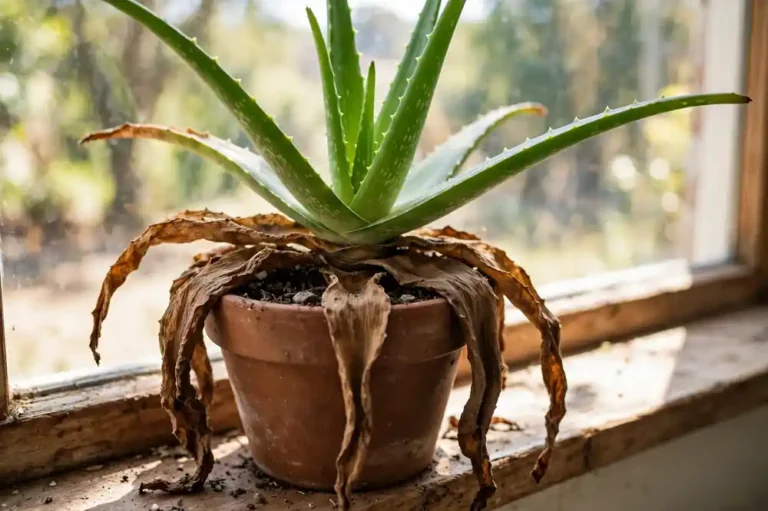
A brown tip never turns green again. That tissue is dead — not resting, not recovering, dead. No spray, feed, or water change will restore it, and any product promising to “heal” brown tips is selling you a story. This is true across the whole wilting-and-browning family of problems; it’s the same verdict we give in our aloe vera turning brown guide: you don’t fix the damaged leaf, you fix the conditions and grow a better one. Everything you do from the moment you change the water is about the next leaves.
Trimming is cosmetic — genuinely useful, but cosmetic. Cutting the brown off makes the plant look cared-for and, just as valuable, it makes new damage easy to spot. It does nothing to the cause. If the water hasn’t changed, the tidy leaf you trimmed in March will be wearing a new brown tip by summer, and that re-browning is information, not bad luck.
The fix has a lag, and it’s measured in leaves, not days. Here’s the part nobody warns you about: fluoride that has already been delivered into a leaf — sitting in the tissue of leaves that grew while you were still using tap water — can keep darkening those leaves’ tips for a while after you’ve switched. The plant also grows slowly; a dracaena may only unfurl a handful of new leaves in a couple of months. So the honest way to judge a water change is: mark the day you switched, ignore the old leaves entirely, and look only at leaves that have fully grown since. Two or three clean new leaves usually means a couple of months on this plant — anyone promising you visibly fixed growth in a week or two is describing a plant that isn’t a dracaena. It works the same way for its other fluoride-sensitive housemates; the peace lily care guide makes the same point for that plant — judge by the new growth, always.
Trimming & Cosmetic Care: How to Cut Tips Without Restarting the Brown
Done right, trimming takes five minutes and a leaf stays tidy for a long time. Done wrong, the brown creeps back within weeks and people conclude trimming “doesn’t work.” The whole secret is one rule:
Leave a sliver of brown. Take sharp scissors — wipe the blades with rubbing alcohol first — and follow the leaf’s natural outline, trimming the dead tip back almost to the green, but stopping while there’s still a hairline of brown tissue left, about the width of a fingernail paring. Then angle the cut to recreate the leaf’s natural point — two small angled cuts, one from each side, look far better than one straight chop across.
Why the sliver matters: green leaf tissue you cut into is a fresh wound. The plant seals it the only way it can — by letting the cells at the cut edge dry and die — which produces a brand-new thin line of brown exactly where you cut, and the cycle restarts. Cut within the already-dead tissue and there’s no living edge to wound, so the trim line stays put. If a trim of yours ever “grew back” brown within a fortnight, this is almost certainly what happened.
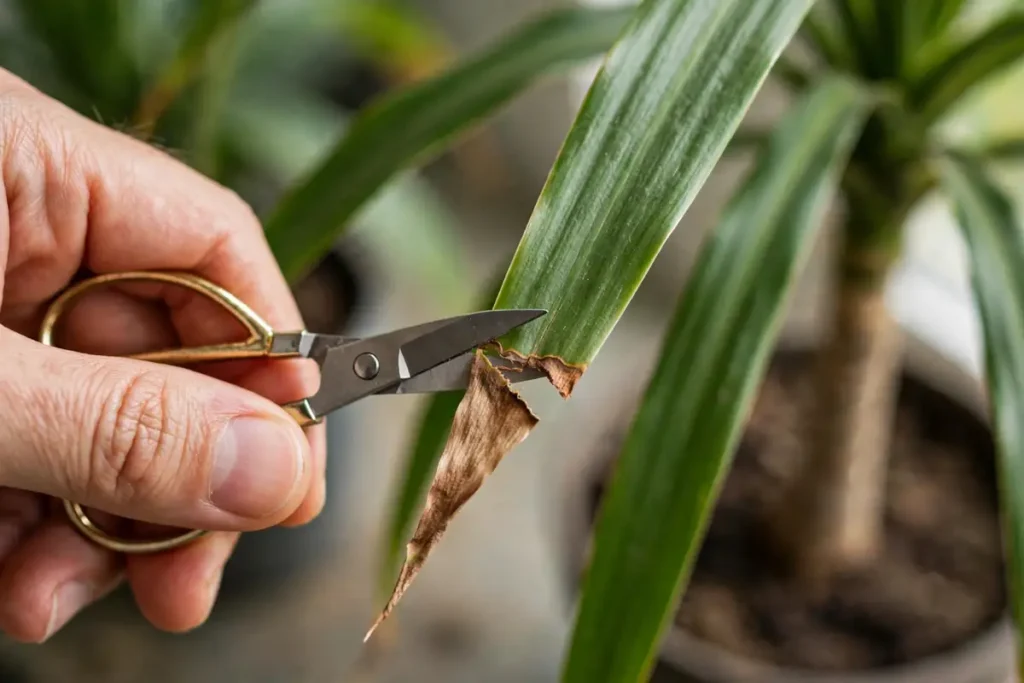
A few more working rules:
- Whole leaf more brown than green? Don’t sculpt it — remove the entire leaf at its base, cleanly, where it meets the stem or cane. A mostly-dead leaf contributes almost nothing and reads as neglect no matter how you trim it.
- Don’t strip the plant. If many leaves are tipped, trim the tips (that removes almost no living tissue) but be conservative about removing whole leaves in one session — the plant needs its green to grow the replacements. Work through the worst leaves over a few weeks.
- Timing is relaxed. You can trim any time of year; it’s dead tissue. Spring, when growth resumes, is satisfying because clean new leaves arrive to confirm the fix.
- While you’re there: wipe the remaining leaves with a damp cloth. Dust genuinely dulls a dracaena’s light intake, and the wipe doubles as your spider-mite inspection — check the undersides for fine webbing, since dry indoor air is mite weather.
Prevention: The Routine That Keeps Tips Clean
- Choose the water once, then be consistent. Most dracaena drama comes from the water, so this is the prevention that matters. Pick the best option from the ladder you can sustain forever — distilled for a single plant, rainwater if you can collect it, an RO unit if you have a jungle — and use it every time. Consistency beats perfection: a plant on steady distilled water stays clean; a plant alternating tap and distilled keeps accumulating.
- Flush the soil every few months. One slow, thorough leaching (three to four pot-volumes of water, fully drained) per season keeps salts from building to burning levels — more often if you feed regularly, less if you barely feed at all.
- Feed lightly, in season, and read the bag. Quarter- to half-strength balanced fertilizer, spring and summer only, nothing in winter, nothing into dry soil — and avoid superphosphate-heavy formulas, the hidden fluoride source.
- Keep the rhythm boring. Thorough watering, full drainage, saucer emptied, then a real dry-down of the top couple of inches before the next round. Boring is the goal; dracaenas reward boring keepers.
- Place it once and leave it. Bright indirect light, no vent blasts, no cold glass, comfortably above 60°F. Most “mystery” browning episodes trace back to a move, a new radiator habit, or a new water source — stability is a care input for this plant.
- Repot when it’s time, not before. A genuinely rootbound plant (roots circling the drainage hole, water running straight through) goes one size up into fresh mix — which doubles as a complete salt reset.
Triage: How Worried Should You Be?
Probably normal — tidy up and carry on:
- A few brown tips on the oldest leaves of a plant that’s otherwise growing. That’s exposure history, not a crisis. Switch the water if you want pristine leaves, trim the tips, and move on.
- One or two lower leaves yellowing and dropping slowly over months while new growth arrives at the top. Dracaenas shed old leaves as the cane grows — a bare trunk with a leafy crown is this plant’s natural adult shape.
Act this week:
- New growth coming in with brown tips — the cause is active now. Run the Checks, and suspect the water first.
- Brown creeping from tips down the margins, or a white crust building on the soil. Flush the pot and audit the water and fertilizer.
- Whole leaves yellowing at a pace of one a week or more, or leaf drop picking up. Check soil moisture deep and the cane base.
Act today:
- A soft, spongy, or blackened cane base, a sour smell from the soil, or the plant leaning/collapsing. That’s rot in the stem and roots, and it’s the one dracaena problem that doesn’t wait — unpot, cut back to firm tissue, repot dry-ish, and water like you’re rationing.
- A whole plant gone limp and dark after a freezing night against the glass. Move it somewhere warm and stable first; assess the damage over the following days, not the following hour.
Frequently Asked Questions
Will my dracaena’s brown tips turn green again? No. Brown tip tissue is dead, and dead leaf tissue doesn’t revive — on a dracaena or any other houseplant. What changes after you fix the cause is the new growth: leaves that unfurl afterward come in clean and stay clean. Trim the existing brown off for looks, and judge everything by the new leaves.
Should I cut the brown tips off, or leave them? Cut them — it’s the tidy, sensible thing to do — but cut them correctly. Sharp scissors wiped with rubbing alcohol, follow the leaf’s natural point, and stop while a hairline of brown still remains. Cutting into the green wounds living tissue, and the plant’s response is a new line of brown along your cut. If a whole leaf is more brown than green, remove that leaf entirely at its base instead.
Does letting tap water sit out overnight make it safe for a dracaena? It makes it safer in one specific way: standing uncovered for about 24 hours lets free chlorine evaporate. It does nothing at all for chloramine (which many cities now use instead, precisely because it doesn’t evaporate) and nothing for fluoride, which never leaves the water by standing, filtering through a standard pitcher, or boiling. If your plant keeps tipping despite the overnight jug, that’s why.
Is distilled water bad for plants because it has no minerals in it? It’s a fair worry and an easy fix. Distilled and RO water remove the chemicals that burn dracaena tips — but they also remove calcium, magnesium, and the trace minerals a plant does use. The answer isn’t to go back to tap water; it’s to feed lightly. A quarter- to half-strength balanced fertilizer a few times through spring and summer replaces everything the distilled water left out, with room to spare.
Can I just use bottled spring water? Read the label carefully before you rely on it. “Spring water” is bottled for people, not plants — it commonly contains the same dissolved minerals as tap water, sometimes deliberately added back for taste, and some brands are fluoridated. Bottled distilled water is the reliable one. If the bottle doesn’t say distilled, assume it hasn’t solved your fluoride problem.
Why are the new leaves coming in with brown tips too? Because the cause is still active — new growth tipping is the plant telling you the problem is in the present tense, not the past. Work through the usual suspects in order: the water (still tap? still softened? a pitcher filter that doesn’t remove fluoride?), the fertilizer (superphosphate? full strength? into dry soil?), and only then the rhythm and the air. One caveat: a leaf that was already formed and unfurling when you switched water was built from the old supply — give the verdict to the next leaf after that one before you conclude the fix failed.
How long after switching water until I see improvement? Honestly: a couple of months, judged correctly. The brown already on the plant is permanent, and leaves that were in the pipeline can still show some damage as they mature. A slow-growing dracaena may only produce a few new leaves in that time — but if those leaves unfurl clean and stay clean, the fix has worked. Anyone who promises visible recovery in a week or two is not describing how this plant grows.
Are brown tips a disease? Can they spread to my other plants? No on both counts. Classic dracaena tip burn is abiotic — a chemistry and care issue, not a pathogen — so it isn’t contagious and there’s nothing to quarantine. (Brown spots with soft, water-soaked edges that are actively spreading are a different symptom and worth a closer, separate look — but ordinary dry, crispy tips with a halo are the water story, not an infection.)
Is my dracaena dying? Almost certainly not. Brown tips are cosmetic — the plant’s complaint department, not its obituary. Worry only if whole leaves yellow rapidly, stems soften, or growth stops entirely; that’s a different problem (Cause 4 above, and the red rows of the triage).
Bottom line: a dracaena’s leaf tips are where its water story gets written down. Read the pattern before you change anything, be precise about what’s actually in your water — chlorine leaves, chloramine stays, fluoride never leaves on its own — and give the plant the one thing it truly rewards: a steady routine and time to grow clean leaves. The brown that’s already there is history. The next leaf is the review that counts.
2 Comments