Why Are My Philodendron Leaves Turning Yellow? Patterns, Causes & Fixes
A philodendron is supposed to be the plant that forgives everything. So when the leaves start turning yellow, it feels like you’ve failed the easiest houseplant there is. You haven’t — or at least, not in any way that can’t be fixed. Here’s the honest fast answer: a yellow leaf is the most generic signal a philodendron owns. It is the plant’s one-word vocabulary for “something changed,” and it uses that same word for too much water, too little light, an old leaf retiring, a cold night, and half a dozen other stories. Which means the leaf itself tells you almost nothing.
The pattern tells you nearly everything. Which leaves are yellowing — the oldest ones at the base, the brand-new growth, or everything at once? Is the whole leaf going yellow, or just the tissue between green veins? Is the soil wet or dry while it happens? Answer those three questions and you’ve usually got your cause before you’ve touched a watering can. This guide teaches you to read that pattern, gives you the three checks that settle arguments, walks the causes in the order they actually happen, and — because philodendrons are genuinely forgiving plants — shows you how fast a recovery usually comes once the real cause is fixed.
One reassurance before we start, because it’s true and most guides bury it: if your plant has one yellow leaf, at the base, on an otherwise vigorous plant, the most likely diagnosis is “nothing.” Philodendrons retire old leaves the way trees drop old foliage. Everything below is about telling that harmless case apart from the ones that need you.
First, Read the Pattern: Which Yellow Is Yours?
Forget the cause list for a moment. Stand in front of the plant and answer three questions.
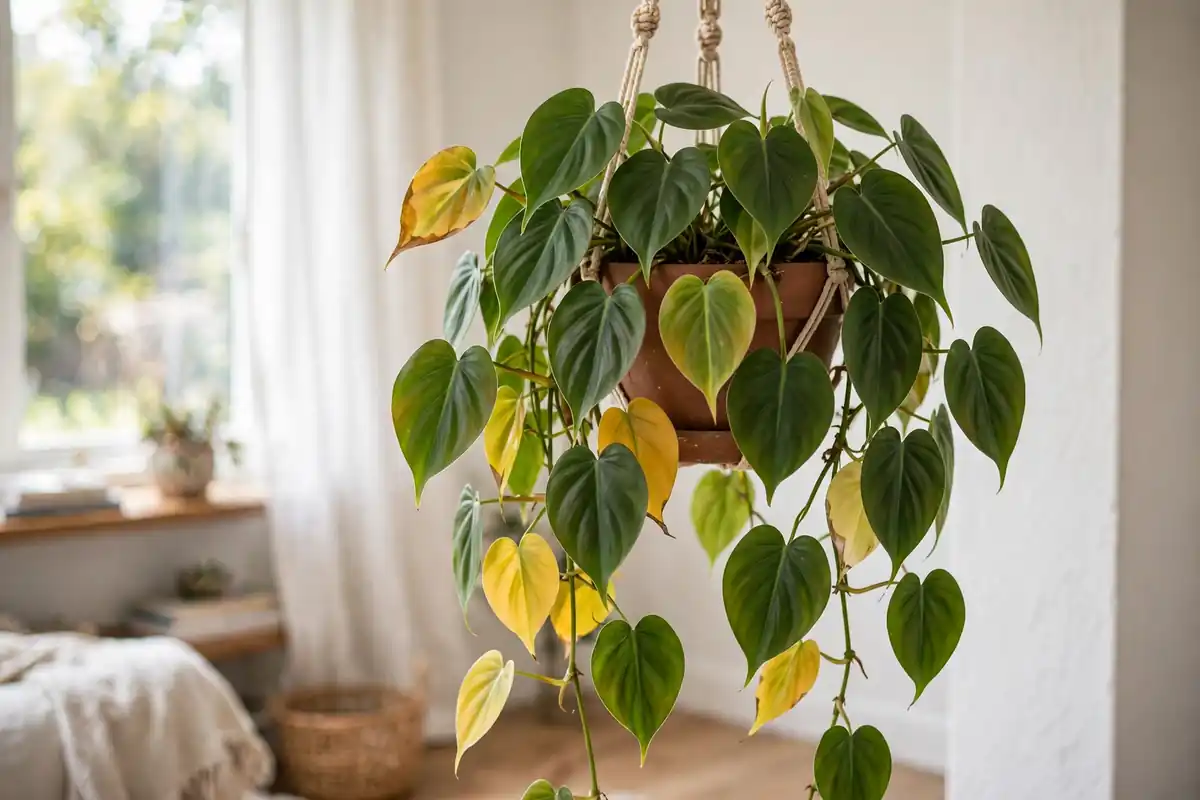
Which leaves? The oldest, lowest leaves yellowing one at a time is the retirement pattern — every philodendron does it. New growth coming in pale or yellow is a different story: the plant is building leaves it can’t properly green, which points at light, or at roots that can’t deliver. Leaves yellowing all over, fast, is the emergency pattern — something systemic, usually in the pot.
What kind of yellow? A whole leaf fading evenly to yellow and letting go is the classic aging/watering story. Yellow tissue with the veins staying green — interveinal chlorosis — looks dramatic but is widely misread online: in a potted philodendron it far more often means struggling roots or old, depleted mix than a specific missing mineral (the causes section explains why, honestly). Fine yellow speckling scattered across leaves suggests something is feeding on them. Crispy yellow-brown edges suggest thirst or dry, parched soil. Pale, bleached patches on the window side suggest the opposite of a light shortage — sun scorch.
What is the soil doing? This is the tiebreaker for almost every argument. Yellow leaves over soil that’s still wet a week after watering is a wet-roots story. Yellow leaves over bone-dry, feather-light soil is a thirst story — or a pot so root-bound that water runs straight through it.
Put your answers together against this table:
| What you see | Most likely story | First move |
|---|---|---|
| One oldest leaf at the base, occasionally; plant otherwise vigorous | Natural aging | Nothing — remove it when it’s mostly yellow |
| Several lower leaves yellowing; soil still wet days after watering; pot heavy | Overwatering, possibly root rot | Stop watering; run the checks below |
| A whole vine or stem yellowing fast; stem base soft | Root rot | Root check today; rescue protocol below |
| New growth pale, yellow-green, small; stems stretching toward light | Too little light | Brighter indirect light, moved gradually |
| Yellow with dry, crispy edges; pot very light; soil pulled from the edges | Underwatering | Deep watering; check for root-bound below |
| Yellow tissue, veins stay green, on new leaves | Root stress or depleted/alkaline mix — rarely a simple deficiency | Check roots and feeding history before buying supplements |
| Fine yellow speckles; sticky leaves; webbing or cottony tufts | Pests | Inspect undersides; treat (Cause 8) |
| Uniform pale yellowing of older leaves on a plant never fed in years | Genuine nitrogen hunger | Half-strength balanced feed (Cause 7) |
| Sudden yellowing after a cold night or a move next to a drafty window | Cold stress | Warm, stable spot; assess over a week |
| Bleached, papery patches on the window-facing side only | Sun scorch | Pull back from the glass |
Two rows deserve a second look. The fast, whole-stem yellowing row is the only one where speed matters — soft tissue at the base means rot may be traveling, and a day or two of delay costs you plant. And the interveinal row is where the internet will try hardest to sell you a bottle: hold off until you’ve read Cause 7.
The Three Checks: Five Minutes That Settle It
Patterns narrow the field; these three checks usually close the case. Run all three before you change anything.
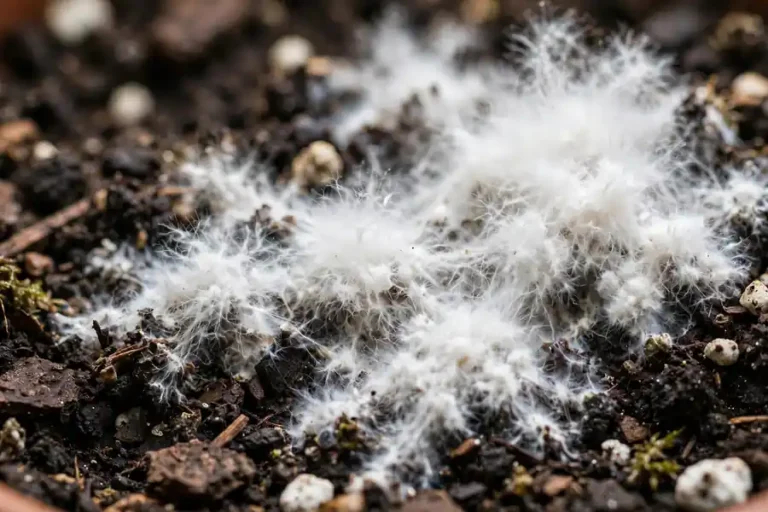
Check 1 — The soil, deep. Push a finger or a wooden skewer all the way to the bottom of the pot. The top inch dries first and lies to you; the bottom is where roots live. A philodendron wants the top inch or two dry between waterings, but the mix at the bottom should never stay soggy for days. If the skewer comes out with wet mix clinging a week after you watered, the roots are sitting in saturation — that’s the overwatering setup whatever the surface looks like. Lift the pot, too: a waterlogged pot is heavy, a thirsty one startlingly light, and your arm learns the difference fast. While you’re there, look at the surface: white fuzz means the mix never dries (our guide to white mold on houseplant soil covers that fellow traveler of wet pots).
Check 2 — Stems and bases. Squeeze the stem bases where they meet the soil. A healthy philodendron stem — vining or upright — is firm and springy. Soft, mushy, darkened, or a stem that wobbles loosely in the mix points below ground: roots, and possibly the stem base itself, are rotting. Also notice the smell of the pot. Healthy potting mix smells like a forest floor; a sour, swampy smell is decay, and decay means act.
Check 3 — The undersides. Take the plant to your best light and turn leaves over. Look along the midrib and in the joints where leaf stems meet the main stem: cottony white tufts are mealybugs; small brown bumps that don’t move are scale; fine webbing and a dusty, stippled look on the surface means spider mites. Run a finger across a leaf — stickiness (honeydew) means something has been feeding even if you can’t find it yet. Philodendron pests are patient and hidden; a yellowing plant whose soil checks out fine is very often a plant nobody turned over.
If all three checks come back clean — soil rhythm sensible, stems firm, undersides clear — and the yellow is confined to an old leaf or two, you are almost certainly looking at retirement, and the correct treatment is a pair of scissors once in a while and no worry at all.
The Causes, One by One
In rough order of how often each one is actually behind a yellowing philodendron in a home — which is not the order most websites list them, because most websites are in a hurry to talk about fertilizer.
1. Overwatering and root rot — the usual suspect
Philodendrons are rainforest plants, and that fact misleads people. In the forest, a philodendron’s roots run through bark, leaf litter, and air — water passes through; it doesn’t sit. In a pot of dense mix that never dries, roots suffocate, and the organisms that live in every potting mix start digesting them. Above ground the plant can no longer drink properly, even though the soil is wet, so it sheds leaves to cut its losses.
The signature: several leaves yellowing over a couple of weeks, lower ones first; soil still wet long after watering; a pot that stays heavy; sometimes a sour smell, sometimes a drifting cloud of tiny fungus gnats above the soil — gnats don’t hurt the plant, but they’re a reliable witness that the mix never dries. The sentence owners always say is the diagnosis in miniature: “It looks thirsty, but the soil is still wet.” A plant wilting over wet soil isn’t thirsty; its roots are failing. (Our peace lily drooping guide is built around the same fork in the road — perks up after watering means thirst; stays flat over wet soil means roots.)
The fix, mild case — soil soggy, stems still firm, yellowing recent: stop watering. Move the plant to the brightest indirect light you have, because light is what lets a plant actually use water. Empty the saucer, check the drainage hole is clear, and don’t water again until the top two inches are dry and the deep mix is merely cool rather than wet. Most mild cases steady themselves within a few weeks.
The fix, advanced case — soft stem bases, sour smell, yellowing accelerating: that’s rot, and it needs the rescue protocol further down this page. Don’t wait and see; rot travels.
2. Natural aging — the one that isn’t a problem
Every philodendron leaf has a lifespan, and when it’s spent, the plant withdraws what it can from it — nitrogen and other mobile nutrients get pulled back into the plant, which is precisely why an old leaf yellows evenly and completely — and then lets it go. On a vining heartleaf, this happens along the length of older stems, one leaf at a time, while the tips keep growing. On an upright type, the oldest outer leaves of the rosette yellow in turn.
The calibration that matters: aging is slow (a leaf every few weeks, not several a week), low or old (the oldest leaves, never the new growth), and accompanied by growth (new leaves still arriving somewhere). If all three are true, remove yellowed leaves when they’re mostly yellow, and change nothing else. Repotting or fertilizing a plant for the crime of retiring a leaf is how a non-problem becomes a real one.
3. Too little light — the slow fade
Philodendrons tolerate low light better than most tropical plants, which is why they survive office corners — but tolerance is not preference. In genuinely dim conditions the plant runs a deficit: growth slows, new leaves come in smaller, paler, and further apart, variegated types lose their patterning, and the plant sheds lower leaves to balance its books. And there’s a hidden second effect that causes endless confusion: a plant in dim light drinks very slowly, so a watering rhythm that was safe in a bright room quietly becomes overwatering in a dark one. Plenty of “overwatering” cases are really this combination.
The fix: medium to bright indirect light — a few feet from an east window, right up to a north one, or back from a south/west window with sheer curtain. Move a plant that’s been in deep shade gradually over a week or so, since leaves built for shade scorch easily. Expect thicker, glossier, faster growth within a month or two — and expect the plant to drink a little faster, while the top-two-inches rule stays the same.
4. Underwatering — the dry yellow
Philodendrons forgive a missed watering, but chronic dryness eventually bills them: leaves droop and soften, edges crisp yellow-brown, and older leaves yellow and drop. The pot is feather-light, the mix has pulled away from the pot’s walls, and a skewer comes out dusty-dry from top to bottom. This is the mirror image of Cause 1 and the check takes ten seconds — which is why Check 1 comes before any treatment in this guide.
The fix is the pleasant one: water deeply until it runs from the drainage holes. Parched mix sometimes goes hydrophobic and lets water sheet straight down the sides; if that happens, set the pot in a basin of water for half an hour to rewet from below, then drain it fully. Leaves already crisped won’t recover, but the drooping should lift within a day and the yellowing should stop.
5. Root-bound — the pot it outgrew
A philodendron that’s been in the same pot for years can fill it so completely with roots that there’s barely any mix left to hold water or food. The tells: water runs straight through and the pot is dry again in a day or two; roots circle the drainage hole or poke from it; growth has stalled despite decent light; older leaves yellow a little faster than retirement alone explains. Tip the plant out and look: a solid mat of circling roots with little visible soil is confirmation.
The fix: repot one size up — just one — into a chunky, airy mix (a standard houseplant mix with extra perlite and orchid bark worked through suits these semi-epiphytic roots), water it in, and resume the normal rhythm. Spring is the kindest season for it, but a genuinely root-bound plant shouldn’t wait months for the calendar. Don’t jump two sizes: a sea of spare wet mix around a modest root ball is Cause 1 in a bigger pot.
6. Cold — the quiet winter cause
Philodendrons are tropical and they keep tropical hours: happiest roughly between 65 and 80°F, sulking below about 60°F, and genuinely damaged by nights pressed against cold window glass or in the blast of an air-conditioning vent. Cold yellowing often arrives a few days after the cold event — a whole section of plant yellows at once following a freezing night by the window, which makes it look mysterious if you’ve forgotten the night.
The fix is placement: a steady, warm, draft-free spot, then a week or two of watching. Cold-killed tissue won’t recover, but if the stems and roots stayed insulated, the plant carries on. If stems turn soft and translucent rather than merely yellow after a real freeze, treat it like rot — cut back to firm tissue.
7. Nutrients — the honest version
Here is where I part company with most of what you’ll read. Nutrient problems are real, but in a potted philodendron that gets fed even occasionally, they are rarely the cause of yellowing — and no leaf pattern, read on its own, can name a missing mineral the way a fertilizer bottle label implies. The honest calibration:
- The one common nutrient story is simple hunger. A plant in the same mix for years, never fed, growing slowly, with older leaves going uniformly pale yellow while new growth comes in small — that plant probably does need feeding. Nitrogen is mobile in the plant, so the plant robs its oldest leaves to build new ones; the pattern is even, pale yellowing down low. Fix: a balanced houseplant fertilizer at half strength, every 4–6 weeks in spring and summer. That’s the whole prescription.
- Interveinal yellowing (green veins, yellow between) is usually not a supplement deficiency. You’ll read that green veins mean iron or magnesium and that you should spray Epsom salts on the leaves. You’ll also read the two minerals’ patterns swapped around from site to site, which tells you something. In real pots, interveinal patterns most often mean the roots can’t take up what’s already there — because they’re waterlogged, or because the mix has gone alkaline from years of hard water and accumulated salts. Buying a supplement before checking the roots treats the plant’s scream as a shopping list. Check water, light, and roots first; flush the pot with plain water if salts are suspected; only then think about feeding.
- Overfeeding causes yellowing too. Salts build up in a sparingly watered pot, roots get stressed, and leaf edges brown while leaves pale. If the yellowing started or worsened after you began a feeding routine, suspect the routine. Flush thoroughly and feed less, less often.
Its cousin across the aroid family plays by the same rules — our guide to why pothos leaves turn yellow works through the identical pattern logic on that plant, and the comparison is genuinely useful because the two are so often confused for each other. This page stays with philodendrons; the checks and the honesty about fertilizer transfer word for word.
8. Pests — the cause nobody sees
Pests rarely yellow a whole plant overnight, but a settled infestation drains it steadily, and the leaf cost shows first as speckled, stippled, or patchy yellowing. The three regulars on philodendrons: spider mites (fine stippling, a dusty bronzed look, webbing where leaf meets stem — they love dry heated rooms), mealybugs (cottony tufts in the leaf joints, feeding and leaving sticky honeydew), and scale (immobile brown bumps along midribs and stems, also honeydew).
The fix is routine, not products: isolate the plant; wipe and rinse what you can reach, undersides included; dab mealybugs and scale with a rubbing-alcohol cotton swab; then insecticidal soap, thoroughly, weekly for three rounds — eggs hatch between treatments, which is why one spray never ends it. Re-inspect before the plant rejoins the collection. And fold a monthly underside check into your habits: every pest here is a nuisance in week one and a siege in month three.
The Root-Rot Rescue: Saving a Philodendron That’s Rotting
For confirmed rot — soft stem bases, sour-smelling mix, yellowing that’s accelerating over wet soil. This is the one case where “today” is literal: rot spreads through tissue while you deliberate.
- Stop watering and unpot the plant. Get it out of the wet mix entirely. Work over newspaper; this is messy.
- Shake and rinse. Wash the old mix off the roots under a gentle stream of water so you can actually see them. Healthy philodendron roots are thick, white to pale tan, and firm — many have a slightly fuzzy, velvety look from their aerial-root ancestry. Rotting roots are brown or black, soft, and stringy; the outer sheath slips off when you tug gently, leaving a thread.
- Cut away everything dead. With clean scissors, remove every soft, dark root and any mushy stem tissue, cutting back into firm, healthy material — a little beyond the visible damage, because rot’s leading edge runs ahead of what you can see. Sterilize the blade with rubbing alcohol before you start and again whenever you move from a rotten section to a healthy one; a blade that just passed through rot will carry it into the next clean cut.
- Let it breathe. Set the trimmed plant in open air for an hour or two so the cuts surface-dry. This small step does a surprising amount of the protective work.
- Repot fresh, snug, and chunky. New, free-draining mix (houseplant mix plus perlite and bark), a clean pot with drainage holes, sized to the roots that remain — which usually means the same size pot or one smaller, not bigger. Set the plant at its previous depth.
- Water once, lightly, then go careful. Water just enough to settle the mix, then don’t water again until the top two inches are dry. You are restarting this plant on slightly-dry rules while it rebuilds roots.
- Bright indirect light, no fertilizer. Light powers the rebuild; fertilizer salts stress a plant working with a fraction of its root system. Skip feeding for at least two months.
- Judge by the right signs. Success looks like: no new yellowing for a week, then two; stems firm; and eventually — philodendrons are quick — a new leaf tip pushing out. That new growth is the signature on the recovery.
If the inspection finds almost no healthy root left, don’t despair and don’t compost it yet: a philodendron doesn’t need its old roots to survive if it has healthy stem. That is exactly the situation the next-but-one section is for.
Not All Philodendrons Yellow the Same Way
Almost every guide on the internet treats “philodendron” as a single plant. It isn’t, and the difference changes how you read yellow leaves. North Carolina State Extension’s Philodendron genus profile divides the genus into the two camps every owner actually lives with:
Vining (climbing) types — heartleaf, Brasil, Micans, and their kin. These grow as long stems carrying many leaves. Leaf retirement is a background process spread along old stems: a leaf here, a leaf there, all year, while the tips push on. Two consequences. First, a long vine gradually goes bare near the base — that’s architecture, not illness, and it’s why old heartleaf vines look lush at the ends and stringy at the pot. Second, your early-warning system is the rate: a vining plant losing several leaves a week, or losing them near the growing tips, is telling you something a retiring leaf never would.
Self-heading (upright) types — Birkin, Congo, Moonlight, Prince of Orange and relatives. These grow as a tight rosette of large leaves from a central crown, with very short stems. They carry far fewer leaves in total, so each one is a bigger fraction of the plant — one yellow leaf on a Birkin is a larger event than one on a 6-foot heartleaf vine, and worth a slightly closer look. Retirement here shows as the oldest, outermost, lowest leaf of the rosette yellowing while the center stays glossy. What should worry you on a self-heading plant is a center leaf yellowing, or several leaves at once — that points into the crown and the roots.
Variegation false alarms. Some “yellowing” is just the variety. Brasil’s leaves carry a natural lime-to-yellow central stripe — a Brasil that looks partly yellow may be perfectly dressed. Birkin’s new leaves emerge pale cream and green down over a week or two, which alarms owners every spring. And chartreuse types like Lemon Lime are yellow-green by design. The question is never “is it yellow?” but “has it changed?” A stable pattern that matches the cultivar is color; a change from the plant’s own normal is a signal.
Two common varieties bend the rules a little. Micans — the velvety, bronze-green one — has thinner leaves than heartleaf and dries out faster, so underwatering shows up on it sooner; it’s also more sensitive to cold drafts. Brasil, with its lime-green center stripe, needs brighter light to hold its pattern: in dim spots its new leaves revert to plain green first, and only yellow if the light drops further — so on a Brasil, losing the stripe is the early warning that yellowing may follow.
Take Cuttings First: Propagation as Insurance
If a vining philodendron is in serious trouble — rot confirmed, decline fast — do this before or alongside the rescue: take cuttings from the healthiest growth. It takes five minutes, and it converts “I might lose this plant” into “I have this plant’s children in a jar.”
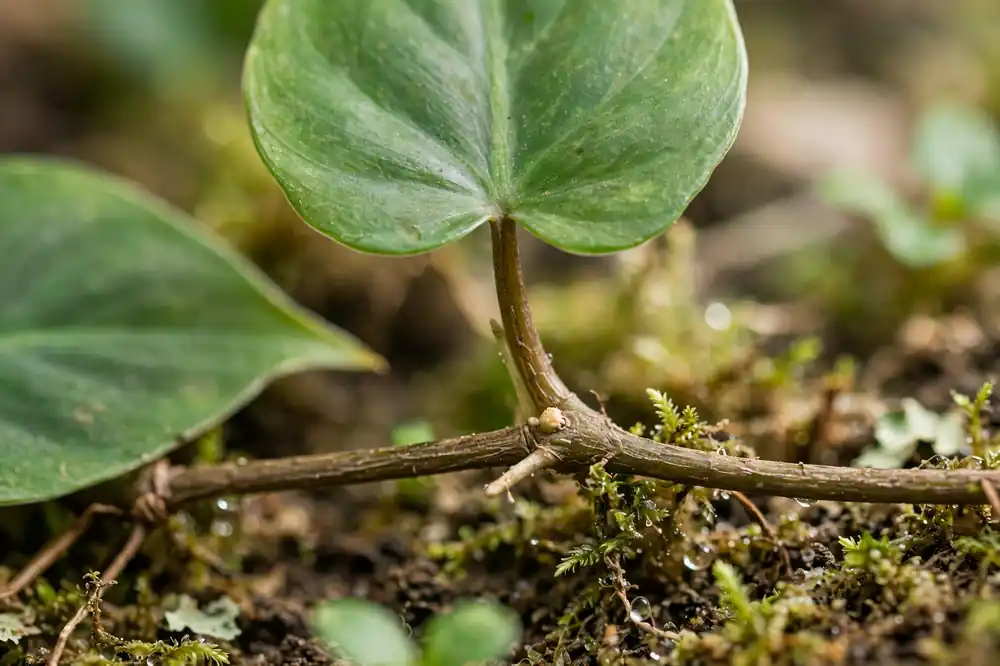
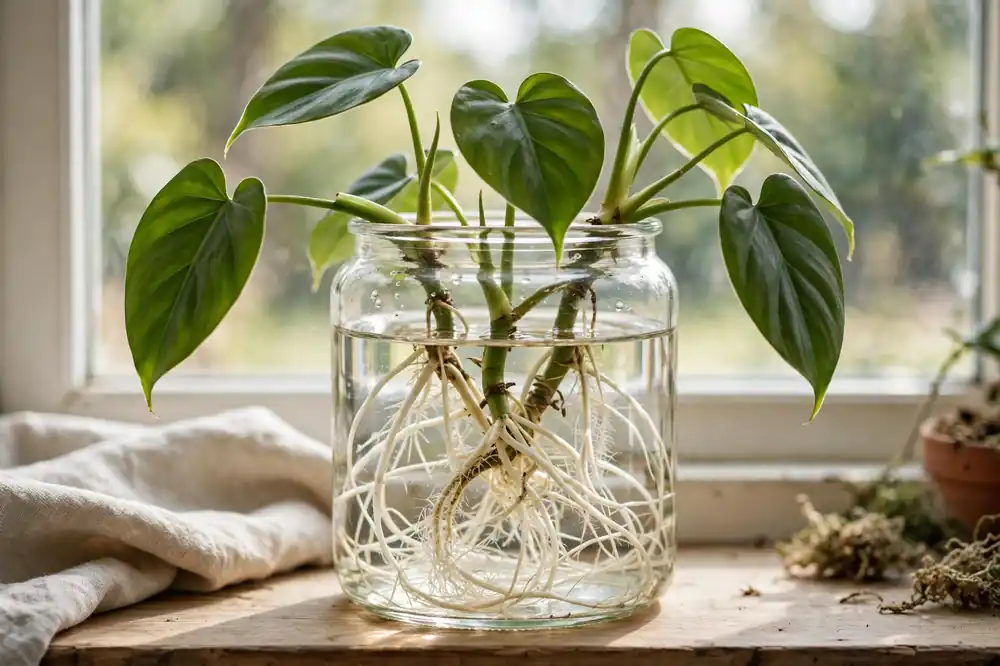
Cut below a node (the bump where a leaf and usually a nub of aerial root sit) on firm, green, healthy stem — never from yellowing or soft sections. A cutting with two or three leaves is ideal. Root it in a glass of water on a bright sill, changing the water weekly, or directly in a small pot of chunky mix kept lightly moist. Roots typically show in about 2–4 weeks in spring or summer, longer in winter — and if you like watching roots form, sphagnum moss in a clear cup works just as well as the water glass. If the mother plant recovers, you’ve got spares to plant back into the pot for fullness — which, not coincidentally, is also the cure for the bare-base look from the types section. If she doesn’t recover, you’ve lost nothing but a pot of soil. Self-heading types don’t offer this escape hatch (they’re propagated by division of offsets, a slower business), which is one more reason to catch their problems at the checks stage.
Prevention: Keeping the Green
- Water by dryness, not by calendar. Top two inches dry → water thoroughly → drain completely → empty the saucer. The rhythm stretches in winter and shortens in summer; the soil decides.
- Give the mix air. Chunky beats dense for these roots: standard houseplant mix opened up with perlite and orchid bark drains freely and still holds moisture. Repot out of the heavy nursery mix when you repot at all.
- Light it like you mean it. Medium to bright indirect light grows compact, glossy, problem-resistant plants — and makes watering predictable, because a plant that’s actually drinking dries its pot on schedule.
- Feed lightly and seasonally. Half-strength balanced fertilizer every 4–6 weeks in spring and summer, nothing in winter, and a plain-water flush once or twice a year to clear accumulated salts.
- Size the pot to the plant. One size up at a time, always with drainage. A snug pot is a safer pot for a plant whose great enemy is sitting wet.
- Look at the undersides monthly. Thirty seconds with the plant in good light is the cheapest pest insurance there is.
Philodendrons are moderate feeders — the goal is steady nutrition without salt buildup. A simple schedule that prevents both problems:
| Season | What to do |
|---|---|
| Spring | Start half-strength balanced liquid fertilizer every 4–6 weeks |
| Summer | Continue; this is peak growth — trailing types can grow inches per week |
| Fall | Taper to every 6–8 weeks as growth slows |
| Winter | Stop completely; the plant is resting |
Triage: How Worried Should You Be?
Probably normal — tidy up and carry on:
- The single oldest leaf yellowing slowly at the base of a vining plant, or the outer leaf of a rosette, while new growth continues.
- A pale new leaf on a Birkin, or a lime stripe on a Brasil, that matches the variety’s normal pattern.
- A leaf or two lost after a repot or a move, with the rate slowing week by week.
Act this week:
- Several leaves yellowing, or yellowing reaching the middle of the plant; soil still wet a week after watering.
- Yellowing plus gnats, surface mold, or a pot that never lightens — the wet-soil complex.
- Speckles, stickiness, tufts, or webbing found on inspection — start the pest routine.
- A plant stalled and paling in a dark corner — begin the gradual move to real light.
Act today:
- Any stem base soft or mushy, a sour smell from the pot, or whole stems yellowing over wet soil — unpot and check the roots; the rescue protocol is written for this afternoon.
- Sudden whole-plant yellowing right after a freezing night against the glass — move it to warmth first, then assess.
Frequently Asked Questions
Will my philodendron’s yellow leaves turn green again? No. Once a leaf has yellowed, that tissue is finished — the plant has already withdrawn what it could from it. Remove leaves that are mostly yellow so you can read the plant clearly, and judge every fix by the new growth that follows, not by the leaves that were already lost.
Should I cut yellow leaves off, or leave them? Cut the mostly-yellow ones off cleanly at the stem — they’re done, and leaving them muddies your diagnosis because you can’t tell old damage from new spread. A leaf that’s only slightly paled at the edges can stay while you watch it; the plant is still using it. Never strip a stressed plant of leaves that are still substantially green and working.
Why is only one leaf on my philodendron yellow? Usually retirement — the oldest leaf finishing its run while the plant grows on, which is the single most common yellow-leaf event in a healthy home. On a self-heading type it’s the outer rosette leaf doing the same job. It earns a second look only if the rate picks up, if the leaf is a young or central one, or if the stem near it feels soft.
How can I tell whether it’s overwatering or underwatering? They both yellow leaves — by the pot, not the leaf. Overwatering: soil still wet days after watering, heavy pot, leaves soft and yellow, possibly a sour smell or gnats. Underwatering: mix dry all the way through, feather-light pot, soil pulled from the edges, leaves crisping at the edges as they yellow. The deep-finger check and the pot’s weight answer it in ten seconds — and they matter, because the two fixes are opposites.
Does a yellow philodendron need fertilizer? Almost never as a first response. Yellowing on a plant that’s fed even occasionally is far more likely to be water, light, or roots than hunger — and fertilizer on a plant with damaged roots adds salt stress to injury. True hunger has a look: years in the same mix, never fed, slow growth, older leaves evenly pale. That plant gets half-strength balanced feed in the growing season. Everyone else gets the three checks first.
Why are the new leaves on my philodendron coming in pale or yellow? Three usual stories. Light: new growth built in a dim spot comes in pale, small, and widely spaced — brighten the plant’s world gradually. Variety: Birkin and other pale-variegated types unfurl light and deepen over days, which is normal. Roots: if pale new growth arrives while the soil stays wet and older leaves are also slipping, the roots can’t supply the new leaves — run the checks and suspect the pot, not the pantry.
How long does recovery take once I’ve fixed the cause? Judge it in stages. The yellowing should stop spreading within one to two weeks of a correct fix. New growth — the real verdict — typically follows within two to four weeks in spring and summer, because philodendrons grow fast when they’re happy. In winter, the honest expectation is a plant that holds steady until the light returns. If yellowing keeps spreading past two weeks with the cause supposedly fixed, the diagnosis was wrong or incomplete — go back to the checks, and look at the roots.
Can a philodendron with root rot be saved? Very often, yes — philodendrons are among the most salvageable houseplants. If any firm root or healthy stem survives, the rescue protocol above (cut back to clean tissue, repot chunky and snug, careful watering) gives it a real chance, and healthy tip cuttings root so readily that a vining plant can effectively be restarted from its own top growth. What can’t be saved is a plant whose stems have gone soft all the way through — which is why soft bases are the “act today” row in the triage.
Are philodendrons toxic to cats and dogs? Yes — all philodendrons contain calcium oxalate crystals and are toxic to cats, dogs, and people if chewed, usually causing mouth and stomach irritation. Keep trailers up on shelves or hangers where pets can’t reach the vines, and call your vet if a pet eats a real mouthful.
A yellowing philodendron feels like a report card on the one plant that was supposed to be un-failable. It isn’t, really — it’s the plant filing its one-word report, and now you know how to read the rest of the sentence: which leaves, what kind of yellow, what the soil is doing. Answer those, fix the one thing that’s actually wrong, and a philodendron does the thing it built its reputation on — it forgives you, and grows.