
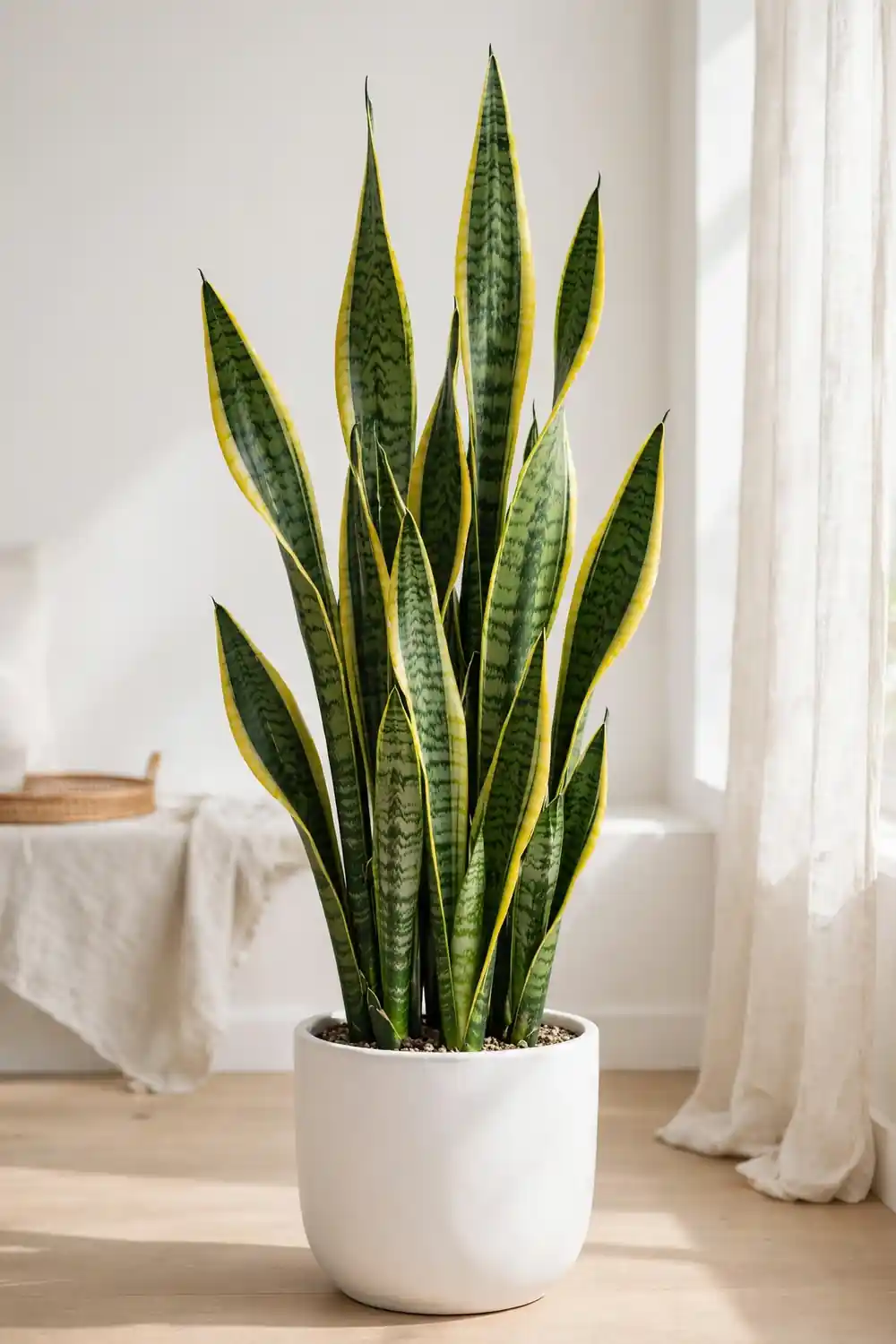
Snake Plant Care Guide: Light, Water, Soil, Propagation & Honest Expectations
The snake plant is the one I hand to people who swear they kill everything. Not because it’s magic — because its care runs opposite to instinct. Most houseplants want attention on a schedule. A snake plant wants to be set up well and then largely left alone, sometimes for weeks at a time. Nearly every dead snake plant I’ve ever been shown died of kindness: watered like a fern, fussed over like an orchid, loved to death in a wet pot.
Here’s the one idea that organizes everything on this page. A snake plant is a savings account, not a spending account. Those thick, upright leaves hold water, and below the soil sits a fat orange rhizome — a creeping underground stem — that banks even more. In its native West African dry country, that bank carries the plant through months with no rain at all. Your entire job as its keeper is to not flood the bank. Light, soil, pot, feeding — they all matter, but they matter mostly in how they affect that single balance.
A quick name note before we start: the plant in your pot was sold as Sansevieria trifasciata for a century, and botanists moved it into Dracaena in 2017, so labels now say Dracaena trifasciata. Same plant, same care. NC State Extension’s Dracaena trifasciata profile keeps the botanical record straight if you want the formal version. This guide sticks with “snake plant” and the name you already know.
Quick-Start Summary: The Essentials at a Glance
| Need | What to do |
|---|---|
| Light | Bright indirect for real growth; medium is fine; low light is survival mode, not a lifestyle |
| Water | Only when the mix is dry all the way through — then soak, drain, and walk away for weeks |
| Soil | Gritty and fast-draining (recipe below); never heavy, moisture-retentive mix |
| Pot | Snug, with drainage holes; terracotta is the forgiving choice |
| Feeding | Barely — two to four light feeds a year is plenty |
| Temperature | 60–85°F is home; protect from anything near 50°F and from cold glass |
| Humidity | Ordinary room air is fine — no humidifier, no misting |
| Growth | Slow. A few new leaves a year is a happy plant, not a stuck one |
| Pets | Toxic if chewed (saponins) — place out of nibbling reach |
Keep that table and you can keep a snake plant for decades. The rest of this guide is the why, the how, and the honest version of a few things the plant tags don’t tell you.
Light: The Honest Scale — Survives, Grows, Thrives
Snake plants are famous as low-light plants, and that fame is exactly half true. Here is the whole truth, in three tiers:
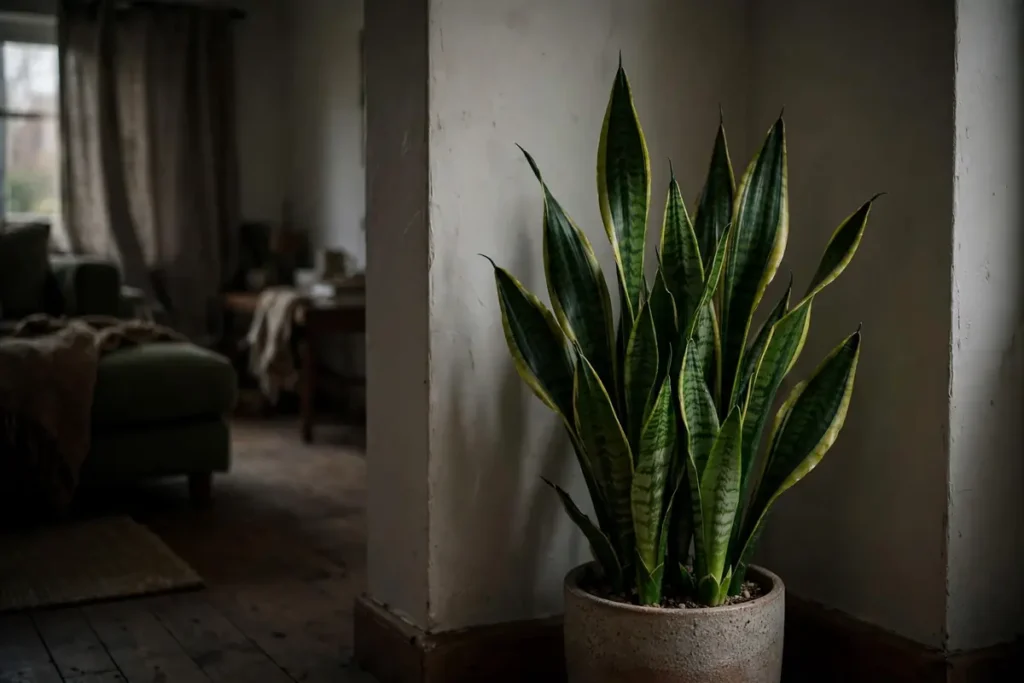
Low light — survival. A snake plant in a dim hallway, a north room away from the window, or an office lit only by ceiling panels will stay alive for a very long time. It will also, for practical purposes, stop. Growth slows to nearly nothing — perhaps one small leaf a year — the patterning on variegated types dulls, and new leaves may come in thinner and paler than the old ones. Nothing is wrong with the plant; it’s idling. There’s a catch, though, and it’s the most useful sentence in this section: a plant in low light drinks very slowly, so the watering rhythm that was safe in a bright room becomes overwatering in a dark one. Most “low-light snake plant deaths” are really wet-soil deaths. If yours lives in the dim spot, water it like it’s asleep — because it nearly is.
Medium light — steady growth. A few feet from an east or west window, or in a bright room without direct sun landing on it, a snake plant grows the way most people picture: a few strong new leaves a year, good color, pups appearing at the base in time. This is the tier most healthy house snake plants actually live at, and it’s perfectly respectable.
Bright indirect light — thriving. Right up to a bright window with the harshest midday sun filtered by a sheer curtain or a couple of feet of distance, a snake plant grows as fast as it ever will: firm, wide, richly patterned leaves, regular pups, and over years, real height. It also handles a few hours of gentle direct sun — morning sun especially — better than most houseplants, once it’s acclimated. The one light it genuinely dislikes is a sudden move from shade into all-day blazing sun through glass, which can bleach pale scorch patches into leaves that were built for dimmer conditions. Move any snake plant toward brightness gradually, over a week or two, and it will take almost anything.
The practical rule: give it the brightest spot you have that isn’t a midday sunbeam, and if it has to live dim, that’s allowed — just pair the dim spot with a much drier watering hand. Light and water are one dial on this plant, not two.
Watering: The Whole Game
Ask me what kills snake plants and I won’t hesitate: water, given too often, into soil that stays wet. Not cold, not darkness, not neglect — those it shrugs off. Saturation is the one thing the bank can’t survive, because roots and rhizome sitting in wet, airless mix suffocate, and then the organisms that live in every potting soil move in and start digesting them. Above ground it looks confusingly like thirst — a rotting plant can’t drink — which is why so many snake plants get watered to death by people trying to save them.
The rule: dry all the way through, then soak
A snake plant wants its mix to dry completely — not the top inch, the whole pot, top to bottom — before it sees another drop. “Dry on top” is a trap with this plant, especially in a tall pot: the surface can feel dusty while the bottom third, where the rhizome sits, is still wet. Watering on the surface reading keeps the bottom permanently damp, and the bottom is where rot starts.
Two checks, used together, tell the truth:
- The skewer test. Push a wooden skewer or chopstick all the way to the bottom of the pot, leave it ten seconds, pull it out. Damp mix clings and darkens the wood — wait. A skewer that comes out essentially clean and dry means the whole column is dry, and you may water. This is the same check I’d use on any water-banking plant, and the one most worth learning.
- The pot-weight check. Lift the pot right after a thorough watering and memorize that heaviness. Lift it before watering days later. A dry snake plant pot is startlingly light compared to a watered one, and after a few cycles your arm becomes a better moisture meter than anything you can buy.
The rhythm: seasonal, not calendrical
How often that dry point arrives depends on light, temperature, pot size, and season — which is why any guide that gives you a fixed number of days is guessing about your house. As a rough map for a plant in medium-to-bright light: in spring and summer, many snake plants land around every two to three weeks. In a dim room, or in winter when growth stops and the plant barely drinks, four to eight weeks between waterings is normal and correct. In a very bright, warm spot in a small terracotta pot, it might be ten days. The checks decide; the calendar just reminds you to run them. When in doubt, wait another week. Underwatering a snake plant takes months of total neglect and announces itself slowly and reversibly. Overwatering can be quietly rotting the rhizome while the leaves still look fine. This is the most forgiving plant in the world about late water and the least forgiving about early water — always err dry.
How to water, when it’s time
Water thoroughly: pour slowly and evenly over the soil surface — not into the center of the rosette, where standing water can sit in the crown and invite rot — until water runs freely from the drainage holes and the whole root ball has actually taken its share. Then empty the saucer, every time. A snake plant standing in a puddle inside a decorative cachepot is a snake plant whose rhizome is sitting in water, whatever the top of the pot looks like. If the mix has gone bone-dry and shrunk from the pot’s walls so water sheets straight down the gap, set the pot in a basin for half an hour to rewet from below, then drain it fully.
One more trap, small but real: don’t give it little sips. A splash every few days keeps part of the root zone permanently damp while never truly watering the plant — the worst of both regimes. Soak rarely beats sip often, every single time.
Soil & Potting: Grit Is the Insurance Policy
Everything about watering gets easier with the right mix, because the mix decides how long “wet” lasts. A snake plant wants water to pass through its pot the way rain passes through the rocky ground it evolved in: quickly, leaving air behind.
A recipe that works: roughly half regular houseplant potting mix and half mineral grit — perlite, pumice, or coarse sand — shaken together until it looks visibly coarse. A bagged cactus or succulent mix with an extra handful of perlite stirred in does the same job with less arithmetic. What you want to avoid is dense, peat-heavy mix straight from the bag: it holds water like a sponge, compacts over time, and keeps the rhizome zone wet long past the point of safety.
The pot rules are few and firm. A drainage hole is non-negotiable — no hole, no snake plant, it’s that direct. Size: snug. Snake plants are genuinely happy a little crowded, and a pot barely wider than the rhizome mass holds far less spare wet soil around the plant than a generous one. Terracotta is the forgiving choice for anyone with a generous watering hand: it breathes through its walls, dries the mix faster, and its weight keeps a tall, top-heavy plant honest. Plastic holds moisture longer — workable, but it lengthens every drying cycle, so adjust your rhythm, not just your pot.
Repotting is an occasional event, not an annual ritual. The honest signals: rhizomes bulging against the pot or deforming (occasionally cracking) a plastic one, roots filling every inch so water runs straight through and the pot dries in days, or a plant that has become unstable. That usually means every two to three years for a growing plant, longer for a slow one in dim light. Go up one size only, in spring if you can, into the gritty mix. Two practical notes the short guides skip: if you cut or broke roots during the repot, wait several days before watering — damaged roots heal better dry than wet — and a repotted snake plant may sit still for a season while it re-anchors. Stillness after a repot is normal, not failure.
Feeding: Barely, and That’s the Point
A snake plant in a pot needs very little food, and the overfeeding direction causes more visible harm than the underfeeding one ever will. Excess fertilizer salts accumulate in a pot that’s watered sparingly and flushed rarely, and the plant complains at the far end of its plumbing: brown, crispy leaf tips and edges on an otherwise sound plant.
My routine, and it’s deliberately boring: a balanced houseplant fertilizer at half strength, two to four times across spring and summer, and nothing at all from fall through winter. If you never feed a snake plant, it will grow more slowly and mind very little. If it lives in the same mix for years and new growth comes in pale and small, that’s the one genuine hunger picture — a light feed in spring is the whole prescription. Never feed a plant that’s stressed, recently repotted, or suspected of root trouble; fertilizer on damaged roots is salt on a wound.
Humidity & Temperature: The Undramatic Section
Humidity gets one honest paragraph, because that’s all it deserves for this plant. Snake plants come from dry country and are completely at home in the ordinary 30–50% humidity of a heated or air-conditioned house. No humidifier, no pebble tray, no misting — misting in particular does nothing for the plant and leaves water sitting in the rosette, which is the one place you don’t want it. If a seller told you this plant needs humidity, they were selling the accessory, not the plant.
Temperature is almost as simple. Snake plants are happy in the range you’re happy in: 60–85°F suits them perfectly. The boundary that matters is the cold one. They sulk below about 55°F and take real damage below 50°F — and the damage has a recognizable look: tissue that was pressed against cold window glass, or caught a freezing draft, or spent a cold night in an unheated room goes soft, water-soaked, and darkens over the following days. It is easily mistaken for rot, and the questions that separate them are: was there a cold night, is the soil dry, and is the base still firm? Cold damage with dry soil and a firm base is a plant that got chilled, not one that’s rotting — move it somewhere steadily warm, keep it dry, and let it grow out of the damage. The genuinely lethal combination is cold plus wet: chilled roots in saturated soil rot fast. Keep the plant off winter glass, out of vent blasts in both directions, and in winter water it even more sparingly than usual, and temperature will never be your problem.
Winter Care: When Snake Plants Actually Die
Winter is when most snake plants die — not from cold, but from winter overwatering. Growth nearly stops, evaporation plummets, and the “every 2 weeks” summer routine quietly becomes a swamp. The winter rules:
- Water half as often as summer — every 6–8 weeks is normal, and longer stretches are fine.
- Keep leaves off cold windows — tissue touching freezing glass gets damaged exactly where it touches.
- Stop fertilizing entirely from fall through winter; there is no growth to feed.
- Don’t repot — spring is the season for that; a winter repot is root disturbance with no growth to repair it.
- Expect zero growth — that’s dormancy, not a problem, and not a reason to water “to help.”
The finger test still rules, and in winter it rules harder: if the soil isn’t completely dry, don’t water — even if it’s been “a while.” Your plant’s schedule doesn’t care about the calendar.
Growth & Expectations: The Slow Plant, Honestly
Here is the section I wish every snake plant tag carried, because most disappointment with this plant is just miscalibrated expectation.
A snake plant is slow. In typical home light, a healthy plant produces a handful of new leaves a year — three to six is a good year in medium light — and adds height gradually, leaf by leaf, from the center of each rosette. A mature trifasciata stands two to four feet tall indoors, but it gets there over years, not a season. A plant that looks exactly the same in March as it did in January is not stuck, sick, or secretly dying. In winter, especially, stillness is the plant’s normal state. Judge a snake plant by the year, not by the week: is this year’s plant bigger, wider, or fuller than last year’s? That’s the only growth question that matters.
How it fills out: snake plants spread by their rhizomes, sending up new rosettes — pups — beside the mother plant. A pup starts as a pale spear poking out of the soil near the base, and over a season becomes a small rosette of its own. This is how one plant becomes a crowd, how pots eventually bulge, and (see Propagation) how you get more plants without any skill whatsoever. A pupping plant is a plant that has everything it needs; a plant that hasn’t pupped yet is usually just young or dimly lit, not failing.
Small maintenance, honestly sized: wipe dust off the leaves a few times a year with a damp cloth — dust costs the plant light, and the wipe doubles as your pest inspection. Remove a leaf only when it’s fully yellow or brown; cut it cleanly at the base. A damaged leaf — creased, nicked, brown-tipped — will never repair itself, but if it’s mostly green it’s still working, and the plant will retire it in its own time. Rotating the pot a quarter-turn every month or so keeps a window-side plant growing evenly instead of leaning into the light. That’s the whole maintenance list. This plant’s care fits in the margins of a busy life, which is the actual reason it’s famous.
Propagation: Division First, Leaf Cuttings with Eyes Open
Division — the reliable route
When your plant has pups — and it will — division is how you multiply it without risk or waiting. Do it at repotting time, ideally in spring:
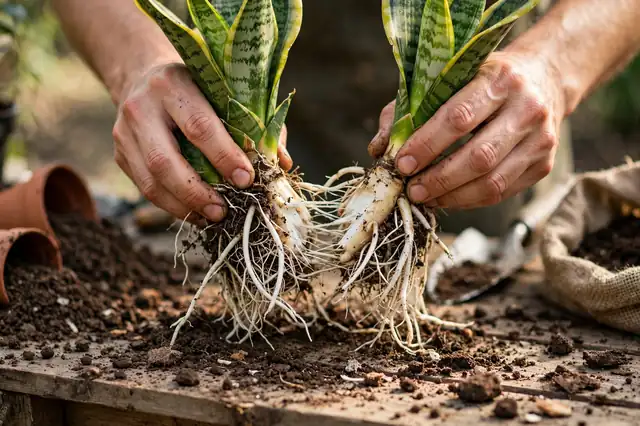
- Unpot the plant and brush the mix away from the rhizomes so you can see how the rosettes connect underground.
- Find a pup with its own roots. A separable pup has its own rosette of leaves and at least a few roots of its own on its section of rhizome — not just a spear still feeding off the mother.
- Cut the connecting rhizome with a clean, sharp knife, keeping each division’s roots with it. Let any large cut surfaces dry for a day if they look juicy — snake plant rhizomes callus readily, and a dried cut is a safer start than a wet one.
- Pot each division snugly in gritty mix, at the same depth it grew before, and water lightly after a few days rather than immediately.
Leaf cuttings — the slow route, and a warning in bold
You can also grow a snake plant from a piece of leaf, and it’s a genuinely satisfying bit of plant magic — as long as you walk in knowing two things:
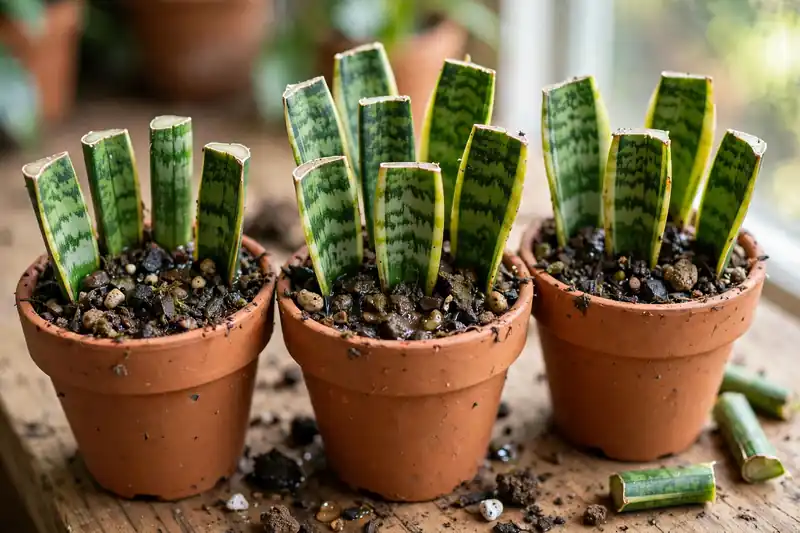
First, it is slow. Cut a healthy leaf into sections three to four inches long. Mark the bottom of each section as you cut — a leaf piece planted upside down will never root; polarity is permanent. Let the cut ends callus for a couple of days, then set the sections, bottom end down, about an inch deep in gritty mix (or root them in water, changing it weekly). Keep the mix barely moist. Roots come in a few weeks; the first pup beside the section commonly takes two to six months, and longer in winter, and a cutting that looks like nothing is happening for a season is behaving normally. A leaf-cutting plant worth looking at is a year away.
Second — and this is the fact most guides leave out — leaf cuttings do not carry variegation. If your plant is a yellow-edged Laurentii, leaf cuttings will grow up plain green. The yellow edge lives in a layer of tissue that a leaf section can’t reproduce; only the rhizome carries it, which is why division keeps the pattern and cuttings don’t. The same logic catches cylindrical snake plant owners: leaf cuttings of cylindrica produce flat leaves, not round spears. None of this makes cuttings a bad idea — a plain green snake plant is a fine plant, and cuttings are free — but if the yellow edges are why you bought the plant, divide it, don’t slice it.
Varieties at a Glance
Same species, same basic care — what changes between varieties is how much light their looks cost them and how fast they bother to grow. In rough order of how commonly you’ll meet them:
Laurentii is the classic: tall green swords with bright yellow edges, the snake plant of office lobbies and grandparents’ porches. It’s one of the fastest growers of the family and the tallest common variety — give it your best bright indirect spot to keep those edges vivid, and remember it can hit three to four feet, so pot weight matters.
Moonshine wears broad leaves in a pale silvery green that can look almost metallic in good light. That silver is a light budget: in dim conditions Moonshine drifts toward ordinary green and loses exactly what you bought it for, faster than Laurentii loses its edges. It also shows water spots and handling marks on those pale leaves more than any other variety — water the soil, not the foliage, and don’t fuss at marks that are only skin deep.
Black Gold is the dark one — deep, near-black green leaves with thin gold edges. With the most green tissue of the edged varieties, it’s the most tolerant of a medium or even dimmer spot, and the slowest to complain. A good choice for the corner Laurentii would sulk in.
Cylindrica (now Dracaena angolensis) grows round, spear-like leaves that rise in a fan rather than a rosette, and it’s in no hurry at all — possibly the slowest plant on this page. It wants the brightest light of the group and the driest hand. Buy the size you actually want; you will not be growing it into a statement piece by Christmas.
Hahnii and the compacta types are the dwarf rosettes — “bird’s nest” snake plants that stay six to eight inches tall and spread sideways instead of up. One care difference matters: that tight funnel of leaves catches and holds water poured over the top, and a rosette that sits wet in its crown is a rot candidate. Water compacta types at the soil edge, never over the center, and tip out any water that’s pooled in the funnel after an accident.
Zeylanica is the original species form the named varieties were selected from — dark green leaves with lighter, wavy horizontal banding, growing 2–3 feet tall at maturity. Its care is this guide, unmodified; if anything it’s the toughest of the tall types, and the one most likely to be sold simply as “snake plant” with no variety name at all.
Common Problems Preview: The Short Answers
Start with the symptom — then read the short answer below it:
| Symptom | Likely cause |
|---|---|
| Mushy base / drooping | Overwatering, root rot |
| Yellow leaves | Usually overwatering |
| Brown, crispy tips | Underwatering, water minerals, or fertilizer burn |
| Wrinkled leaves | Underwatering (rare) |
| No growth | Too dark, rootbound — or winter, which is normal |
| Falling over | Rotted base, or extremely rootbound |
This is a care guide, so these are the honest short versions — the pattern to recognize and the first move — with the door to the full diagnosis where the site keeps it.
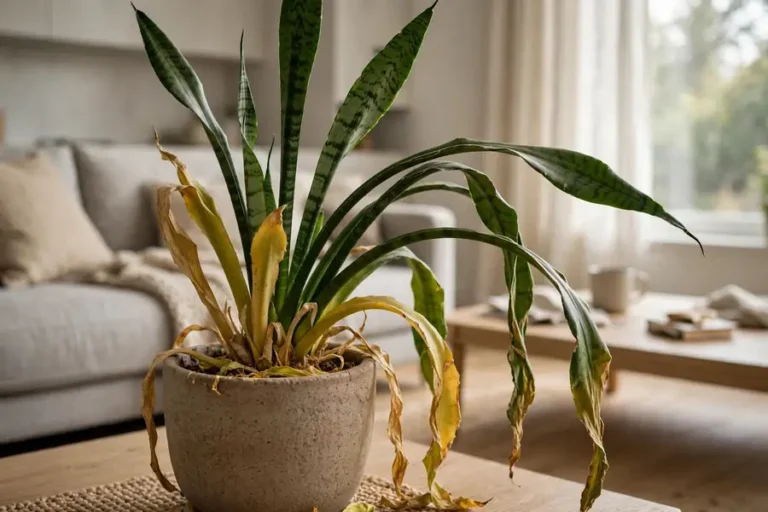
Drooping or falling leaves. A healthy snake plant’s leaves stand because the rhizome anchors them and the tissue is full of water. When leaves flop, fold at the base, or fall outward, the story is usually below the soil: roots or rhizome weakened by wet conditions, sometimes finished off by a cold spell — though a plant stretching in deep shade can also grow too weak to hold itself up. Check the base for firmness and the soil for wetness before you do anything, and don’t reflexively water a flopping plant. The full walk-through lives in our guide to why a snake plant is drooping, which covers the squeeze test and the rescue step by step.
Yellow leaves. One oldest leaf yellowing slowly at the base of a growing plant is retirement. Yellowing on several leaves, or a leaf going yellow and soft at the base, is the wet-roots story again — the same rhizome trouble that yellows its water-banking cousin, which our guide to ZZ plant leaves turning yellow diagnoses in detail. Yellow plus a pot that stays heavy for weeks means stop watering and check the roots, not feed.
Mushy leaves. Soft, translucent, collapsing leaves are tissue that has drowned and begun to rot — act the day you find them, because rot travels. Cut mushy leaves off at the base with a clean blade, unpot and inspect if more than one is affected, and cut rhizome back to firm, pale tissue. The same wet-base failure turns succulent leaves mushy and falling off on your other succulents, and the rescue logic is shared.
Root rot. The advanced form of the stories above: soft rhizome, sour-smelling soil, a plant that wobbles in its pot. The rescue is mechanical — unpot, cut away everything soft and dark back to firm tissue with a sterilized blade, let cuts dry, repot into fresh gritty mix, and withhold water while it re-establishes. And if tiny flies have started rising from the soil, that’s the fungus-gnat signal that the mix has been staying wet — our fungus gnats guide has the full eviction. Prevention, in every case, is the watering section of this page.
Brown tips and crispy edges are the mild complaint: salt buildup from feeding, a long dry spell, cold or hot dry air at a vent. Trim them with the sliver rule — cut within the brown, not into the green — and fix the cause; browned tissue never re-greens. Pests are mercifully rare: check leaf bases and undersides monthly for mealybugs (cottony tufts — dab with a rubbing-alcohol swab) and spider mites (fine stippling and webbing — shower, then treat). A snake plant’s pest problems almost always arrive on a new plant, so a month of quarantine for newcomers is cheap insurance.
Pet Safety: Tough Leaves, Real Caution
Snake plants contain saponins — bitter, soapy compounds the plant makes to discourage exactly the chewing we’re discussing — and they are listed as toxic to cats and dogs. The honest calibration: a pet that chews a snake plant leaf usually gets an unpleasant mouthful, drooling, and possibly vomiting or diarrhea, and the leaf’s toughness and bitterness mean most animals stop at a bite. It is not among the most dangerous houseplants to pets, but it is not a snack either, and puppies and determined chewers are a different risk class than a cat who sniffed once.
Placement is the whole solution, and this plant makes it easy: a snake plant’s upright shape suits a shelf, a plant stand, or a floor corner behind furniture just as well as an open floor spot. Put it where the architecture is admired and the leaves aren’t at chewing height, pick up fallen leaves promptly, and everyone coexists for decades. If a pet eats a real quantity and symptoms don’t settle, call your vet — and bring a leaf for identification.
Frequently Asked Questions
How often should I water a snake plant? Whenever the mix has dried all the way through the pot — check with a skewer pushed to the bottom, or by the pot’s light weight. In a bright room in summer that might be every two to three weeks; in a dim room or in winter, every four to eight weeks is normal. There is no calendar answer, and waiting an extra week is always safer than watering a week early.
Can a snake plant really live in low light? It can live in low light — it’s one of the most shade-tolerant houseplants there is — but it will barely grow there, its patterning will dull, and it will drink so slowly that your usual watering rhythm can rot it. Medium light is where it actually lives well. Think of low light as this plant’s survival skill, not its preference.
Why is my snake plant not growing? Usually because nothing is wrong. Snake plants grow in a spring-and-summer season and rest in winter, and even in season they add only a few leaves a year. If it hasn’t grown in a full year of decent light, check the three usual suspects: light too low to fund growth, a pot so root-filled there’s no room, or a plant that was recently repotted and is still re-anchoring. A firm, green, upright plant that isn’t growing is almost always just being a snake plant.
How fast does a snake plant grow, and how big will it get? Slowly — a few inches of height and a few new leaves a year in good home light. Most indoor trifasciata varieties top out between two and four feet over years. If you want a tall plant soon, buy a tall plant; this is not a species that hurries, and its slowness is exactly what makes it nearly maintenance-free.
Will the yellow edges come back if I propagate my Laurentii from a leaf? No — and this surprises almost everyone. Leaf cuttings of yellow-edged varieties grow up plain green, because the variegation doesn’t pass through leaf tissue. To keep the yellow edges you must propagate by division, splitting off a pup with its own piece of rhizome. Only the rhizome carries the pattern.
Can I grow a snake plant in water only? You can keep one alive in water for a long time — it will root and persist — but it grows even more slowly than in soil, needs a drop of dilute fertilizer now and then since water holds no food, and the rhizome was built for gritty ground, not a jar. As a look, it works; as the plant’s best life, soil wins.
When should I repot my snake plant? When it tells you: rhizomes bulging or deforming the pot, roots filling it so completely that water runs straight through and it dries in days, or the plant has become top-heavy and unstable. For most plants that’s every two to three years at most. Go up one size, in spring, into gritty mix — and wait a few days before watering if you cut any roots.
Is a snake plant really an air purifier? It was one of the plants in NASA’s sealed-chamber clean-air study, and it does exchange gases at night, which is a neat trick. In a real living room, though, you’d need a jungle to measurably change your air — grow it because it’s handsome and nearly unkillable, and treat the air story as folklore with a true footnote.
Are snake plants toxic to pets? Yes — they contain saponins and are listed as toxic to cats and dogs if chewed, most often causing drooling, vomiting, or an upset stomach rather than anything life-threatening. The leaves are tough and bitter, so most pets stop at a test bite. Keep it on a stand or shelf out of chewing reach, and call your vet if a pet eats a real amount.
My snake plant’s leaves are wrinkled. What does that mean? Wrinkled, puckered leaves are the plant spending its leaf water reserves — the underwatering picture. Give it a deep soak and the leaves plump back up within days. The fork that matters: wrinkling with a mushy base is the opposite problem — that’s overwatering, and the fix starts with checking the roots.
Why are my snake plant leaves curling? Inward curling usually means thirst or prolonged drought — water deeply, and the leaves uncurl as the pressure inside them returns. Outward curling with a soft texture points the other way, to overwatering. Texture decides, as it does everywhere on this plant.
A snake plant asks for almost nothing — decent light, a gritty pot, a drink every few weeks, and to be left out of the cold. What it gives back is decades of architecture for about ten minutes of care a month, plus free plants whenever its pups outgrow the pot. Set it up by the table at the top of this page, water it by the skewer and not the calendar, and then do the hardest thing in snake plant care: nothing, patiently, while it grows at exactly its own speed.
2 Comments