ZZ Plant Care Guide: Light, Water, Soil, Propagation & Problems
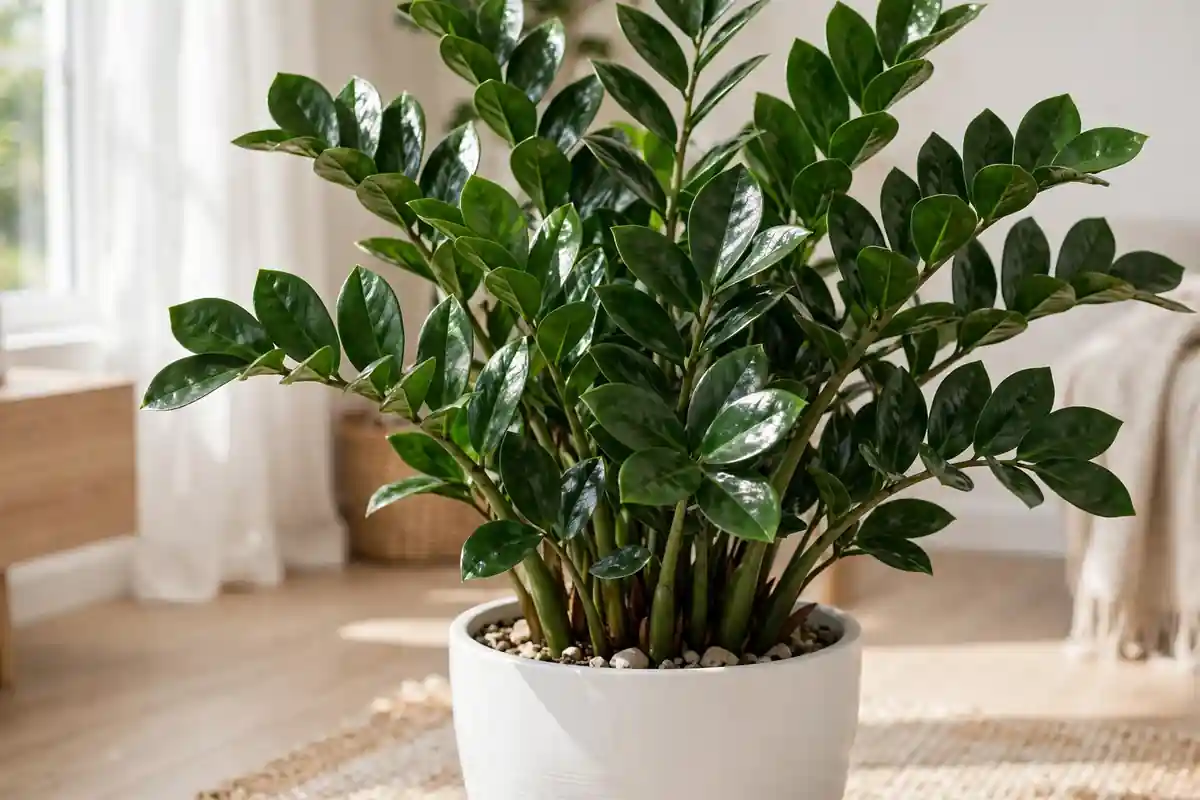
The ZZ plant has a reputation as the houseplant you cannot kill, and like most reputations, it is about three-quarters true. Zamioculcas zamiifolia — Zanzibar gem, eternity plant, emerald palm — survives dim corners, missed waterings, dry office air, and owners who travel for work. What it does not survive is the opposite problem. Almost every dead ZZ plant I have ever been asked about was not neglected. It was watered, faithfully and lovingly, on a schedule meant for a fern.
That is because a ZZ plant is not built like other houseplants, and once you understand the one piece of engineering underneath it, every rule in this guide becomes obvious. The plant keeps its own water supply underground, in thick, potato-like rhizomes. Your whole job is to not drown the reservoir.
This guide covers the full routine: the honest truth about light, watering as the main event, soil and pots, feeding (barely), growth you can realistically expect, propagation with honest timelines, the varieties worth knowing, the handful of problems that actually occur, and pet safety without the internet scare stories. Short version first, for anyone standing in a plant shop right now deciding whether to buy one: yes, buy it. It is the easiest plant in this guide series to keep alive, provided you can resist watering it.
ZZ Plant Care at a Glance
| Need | What to do |
|---|---|
| Light | Bright indirect is best; medium light grows it slowly; low light is survival mode, not growth mode |
| Water | Only when the soil is dry all the way through — then soak and drain completely |
| Soil | Gritty, fast-draining mix; a pot that feels almost too small |
| Temperature | 65–80°F is comfortable; keep it above 50°F and away from cold drafts |
| Humidity | Ordinary room humidity is fine; no misting, no pebble tray needed |
| Feeding | A few light feeds a year at most, in spring and summer only |
| Growth | Very slow; 2–3 feet tall indoors eventually; months of looking the same is normal |
| Pets | Toxic if chewed (calcium oxalate) — keep out of reach, but read the calm version below |
The Rhizome Bank: Why This Plant Plays by Different Rules
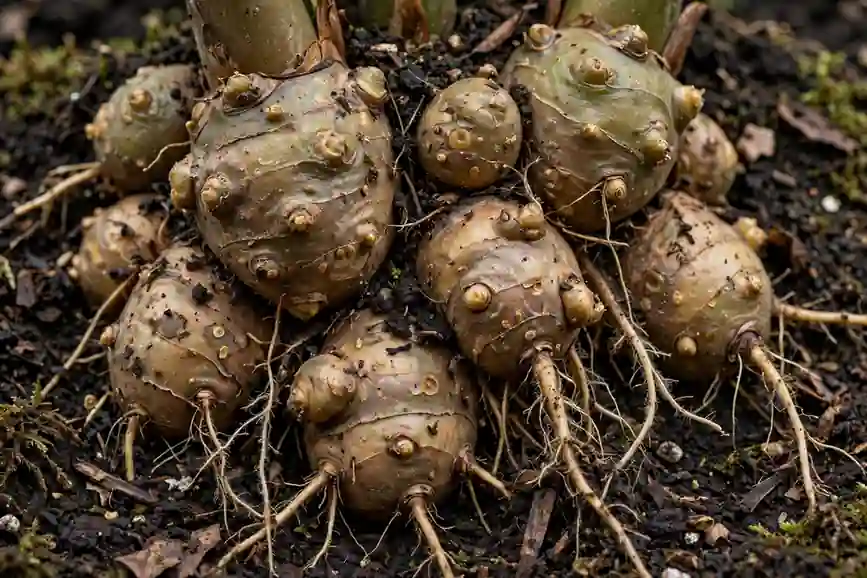
Dig a ZZ plant out of its pot — wait until repotting day, please — and you will find the secret: a cluster of thick, pale, potato-shaped rhizomes packed under the stems. Those rhizomes are storage organs. The plant banks water and energy in them during good times and spends from the account during drought, which is exactly what its native habitat demands. In the dry forests and grasslands of eastern Africa, rain arrives in bursts with long dry spells between, and the ZZ evolved to treat water as something you save, not something you sip daily.
Three practical consequences follow, and they run this entire guide.
First, a ZZ plant with big, mature rhizomes can go a long time between waterings — weeks, comfortably — because it is drinking from its own reserves. A small, young plant with one or two modest rhizomes has a much smaller account and dries out its pot faster. Same species, different bank balance, different watering rhythm.
Second, the plant cannot refuse a deposit. If you water soil that is still wet, the rhizomes and roots sit in moisture they do not need, oxygen can’t reach them, and rot organisms move in. Rot starts underground, quietly, often weeks before a single leaf complains. By the time stems go soft at the base, the damage downstairs is well advanced. This is why ZZ care is mostly watering restraint: you are protecting an underground organ you cannot see.
Third, growth is funded by the bank, and the bank refills slowly. New stems are expensive. A ZZ plant spends carefully, which is why it grows slowly even when you do everything right — and why no fertilizer schedule or pep talk will turn it into a fast plant. More on that in the growth section, because unrealistic expectations cause almost as much trouble as overwatering.
NC State Extension’s profile of Zamioculcas zamiifolia puts the official version plainly: the plant is highly drought tolerant, wet feet are not tolerated, and it should be treated more like a succulent than a typical tropical foliage plant. Everything below is that sentence, expanded.
Light: The Honest Scale
“ZZ plants tolerate low light” is the most repeated — and most misunderstood — sentence in houseplant care. Tolerate is doing heavy lifting in that sentence. Here is the scale nobody prints on the plant tag:
| Light level | What actually happens |
|---|---|
| Low light (a few feet from a small window, interior office, hallway) | The plant survives. It holds its existing stems, grows very little or nothing, and slowly spends its reserves |
| Medium light (bright room, several feet from a good window) | Slow, steady growth; a new stem or two in the growing season |
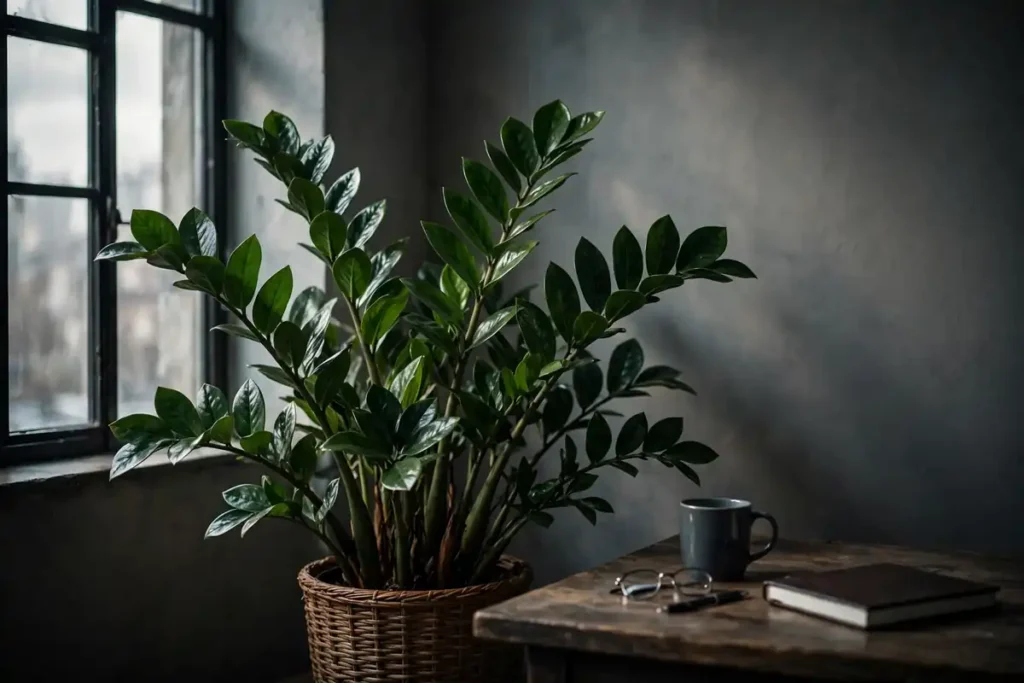
| Bright indirect light (near an east window, or a few feet back from a south or west window with sheer cover) | The best growth this slow plant can offer: sturdier stems, richer color, regular new spears in spring and summer |
Direct, unfiltered sun through glass is the one light mistake that damages a ZZ quickly — leaflets scorch to pale, papery patches on the window side. Gentle early-morning sun from an east window is fine and usually enjoyed. Everything between dim and scorching is negotiable.
Two more light truths worth knowing. Stems that stretch long and thin, with wide gaps between leaflets and a lean toward the window, are a plant asking for more light — rotate the pot a quarter turn every month or so to keep the shape even, and consider moving it a few feet closer to the glass. And a ZZ in low light is a ZZ on a budget: it is spending reserves, not earning. It can coast like that for many months, which is why the species owns the office-corner niche, but a plant that has coasted for a year appreciates a brighter “recovery” spot if you can offer one.
If low-light survivors are your thing generally, the snake plant care guide on this site covers the other great corner plant — and it runs on a strikingly similar rhizome-bank watering logic.
The rule that ties light to watering
This is the interaction that kills more office ZZ plants than anything else: the dimmer the spot, the slower the plant drinks and the slower the soil dries — so the longer you must wait between waterings. A ZZ in a bright kitchen might take water every three weeks in summer. The same plant in a dim hallway might need eight. Most watering advice fails because it gives a number without asking where your plant lives. Forget numbers. The check in the next section is the schedule.
The dark-spot compromise. If a ZZ has to live somewhere genuinely dark — the windowless office, the interior hallway — keep two plants and rotate them every few months between the dark spot and a bright window. Each gets its recovery season in the light; neither declines. It’s the honest fix for a spot no plant can truly thrive in, and it works better than pretending one plant can.
Watering: The Whole Game
If this guide had to shrink to one section, it would be this one. Watering is where ZZ plants live or die, and the doctrine has four parts.
1. Fully dry, all the way through
Water only when the potting mix has dried completely — not “the top inch is dry,” not “mostly dry.” The whole pot. The rhizomes sit in the lower half of the pot, and the lower half is the last to dry. A plant can have dusty-dry surface soil and a swamp around its rhizomes, and watering on surface evidence is exactly how the swamp becomes permanent.
2. Check like you mean it
Three checks, ranked by reliability:
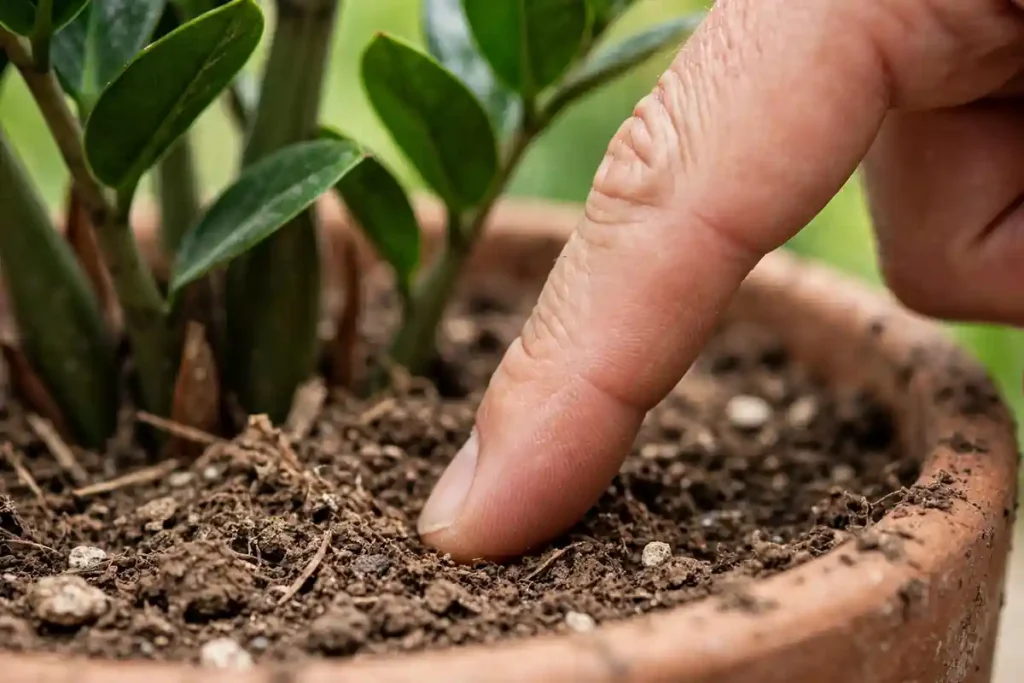
- The skewer test (best). Push a wooden skewer or chopstick to the bottom of the pot and leave it for a minute. Pull it out. If it comes back with damp mix clinging to it or feels cool and moist against your wrist, wait. Clean and dry means water.
- Pot weight (excellent once learned). Lift the pot right after a thorough watering and memorize how heavy “full” feels. Lift it before watering. A dry ZZ pot — especially in plastic — feels dramatically lighter. This becomes second nature within a few waterings and is the fastest check there is. It is less reliable in heavy ceramic, where the pot outweighs the soil; pair weight with the skewer there.
- The finger test (weakest — use as backup). A finger only samples the top two inches of a pot whose rhizomes live deeper. It is better than nothing and worse than the other two. If the finger is your check, push it in as deep as it goes and be strict about “bone dry, not slightly cool.”
When the checks disagree, or you genuinely cannot tell: wait three or four more days and check again. A ZZ plant a week late for water is a slightly annoyed plant that recovers in a day. A ZZ plant a week early, repeatedly, is a rot case in progress. When in doubt, you already know which error this plant forgives.
3. Soak, drain, done
When it is time, water properly. Take the plant to the sink, soak the mix slowly and evenly until water runs freely from the drainage hole, let it drain for ten minutes, and empty the saucer or cache pot. Never leave a ZZ standing in water, and if you use a decorative outer pot, lift the inner pot out to water — a cache pot hides standing water beautifully, which is precisely the problem. Then leave the plant alone until the mix is fully dry again. Small sips on a frequent schedule are the worst of both worlds: the surface stays damp, the rhizomes stay wet, and the plant never gets a proper drink either.
4. The seasonal rhythm
The interval floats with the seasons because the plant’s spending does:
| Season | Typical rhythm | Why |
|---|---|---|
| Spring and summer (active growth) | Water when fully dry — often every 2–4 weeks in a bright spot, longer in a dim one | New stems are being built; the bank is being spent and refilled |
| Fall | Intervals stretch; let the plant tell you | Growth slows, light drops, mix dries slower |
| Winter | The longest gaps — a month or more is common and fine | Near-dormant; the plant mostly lives off its reserves; wet winter soil is the classic rot setup |
Room temperature water is a kindness for any houseplant; icy water on warm roots is a small shock the plant does not need. And a note for the calendar-minded: throw the calendar away. Pot size, mix, light, heating vents, and air conditioning all change drying speed, which is why two honest guides can give two different week counts and both be right about their own plant. The skewer does not care what month it is.
Soil and Potting: Gritty, Snug, and Drained
A ZZ plant’s mix has one job: hold a little moisture briefly, then let the rest go. Dense, peat-heavy mix that stays wet for a week works against the rhizomes every single day. Think gritty and open — closer to a succulent mix than to what you would give a fern.
A recipe that works in most homes:
- 2 parts regular houseplant potting mix
- 1 part perlite or pumice
- 1 part coarse material — orchid bark fines or a cactus/succulent blend both work
If your home runs humid or your plant lives in low light (slow drying, remember), push the grit higher — equal parts mix and perlite is not too much. If mixing your own is not happening, a bagged cactus and succulent mix with a handful or two of extra perlite stirred in gets you most of the way there. What to avoid: garden soil (far too dense), mixes with water-retention crystals, and a layer of decorative moss or stones on top if you are an overwaterer — it looks tidy and slows the surface drying you depend on.
The snug-pot doctrine
ZZ plants belong in pots that look, to eyes used to other houseplants, slightly too small. This is deliberate. A snug pot holds a small volume of mix, the plant’s roots and rhizomes occupy most of it, and the mix dries in days rather than weeks. An oversized pot is the quiet killer: a large mass of mix stays wet long after watering, the small rhizome cluster sits in the middle of it unable to drink it dry, and rot finds exactly the conditions it wants. When you repot, go up one size only — an inch or two wider, no more — and the pot must have a drainage hole. No hole, no ZZ, no exceptions; a “layer of gravel at the bottom” does not substitute and mostly raises the wet zone closer to the rhizomes.
Terra cotta suits heavy-handed waterers because it breathes and wicks moisture, speeding the dry-down. Plastic and glazed ceramic hold moisture longer — fine for hands-off owners in bright rooms, riskier in dim ones. Match the pot to your habits, honestly assessed.
Repotting: signals and timing
Slow-growing plants in snug pots still, eventually, need a move — but a ZZ tells you plainly when, because the rhizomes quite literally push back:
- Rhizomes bulging visibly against the pot wall, or a plastic pot distorted out of round
- The soil surface lifting or cracking as rhizomes expand underneath
- Roots pushing out of the drainage hole in numbers
- Water running straight through a mix that has gone tired and compacted
Do not repot on a calendar; repot on signals — often every two to three years for a healthy plant, sometimes longer. Spring or early summer is the kindest timing, when the plant is geared to grow and can settle quickly. Unpot gently (squeezing a flexible pot helps), shake off old mix, and take a moment to inspect the rhizomes: firm and pale is healthy; anything soft, dark, or sour-smelling gets cut away with a clean knife before repotting. Set the plant at the same depth as before, firm fresh mix around it, water once, then return to the fully-dry doctrine. And if the plant has outgrown the pot because it has built several rhizome clusters, repotting day is also division day — more on that under Propagation.
Repotting, step by step:
- Water lightly 2–3 days before (not the day of — you want the root ball cohesive but not soggy).
- Slide the plant out and inspect the rhizomes. Firm and pale means healthy; trim any mushy bits with clean scissors.
- Set it in the new pot at the same depth — never bury rhizomes deeper than they were. Buried rhizomes rot.
- Fill with fresh mix, firm gently, and wait 3–5 days before the first watering, to let any root nicks heal.
Feeding: Barely, and on Purpose
Here is the feeding section in full, and it is short because the truth is short: a ZZ plant needs very little fertilizer. A few light feeds a year is plenty. In practice that means a balanced liquid houseplant fertilizer at half the label strength, two or three times across spring and summer, always applied to soil that is already moist — never into dry mix, where it can burn roots — and nothing at all in fall and winter.
Heavy feeding does not make a slow plant fast. It mostly loads the mix with salts the plant never spends, and salt build-up shows up as brown leaflet tips and a white crust on the soil surface. If you see the crust, flush the pot with plain water at the next watering and skip feeding for a while. If your plant has fresh mix — which repotting every couple of years provides — it may need no fertilizer at all in a given year and will not sulk about it. Pale, weak growth on a ZZ is far more often a light problem than a food problem. Move the plant before you feed it.
Humidity and Temperature: Ordinary Rooms, Honestly
The ZZ plant’s native climate is warm and seasonally dry, and it shows. Ordinary indoor humidity — the 30–50% most homes sit at — is genuinely fine. No misting routine, no pebble tray, no bathroom exile required. Very dry winter air from heating can crisp the tips of the smallest leaflets on young plants, but on a mature plant it is rarely even noticeable, and misting is not the fix anyway; it wets leaflets for an hour and raises room humidity not at all. If a whole collection of plants complains about dry air, treat the room, not the leaf.
Temperature matters more, and specifically cold does. The comfortable range is roughly 65–80°F — the same range most people keep their homes, which is no coincidence in the plant’s popularity. Growth stalls as temperatures fall through the 50s, and exposure below about 50°F risks real damage: leaflets yellow and drop, and cold-damaged tissue does not recover. The practical rules are simple ones. Keep the plant off windowsills that turn cold overnight in winter, away from exterior doors that blast it every time they open, and not in the direct stream of an air-conditioning vent in summer. If your ZZ summers outside on a shaded porch — fine in warm climates — bring it in well before nights drop into the 50s.
Growth and Expectations: The Slow Plant, Honestly
Let us set the expectation plainly, because this is where ZZ owners quietly decide their plant is failing when it is not: a ZZ plant is a very slow grower, and a healthy, happy ZZ plant can look exactly the same for months at a time. That sameness is the plant working as designed.
What growth looks like when it comes: a new stem starts as a pale green spear pushing up through the soil from a rhizome — gardeners sometimes call it a spike — and it rises closed, like a green candle, before the leaflets unfurl along its length over the following weeks. Stems emerge in flushes rather than a steady trickle, typically in spring and summer: nothing for months, then two or three spears at once. In winter, expect nothing, and do not interpret nothing as a problem. The plant is living off its bank account and waiting out the dark season, the way it evolved to.
Size, given years: indoors, a mature ZZ commonly reaches 2–3 feet tall and wide, with stems arching gracefully as they lengthen. It gets there at its own pace. A plant that adds two stems a year in a bright spot is doing well. A plant in low light that adds none is surviving honestly, and the fix — if you want growth rather than survival — is more light, not more water and not more fertilizer. Those last two, applied to a plant that is actually just being a ZZ, are how the trouble in the problems section starts.
Pruning and Grooming: Almost Nothing, Done Right
A ZZ plant needs almost no pruning, and the pruning it does need follows one rule: you remove whole stems, because a ZZ stem never branches. Cutting a stem partway down does not encourage it to fork or bush out — the cut portion simply ends, and any new growth will come from the rhizome at soil level. So:
- Spent stems: when an old stem yellows and declines — usually one of the oldest, after years of service — cut it cleanly at the base, right at soil level, with clean pruners. That is the plant retiring a stem, and removing it tidies the pot and directs energy to the rest.
- Damaged leaflets: individual brown or damaged leaflets can be snipped off a stem that is otherwise healthy.
- Shaping: if stems lean hard toward the light, the answer is rotating the pot, not cutting good growth. Cut only what is dead, damaged, or genuinely in the way.
Grooming is mostly dust. Those glossy leaflets are solar panels, and a film of household dust dims them. Every month or two, wipe leaflets gently with a soft, damp cloth — supporting the leaflet from beneath so you do not tear it — or rinse the whole plant under a lukewarm shower and let it drain thoroughly. That is the whole shine routine. Skip commercial leaf-shine sprays: they coat the leaflet surface, can clog the pores the leaf breathes through, and produce an artificial gloss that plain water and a cloth beat anyway. The plant’s shine is wax it makes itself; your job is just to keep the dust off it.
One safety note for bigger jobs: ZZ sap can irritate skin, so wear gloves when dividing rhizomes or pruning several stems at once, and wash your hands after.
Propagation: Three Routes, Honest Timelines
All propagation routes work. They differ wildly in how long they take, and the honest ranking is division first, stems second, leaves last.
Division — the reliable route
Division is not so much propagation as giving an existing plant’s rhizome clusters their own pots, and it is the only method that gives you a full-sized new plant the same day. Do it at repotting time, in spring or early summer. Unpot the plant, shake and tease the mix away from the rhizomes, and find the natural constrictions where clusters join. Pull clusters apart gently where they separate willingly; cut connecting tissue with a clean knife where they do not. Each division needs at least one healthy rhizome — two or three stems’ worth makes a better-looking plant — with roots attached. Pot each division in the gritty mix, snug pot, water once, and return to the fully-dry routine. Divisions sulk briefly, then resume being ZZ plants. Wait until a mother plant is well established, with several rhizome clusters, before dividing; a young single-cluster plant has nothing to spare.
Stem cuttings — slow, steady, rhizome first
A cut stem can be rooted in water or directly in a light, perlite-heavy mix. Cut a healthy stem at the base, remove the lowest leaflets, and set it in a jar of water (changed weekly) or in barely moist mix in bright indirect light. Then settle in: the cutting’s first job is not leaves, it is building a rhizome at its base, and that construction project takes months — commonly three to six before a visible little rhizome forms and top growth resumes. The stem may look completely unchanged the entire time. Unchanged is not dead. If the base stays firm and green, it is working.
Leaf cuttings — the patience route, told straight
Yes, a single leaflet can become a plant — and here is the timeline most guides soften: pull or cut a healthy leaflet with a small sliver of its base, let the cut end dry for a few hours, and press the base into barely moist, gritty mix. Kept warm and in bright indirect light, the leaflet will, over one to three months, form a tiny rhizome at its base underground. A first small stem may follow months after that. From leaflet to a plant that actually resembles a ZZ, expect a year or more — sometimes comfortably more.
That is not a reason to avoid the method; it is a reason to set it up properly. Start a whole tray of leaflets at once (not every one takes), label them with the date so future-you is not guessing, and treat the tray as a background project you check when you water other plants. Leaf propagation is a lovely, nearly free experiment. It is just not how you get a plant for a friend’s birthday this season — division is.
Varieties at a Glance
| Variety | Looks | Notes |
|---|---|---|
| Standard green | Glossy deep-green leaflets on upright, arching stems | The classic; the easiest and cheapest to find |
| ‘Raven’ | New stems emerge bright green and darken over the following weeks to a purple-black so deep it reads as black | The darkening is gradual and normal — a green new stem on a Raven is not reverting; give it bright indirect light and time, roughly 4–8 weeks per stem to fully darken; costs more than standard |
| ‘Zenzi’ | A dwarf form: shorter, densely packed stems with slightly curled, chunkier leaflets | Same care, smaller footprint — the desk-sized ZZ; its compact stems make the pot look full sooner |
| Variegated | Green leaflets splashed with cream, white, or yellow | Rare and expensive; the pale tissue photosynthesizes less, so it wants brighter light than the green forms and grows even more slowly; buy from reputable sellers — cheap “variegated ZZ” listings are a known scam shape |
| ‘Chameleon’ | New growth emerges golden-yellow and matures to green over the following weeks | A newer cultivar; the color show lasts weeks per flush, and bright indirect light keeps it vivid |
Care is identical across varieties, because the rhizomes underneath are identical. Color and stature are the variables; the watering doctrine is not.
The Year at a Glance: A Seasonal Care Calendar
| Season | Light | Water | Feed | Notes |
|---|---|---|---|---|
| Spring | Bright indirect; the best growth window | Resume normal checks as growth starts | First half-strength feed | Ideal repotting and division time; new spears emerge |
| Summer | Bright indirect; avoid harsh direct sun | Most frequent — still only when fully dry | Optional second light feed | Growth peak; rotate for symmetry |
| Fall | Maintain brightness as days shorten | Reduce frequency | Last feed in early fall (or skip it) | Growth slows; check less often |
| Winter | Brightest spot available | Least frequent — 4–6+ weeks is typical | Nothing | Cool rooms slow drying — resist watering; keep above 50°F and off cold glass |
Common Problems: A Preview
Start with the symptom — the likely cause and the first fix:
| Symptom | Most likely cause | Fix |
|---|---|---|
| Yellow lower leaflets | Overwatering (most common) | Let the soil dry fully; check rhizomes for rot |
| Mushy stem base / foul soil smell | Rhizome rot | Unpot, trim the mush, air-dry, repot into fresh dry mix |
| Brown, crispy leaflet tips | Underwatering, or fertilizer salts | Water deeply when dry; flush salts; skip extra feeding |
| Leggy, stretched, pale stems | Too little light | Move to brighter indirect light; rotate regularly |
| Scorched, bleached leaflets | Direct sun shock | Move out of direct sun; acclimate gradually |
| No new growth for a year+ | Normal slowness — or too dark | Brighter light; a light spring feed; patience |
| Drooping stems (firm base) | Severe underwatering, or top-heavy growth | Water deeply; stake if needed; check the rhizomes are firm |
| White crust on the soil | Fertilizer salt buildup | Flush with plain water; reduce feeding |
| Small black spots on stems | Usually harmless pigmentation | Normal on many ZZs — only worry if spreading or soft |
| Mealybugs in the leaf joints | Pest infestation (rare) | Alcohol swab; insecticidal soap; isolate the plant |
A healthy ZZ has very few problems, and almost all of them trace back to water. Short answers here; the dedicated guides go deep.
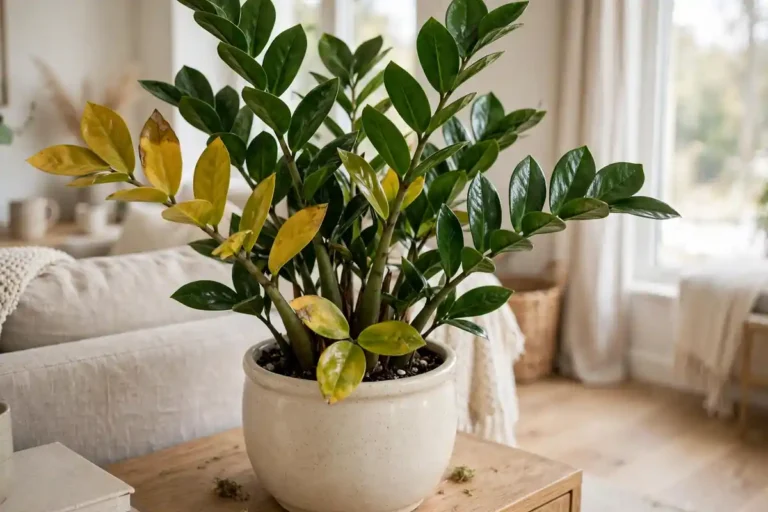
Yellow leaves. The headline problem, and on a ZZ it almost always means the rhizomes are sitting too wet — overwatering, a pot without drainage, or a dim spot stretching the dry-down longer than your routine assumes. One old leaflet yellowing on an old stem is ordinary aging; widespread yellowing is a watering audit. The full diagnosis — including how to tell wet-rot yellow from the other, rarer causes — is in our guide to ZZ plant leaves turning yellow.
Leaning or drooping stems. Usually light: stems lean and stretch toward the nearest window. Rotate the pot and improve the light if you can. A single stem that goes soft and collapses at the base, though, is not leaning — that is rot at the rhizome, and it belongs in the next entry.
Mushy stems. Act the day you notice. A stem that is soft or squishy at the base means the rhizome beneath it is rotting. Unpot, cut away every soft, dark, sour-smelling piece of rhizome with a clean knife until only firm, pale tissue remains, let cut surfaces dry for several hours, and repot into fresh, dry, gritty mix. Do not water for about a week. Caught early, the rest of the plant is usually savable; left alone, rot spreads cluster to cluster.
Leaf drop. A stressed ZZ sheds leaflets. Sudden cold (a winter windowsill, a drafty move) is a common cause, as is the advanced stage of overwatering. Check temperature first, then check the rhizomes if the soil has been staying wet.
Pests — rare. A ZZ plant is low on most insects’ wish lists. Scale insects occasionally settle along stems, and mealybugs appear on stressed plants in crowded collections; both wipe off with a cotton swab dipped in rubbing alcohol, repeated weekly until gone. The pest you are most likely to meet is the fungus gnat, and it is really a watering report, not a plant problem — gnats breed in persistently damp surface mix, so if they show up, let the pot dry fully and read our guide to getting rid of fungus gnats on houseplants.
Pet Safety: The Calm Version
You may have seen the ZZ plant described online in language better suited to a poison garden. Here is the measured version.
Like its aroid relatives — including the peace lily covered in our peace lily care guide — the ZZ plant’s tissues contain calcium oxalate crystals, microscopic needle-like structures called raphides. If a pet or child chews a leaflet, those crystals irritate the mouth and throat: the typical result is immediate discomfort — drooling, pawing at the mouth, possibly vomiting — and, importantly, the burning sensation usually stops the chewing quickly, which is why serious outcomes are uncommon. This is an irritant plant, not a systemic poison in the class of true lilies for cats. It still does not belong in reach of a pet that chews plants or a toddler in the mouthing-everything phase: place it on a shelf or stand (a ZZ tolerates the somewhat lower light up there better than most plants, which makes this easy), and call your veterinarian or pediatrician promptly if a pet or child has a real chew session — sooner if you see facial swelling or any trouble breathing, which is rare but is the symptom that matters.
The sensible summary: respect it, place it thoughtfully, and do not let the scariest headline on the internet make the decision for you. Gardeners with sensitive skin should also wear gloves for division and big pruning jobs, since the sap can irritate skin on contact.
Frequently Asked Questions
How often should I water a ZZ plant? Whenever the mix has dried all the way through the pot — and only then. In a bright spot in summer that might be every two to four weeks; in a dim room in winter it can be six weeks or more. Ignore the calendar and use the skewer test: if the skewer comes out clean and dry from the bottom of the pot, water thoroughly and drain completely.
Can a ZZ plant really grow in low light? It can survive in low light for a long time, holding its existing stems on stored reserves, but it will grow little or nothing there. Medium light grows it slowly; bright indirect light grows it as well as this slow species grows anywhere. If your ZZ has added no new stems in a year, light — not food or water — is the first thing to fix.
Why is my ZZ plant not growing at all? Usually because it is a ZZ plant. Months of sameness are normal, and winter stillness is expected. Check the real causes in order: light (too little is the common one), season (nothing pushes spears in December), and recent disturbance (repotted or divided plants pause). If the plant is green, firm, and unchanged, it is very likely fine.
How big does a ZZ plant get indoors? Typically 2–3 feet tall and wide at maturity indoors, reached slowly over years. The dwarf variety ‘Zenzi’ stays notably smaller and denser, which makes it the better choice for desks and small shelves.
Why are the new stems on my Raven ZZ green? Because that is how ‘Raven’ grows. Every new stem emerges bright green and darkens gradually over the following weeks — roughly four to eight — to the near-black the variety is named for. A green new stem is a young stem, not a plant reverting to the standard form. Brighter indirect light supports the richest final color.
Can I propagate a ZZ plant from a single leaf? Yes — a leaflet can root and form a tiny rhizome at its base — but set your expectations honestly: the rhizome alone can take one to three months to form, a first stem months more, and a plant that actually looks like a ZZ a year or more from the day you started. For a new plant this season, divide the rhizomes instead.
What should I do if my ZZ plant’s stems are mushy at the base? Treat it as rhizome rot and act the same day. Unpot the plant, cut away all soft, dark, foul-smelling rhizome tissue with a clean knife until only firm pale tissue remains, let the cuts dry for several hours, repot into fresh dry gritty mix, and wait about a week before watering. Then return to the fully-dry routine that prevents it.
Is the ZZ plant poisonous to cats and dogs? It is an irritant plant: all parts contain calcium oxalate crystals, so a pet that chews it typically gets a sore, burning mouth, drools, and may vomit — unpleasant, and the taste usually stops the chewing quickly, so serious outcomes are uncommon. Keep it out of reach of plant-chewing pets anyway, and call your vet if your pet has chewed a significant amount or shows any facial swelling or difficulty breathing.
Does a ZZ plant need fertilizer? Barely. Two or three half-strength liquid feeds across spring and summer are plenty, and a plant in fresh mix can skip a year entirely. Never feed in winter, never feed into dry soil, and do not feed a slow plant hoping to speed it up — excess fertilizer salts the mix and browns the leaflet tips.
When should I repot my ZZ plant? When the rhizomes tell you: bulging against the pot walls, distorting a plastic pot, lifting the soil surface, or pushing roots out of the drainage hole. That is often every two to three years. Repot in spring or early summer, one pot size up only, into gritty mix — and never into a pot without a drainage hole.
Why is my ZZ plant leaning to one side? It is growing toward the light. Rotate the pot a quarter turn every month or so to even it out, and move it closer to the window if the stems are also stretching thin and sparse. A lean is cosmetic; a stem that is soft at the base is not — that one is rot, and it needs the mushy-stem treatment above.
The Short Version to Remember
Everything about this plant follows from what is under the soil. The rhizomes bank water, so you water rarely and thoroughly. They rot when they sit wet, so the mix is gritty, the pot is snug, and low light means longer waits, not shorter ones. The plant grows slowly because it spends from savings carefully, so you set your expectations to spears in spring and patience in between — and you get, in return, one of the most handsome and forgiving houseplants there is.
If easy plants are your collection strategy, our pothos care guide is the natural next read — a faster, trailing counterpoint to the ZZ’s slow upright calm, and nearly as hard to get wrong. And if your ZZ is already showing symptoms, start with the yellow-leaves guide linked above and work the problem in order. The plant wants to live. Your main job is to let it.