How to Get Rid of Scale on Houseplants
You’re watering your ficus on a quiet Sunday morning when something catches your eye: a row of small brown bumps along the stem, right where the leaves meet the wood. You poke one with your fingernail. It doesn’t move. It doesn’t look like a bug at all — more like a weird scab or a natural part of the plant. So you shrug and move on. Two weeks later, there are twice as many, the leaves are looking dull, and there’s a sticky film on the table underneath the pot.
Congratulations — you’ve just met scale on houseplants, the sneakiest pest in indoor gardening. Unlike aphids that cluster in obvious colonies or spider mites that leave telltale webbing, scale insects disguise themselves as part of the plant. Many plant parents don’t realize they have an infestation until it’s been quietly draining their plant for months.
Here’s what makes scale uniquely frustrating: most insecticide sprays literally bounce off them. Adult scale insects hide under a waxy armor that repels contact insecticides the way a raincoat repels drizzle. Spray all you want — the adults sit there unbothered. But scale has one critical weakness, a brief window in its life cycle when it’s soft, mobile, and completely vulnerable. Learn to time your treatments to that window, and this “impossible” pest becomes very beatable.
This guide walks you through everything: how to tell armored scale from soft scale (it changes your whole strategy), how to find the crawler stage, a step-by-step treatment plan from gentle to aggressive, and how to decide when a plant is worth saving versus when it’s time to let go.
In This Guide
- What scale insects actually are (armored vs. soft scale)
- How to identify scale on your houseplants
- The crawler stage: your one vulnerable window
- Step 1: Isolate and assess the infestation
- Step 2: Manual removal (scraping and picking)
- Step 3: Rubbing alcohol spot treatment
- Step 4: Horticultural oil — the smothering technique
- Step 5: Insecticidal soap for the crawler stage
- Step 6: Systemic insecticides (the last resort)
- Your repeat schedule, timed to the life cycle
- When to prune — and when to say goodbye
- Prevention: never invite scale home again
- Scale vs. mealybugs vs. aphids
- FAQs
What Scale Insects Actually Are
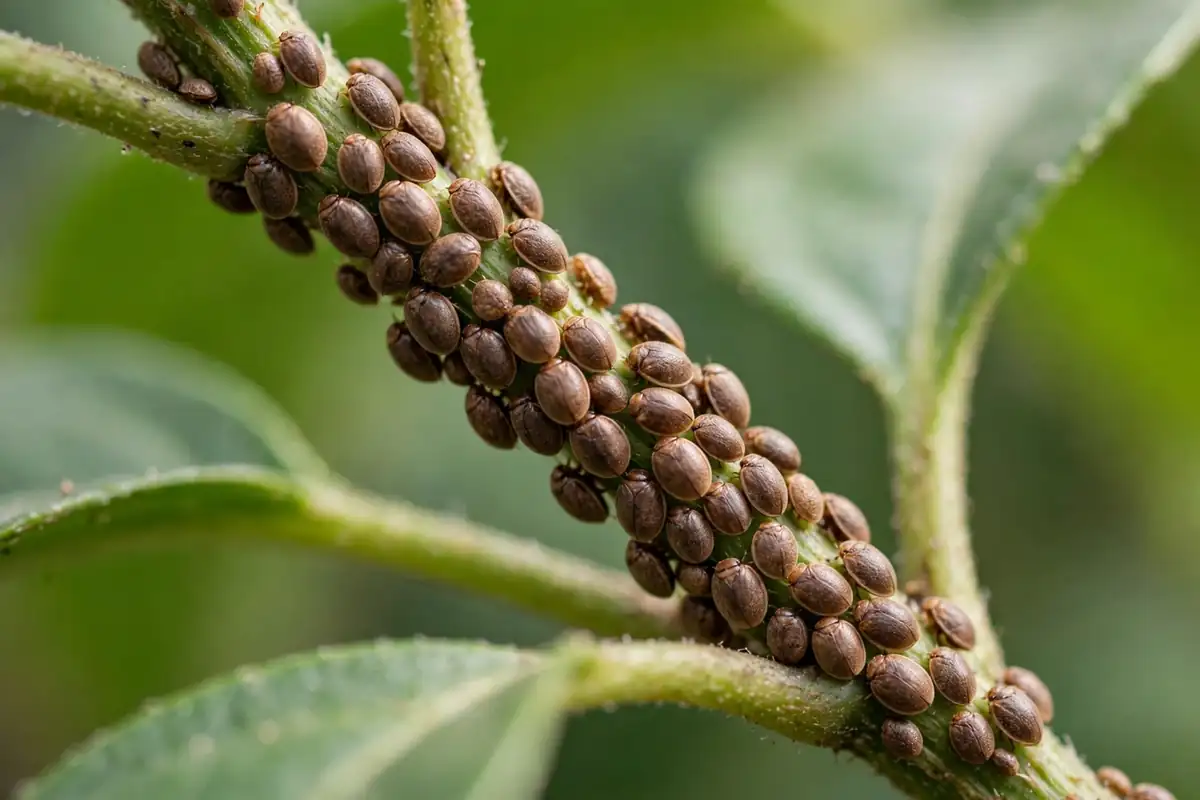
Scale insects aren’t like other bugs. A mature female scale has no visible legs, no wings, no antennae — she parks herself on a stem or leaf vein, inserts her straw-like mouthparts into the plant’s tissue, and spends the rest of her life in that exact spot, sucking sap and laying eggs underneath her own body. From the outside, she looks like a bump, a scab, or a bit of bark texture. This camouflage is the whole reason scale infestations go unnoticed for so long.
The roughly 8,000 known scale species split into two groups that matter enormously for treatment, and this is the distinction most houseplant articles skip entirely. Armored scale (family Diaspididae) secretes a hard, waxy covering that is not part of its body — think of it as a detachable shield. If you pry it up with a fingernail, you’ll find the soft insect living underneath. Soft scale, by contrast, secretes a waxy covering that is an integral part of its body — the armor and the insect are one unit.
Why does this matter? Two reasons. First, that detachable armor on armored scale makes them even harder to kill with contact sprays — the shield sheds water-based insecticides effortlessly. Second, only soft scale excretes honeydew, the sticky sugary waste that leads to black sooty mold growing on your leaves and stems. Armored scale doesn’t produce honeydew at all. So if your plant is sticky with moldy black patches, you’re dealing with soft scale; if the plant just has dry bumps and is slowly declining, it’s more likely armored scale. Clemson University’s Home & Garden Information Center describes exactly this split in their houseplant pest guide, noting that adult scales are relatively protected from insecticides by their waxy covering while their young crawlers remain susceptible.
Scale ranges from 1/16 to 1/2 inch depending on species, age, and sex. Males, when they exist, are tiny winged gnats you’ll never notice. It’s the females — the immobile bumps — that do all the damage, draining sap, weakening growth, yellowing leaves, and in heavy infestations, killing branches or the entire plant.
How to Identify Scale on Houseplants
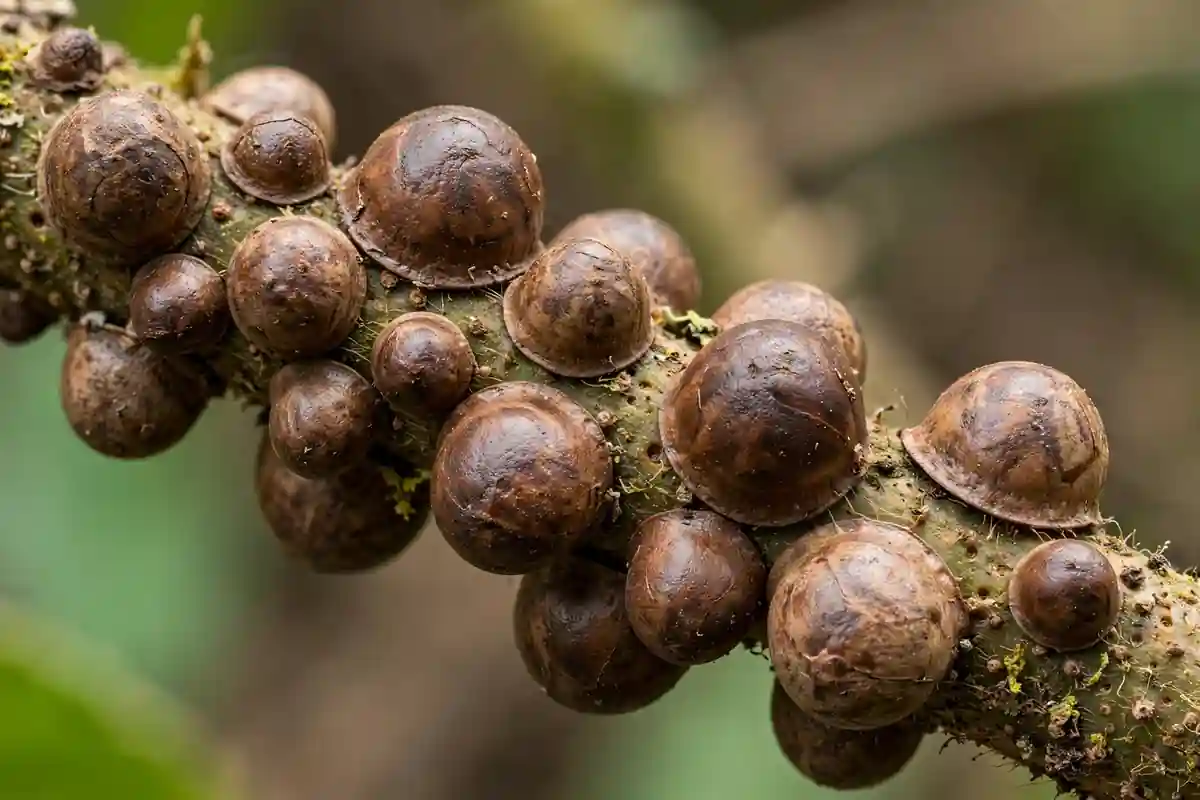
Scale’s disguise is so good that the first identification skill to learn is simply suspicion. Any small, immobile bump on a stem or leaf that you don’t remember being there deserves investigation. Here’s your inspection checklist:
Where to look. Scale clusters along stems, at leaf joints (nodes), along the midrib and veins on leaf undersides, and sometimes on the upper leaf surface near the base. On ferns, check the frond stems. On palms, they hide in fibrous leaf bases. On citrus and ficus — two of scale’s favorite indoor hosts — scan every inch of woody stem.
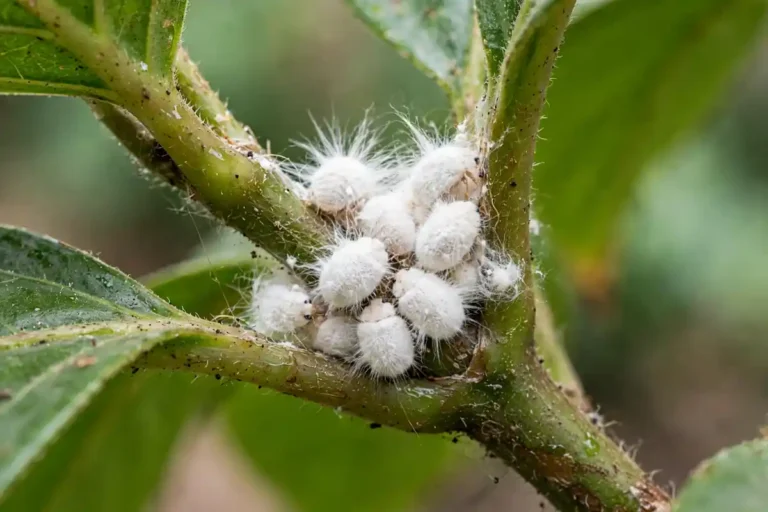
What to look for. Brown, tan, gray, or black bumps that are slightly raised and feel hard or waxy. Some species look like tiny fish scales stuck flat to the stem; others form rounded, domed masses; a few (like cottony cushion scale) produce white, fluffy egg sacs. Sizes range from pinhead to roughly half a centimeter.
The fingernail test. This is the definitive check. Try to scrape the bump off with your fingernail. If it pops off and you see a soft, often yellowish or orange body underneath (armored scale), or if the whole thing comes away as one waxy unit (soft scale) — it’s scale. If it doesn’t budge and looks like normal bark texture, it’s just the plant.
Secondary clues. Sticky honeydew on leaves or the surface below the plant, black sooty mold growing on that honeydew, ants marching up and down the plant (they “farm” soft scale for honeydew and will actually defend them), yellowing leaves, premature leaf drop, and stunted new growth. If your fiddle leaf fig is dropping leaves and the stems feel bumpy, scale should be your prime suspect — ficus species are among scale’s most beloved hosts.
The Crawler Stage: Your One Vulnerable Window
Here is the single most important concept in this entire guide, and the one most articles never explain: adult scale is nearly indestructible, but baby scale is fragile. Understanding this changes everything about how you treat.
The scale life cycle goes like this. The immobile adult female lays eggs underneath her body or waxy covering, protected from the world. Those eggs hatch into crawlers — the only mobile stage of the scale’s life. Crawlers are tiny (barely visible), soft-bodied, six-legged, and they wander the plant for a few hours to a few days looking for a good feeding spot. Once a crawler finds one, it inserts its mouthparts, starts feeding, and begins building its waxy armor. Within days it becomes immobile and essentially untouchable by contact sprays.
This means every contact insecticide — insecticidal soap, neem oil, horticultural oil, pyrethrins — works best (and in the case of soap, only) against crawlers. Spraying a plant covered in armored adults is like hosing down a turtle and expecting it to drown; the shell does its job. But catch the crawler wave, and those same sprays are devastatingly effective.
How to detect crawlers. Wrap a band of double-sided tape or electrical tape (sticky side out) around an infested stem, near but not on the scale cluster. Check it every few days with a magnifier or macro lens. When you see tiny yellowish or orange specks stuck to the tape, crawlers are active — that’s your signal to spray. Indoors, without winter to synchronize them, scale generations often overlap, which is why a single treatment never works: you have to spray on a repeat schedule to catch each successive wave of crawlers as eggs keep hatching.
The practical takeaway: stop expecting one heroic spray to fix scale. Plan for a campaign of 3–4 treatments spaced 7–10 days apart, timed to keep killing each new generation of crawlers before they can armor up. Horticultural oil is the exception that also smothers adults — more on that below — but even oil works best as part of a repeated program.
Step 1: Isolate and Assess the Infestation
The moment you confirm scale, move the plant away from every other plant you own. Crawlers are mobile and can wander to neighboring pots, and ants can carry them around. A separate room is ideal; at minimum, several feet of clear space with no leaf-to-leaf contact. Plan to keep it quarantined for at least six weeks after the last sign of live scale — that’s roughly two life cycles, enough to be confident the infestation is truly gone.
Now assess honestly. Count roughly: are we talking a dozen bumps on one stem, or hundreds encrusting every branch? Check the undersides of leaves, the soil surface, and the pot rim. Also inspect every neighboring plant, even if they look fine — early scale is invisible to a casual glance, and catching a second infestation early saves you a repeat of this whole process. Use your magnifier on leaf joints and stem crevices.
Take a “before” photo. It sounds silly, but after three weeks of treatment you’ll want proof of progress, and photos help you notice new bumps versus old dead ones (dead scale often stays stuck to the plant even after successful treatment — more on telling the difference later).
Step 2: Manual Removal — Scraping and Picking
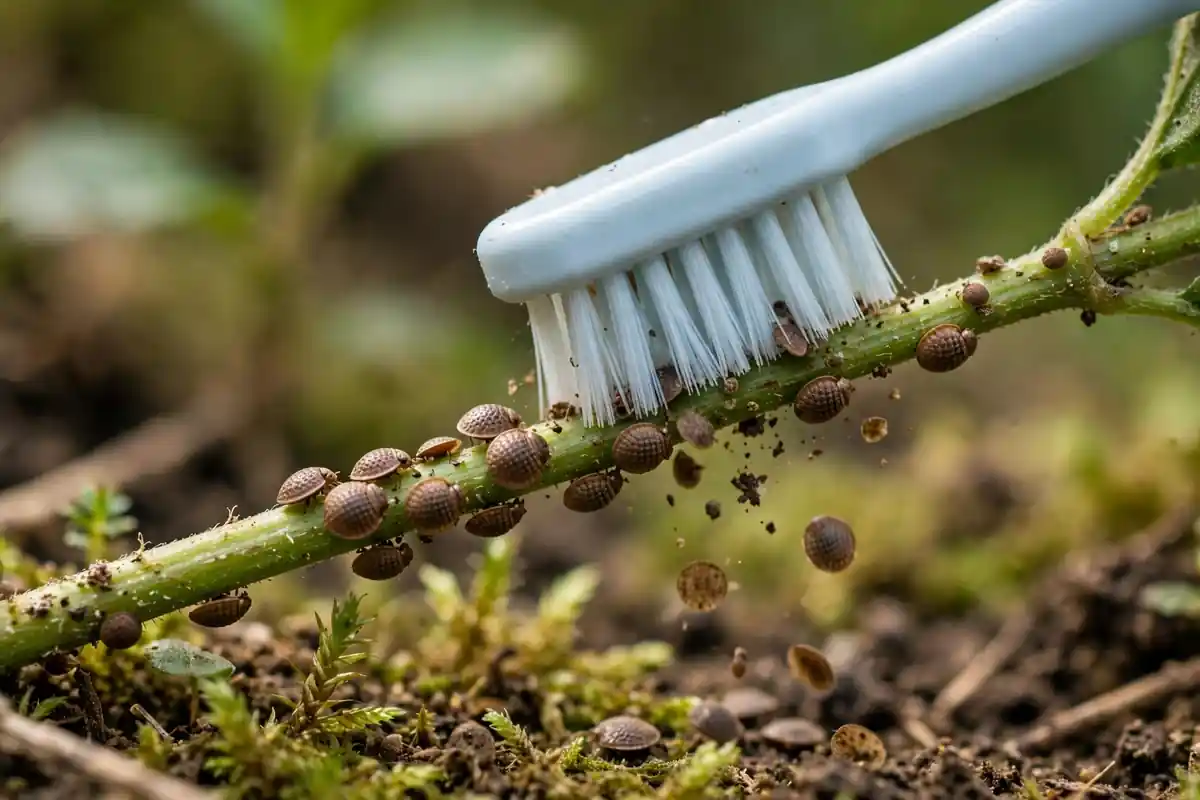
For light infestations, your fingernails are genuinely one of the best tools available. Clemson’s extension specialists note that early scale infestations can be removed simply by scraping with a fingernail — no chemicals required. Here’s how to do it properly:
- Work over a trash bag or paper towel. Every scale you dislodge contains potential eggs. Don’t let them fall into the pot’s soil or onto the table.
- Scrape with your thumbnail or a soft toothbrush. Use firm but gentle pressure along the stem. For delicate leaves, a cotton swab works better than a nail. An old soft-bristled toothbrush is perfect for getting into leaf joints and textured bark.
- Be thorough but don’t shred the plant. You’re removing bumps, not bark. If a stem is so encrusted that scraping would strip it bare, skip to the triage section — that stem is a candidate for pruning instead.
- Bag and trash everything. Seal the paper towel or bag and put it in your outdoor trash. Do not compost it — home compost doesn’t get hot enough to kill scale eggs.
- Follow up with a wipe-down. After scraping, wipe the stems and both leaf surfaces with a damp cloth to remove honeydew, sooty mold, and any crawlers you missed.
Manual removal alone can eliminate a genuinely small infestation (a dozen or fewer scales on a single stem). For anything larger, consider it Step 1 of the campaign — you’re knocking down the adult population before the chemical steps, which dramatically improves their odds.
Step 3: Rubbing Alcohol Spot Treatment
Seventy percent isopropyl alcohol is scale’s quiet nemesis. It dissolves the waxy coating that protects both armored and soft scale, desiccating the insect underneath on contact. It’s cheap, you already own it, and it’s precise — perfect for plants where you can see every individual scale.
Dip a cotton swab or cotton ball in 70% rubbing alcohol (not 90%+ — it evaporates too fast to work, and the 70% formulation is actually more effective at penetrating). Dab each scale individually, making sure the alcohol contacts the bump itself. You’ll often see the scale’s color change or the waxy coating dissolve slightly — that’s it working.
Two cautions. First, spot-test on a leaf first and wait 24 hours. Most houseplants tolerate alcohol fine, but some — particularly ferns and plants with hairy or delicate leaves — can show burn or discoloration. Second, don’t spray alcohol across the whole plant as a shortcut; targeted dabbing is effective and far safer. Alcohol has no residual effect, so like every contact treatment, it only kills what it touches — plan to repeat weekly for a few rounds to catch newly hatched crawlers.
Alcohol treatment pairs beautifully with manual removal: scrape off the big adults, then dab alcohol on the ones in crevices you couldn’t reach and on any suspicious tiny bumps that might be newly settled crawlers.
Step 4: Horticultural Oil — The Smothering Technique
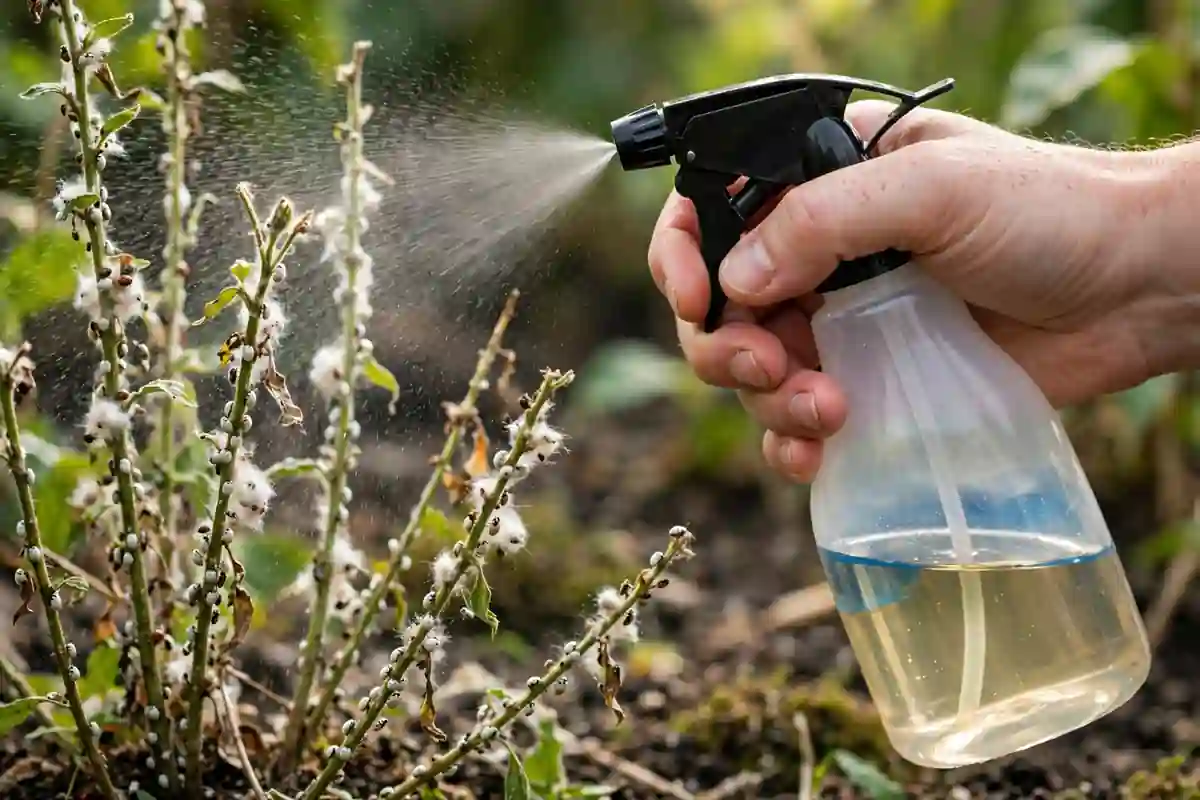
If there’s one product to buy for a serious scale battle, it’s horticultural oil (sometimes sold as neem oil extract, superior oil, or summer oil — canola-oil-based versions also work). Unlike insecticides that poison, oil kills by smothering: it coats the insect and blocks the tiny breathing pores (spiracles) in its body. This is why it’s the rare treatment that works on all scale stages, including armored adults — armor doesn’t help when you can’t breathe. Clemson’s citrus pest guide calls horticultural oil “an excellent, proven product for scale control” that kills all stages present at application.
Here’s the technique that actually works:
- Take the plant outside or to the shower/tub. You’ll be spraying to the point of runoff, and you want thorough coverage without soaking your furniture. If you must spray indoors, lay down plastic sheeting.
- Mix exactly per the label. For most horticultural oils, that’s roughly 2% solution — but follow your product’s label, not my memory. More concentrated isn’t better; it risks leaf burn.
- Spray every surface until it drips. Tops and undersides of every leaf, all stems, branch crotches, leaf joints — anywhere a scale could hide. Incomplete coverage is the #1 reason oil treatments fail. The oil must physically contact each insect.
- Time it right. Spray in the cooler part of the day or in shade — never in direct hot sun or when temperatures are above 90°F, or you risk frying the leaves. Make sure the plant isn’t drought-stressed; water it a day before if needed.
- Repeat every 7–10 days, 3–4 times. The first application smothers adults and any crawlers present. The repeats catch the next waves hatching from eggs the first round missed.
Neem oil extract deserves a special mention: it works as a smothering oil and contains azadirachtin, which disrupts insect feeding and reproduction — a nice bonus against crawlers. Whichever oil you choose, keep treated plants out of reach of pets until dry, and never use oil on a plant you’re about to move into harsh sun.
Step 5: Insecticidal Soap for the Crawler Stage
Insecticidal soap (potassium salts of fatty acids — the real thing, not dish soap, which can burn leaves) is a contact killer that destroys soft-bodied insects on contact by disrupting their cell membranes. Against armored adult scale, it’s nearly useless. Against crawlers, it’s excellent.
This is where your crawler detection pays off. When your tape traps show crawler activity, that’s the moment for insecticidal soap. Spray thoroughly — like oil, it only kills what it directly contacts, and it has zero residual effect, so coverage is everything: leaf undersides, stems, joints. Apply in the same cool-conditions timing as oil, and never combine soap and oil in the same week without checking labels — the combination can damage foliage on some plants.
Use insecticidal soap as the crawler-wave weapon between your oil applications: oil in week 1, soap in week 2 when the next crawler wave emerges, oil in week 3, and so on. This rotation attacks both the armored adults (oil) and each generation of vulnerable young (soap), which is exactly the one-two punch that breaks the life cycle.
Step 6: Systemic Insecticides — The Last Resort
When you’ve done manual removal, alcohol, oil, and soap across a full month and scale is still winning — usually on a large plant where thorough spray coverage is physically impossible — it’s time to consider a systemic insecticide. These are absorbed through the roots (as granules or a soil drench) and distributed through the plant’s sap. When scale feeds, it ingests the poison. Armor irrelevant.
The common systemics for houseplants contain imidacloprid or acetamiprid (both in the neonicotinoid family) or dinotefuran. They’re effective — there’s no question. But they come with serious responsibilities, so read this carefully:
- Follow the label exactly. Indoor rates differ from outdoor rates. Measure, don’t eyeball.
- Keep away from children and pets. Treated soil stays toxic for weeks to months.
- Never use on herbs, vegetables, or any edible plant. This should go without saying, but it needs saying.
- Never use on flowering plants that go outdoors, where pollinators could visit — neonicotinoids are implicated in pollinator harm, and a treated plant taken outside becomes a hazard to bees.
- It’s slow. Systemics take 1–3 weeks to distribute through the plant. This is not a quick fix; it’s a long siege weapon.
Think of systemics as the option for a beloved, large, valuable plant (a mature citrus tree, a specimen ficus) where every other method has failed and the alternative is the trash. For a $12 pothos with heavy scale, the trash is the more rational choice — and there’s no shame in that math.
Your Repeat Schedule, Timed to the Life Cycle
Here’s the campaign calendar. Adjust based on what you’re seeing on your tape traps, but don’t shorten it — overlapping generations mean eggs keep hatching for weeks:
| Week | Action | Target |
|---|---|---|
| Week 0 | Isolate, photograph, manual scrape + alcohol dab | Adult population knockdown |
| Week 1 | Horticultural oil spray, full coverage to runoff | Adults + present crawlers (smothering) |
| Week 2 | Insecticidal soap spray | New crawler wave |
| Week 3 | Horticultural oil spray again | Remaining adults + next crawler wave |
| Week 4 | Inspect with magnifier; soap if crawlers found | Cleanup |
| Week 6 | Final inspection; if zero live scale for 2+ weeks, end quarantine | Confirmation |
How to tell dead scale from live scale. This trips everyone up: dead scale doesn’t fall off. After successful treatment, the bumps remain stuck to the plant like tiny tombstones. To check, scrape one off and look underneath — a live scale has a plump, moist body (often yellowish); a dead one is dry, shriveled, and hollow. If you crush it and it’s dry dust, it’s dead. New, shiny, plump bumps mean the infestation is still active.
What success looks like: no new bumps appearing over 2–3 weeks, tape traps staying clean, new growth coming in clean and healthy. Old dead bumps can stay — they’re harmless now, just cosmetic.
When to Prune — and When to Say Goodbye
Not every plant should be saved, and knowing the difference is a skill. Here’s my triage framework:
Save it (light infestation): Fewer than ~20 scales, confined to one or two stems, plant otherwise healthy. Scrape, alcohol, oil — you’ll win this in a month.
Prune it (moderate infestation): One branch or section heavily encrusted but the rest of the plant is clean. Prune off the worst stems entirely — cut back to healthy tissue with sterilized shears, seal the cuttings in a bag, trash them. Then treat the remaining plant with the full schedule. Pruning removes the bulk of the egg-laying adults in one move, which is often the turning point.
Toss it (heavy infestation): Stems encrusted along their full length, scale on most leaves, heavy sooty mold, plant declining (yellowing, dropping leaves, no new growth). At this point you’re looking at months of treatment with uncertain odds — and every week it sits there, crawlers are colonizing your other plants. Bag the entire plant, pot and all, and put it in the outdoor trash. Then disinfect the area, check every neighboring plant with a magnifier, and keep them under observation for six weeks.
The guilt is real — I know. But one heavily infested plant is a reservoir threatening your entire collection. Experienced growers cull without hesitation, and you should too. Your other twenty healthy plants will thank you.
Prevention: Never Invite Scale Home Again
Scale almost always arrives on a new plant. The nursery plant looked fine because the infestation was young — a few settled crawlers invisible to the naked eye. Six weeks later, you have bumps. Here’s the prevention routine:
- Inspect before you buy. In the store, check stems, leaf joints, and leaf undersides. Look for bumps, stickiness, sooty mold, and ants. If you see any of it, put the plant back — there are plenty of clean ones.
- Quarantine every new plant for six weeks. Separate room or far corner, weekly inspections with a magnifier. Clemson’s prevention guidance recommends exactly this: isolate new plants and examine them regularly, paying special attention to leaf undersides where pests hide.
- Know the high-risk plants. Citrus trees, ficus (including fiddle leaf figs and rubber plants), ferns, palms, and orchids are scale magnets. Give new arrivals in these families extra scrutiny.
- Wash smooth-leaved plants regularly. Wiping or showering foliage every few weeks dislodges wandering crawlers before they settle — and your plants look better for it.
- Check plants returning indoors. Anything that summered outside gets a full inspection (including the pot exterior and drainage holes) before it rejoins the indoor collection.
- Keep plants vigorous. Stressed plants — too dark, overwatered, root-bound — are more susceptible to every pest, scale included. Good culture is quiet prevention.
Scale vs. Mealybugs vs. Aphids: Know Your Enemy
These three sap-suckers get confused constantly, and treating the wrong one wastes weeks. Here’s how to tell them apart at a glance:
| Feature | Scale | Mealybugs | Aphids |
|---|---|---|---|
| Appearance | Hard/waxy immobile bumps | White cottony clusters | Small soft pear-shaped bugs |
| Mobility (adults) | None — fixed in place | Slow — can crawl | Slow — cluster and crawl |
| Honeydew / sooty mold | Soft scale only | Yes | Yes |
| Where found | Stems, leaf veins, joints | Leaf joints, crevices, undersides | New growth, buds, leaf undersides |
| Waxy armor vs. spray | Armor repels sprays — smother or time crawlers | No armor — soap/oil works directly | No armor — easiest of the three to kill |
| Key treatment | Horticultural oil + crawler timing | Alcohol dab + insecticidal soap | Strong water spray + soap |
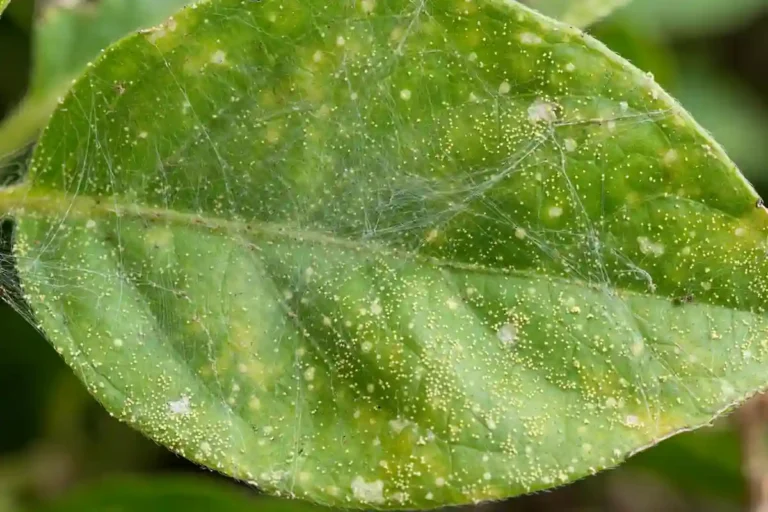
If your pest is white and cottony rather than brown and bumpy, you’re dealing with mealybugs — head to our mealybug guide instead, since the treatment emphasis is different. And if the problem is fine stippling with webbing rather than bumps, suspect spider mites. Yellow leaves with no visible pest at all? Check our philodendron yellow leaves guide for the full diagnostic walkthrough.
Frequently Asked Questions
Small, immobile brown, tan, or gray bumps clustered along stems, leaf joints, and leaf veins — often mistaken for part of the plant itself. They range from pinhead to about half a centimeter. Soft scale may also leave sticky honeydew on leaves and the surface below, with black sooty mold growing on it. The definitive test: scrape one with your fingernail. If it pops off revealing a soft body underneath, it’s scale.
Yes, absolutely. While adult scale never moves, the crawler stage is mobile and can wander to neighboring plants, especially ones with touching leaves. Ants can also carry crawlers around. This is why immediate isolation is step one of any scale treatment — move the infested plant to a separate room and inspect every nearby plant with a magnifier, even if they look healthy.
Because adult scale wears waterproof waxy armor that repels contact insecticides. Most sprays only kill the soft-bodied crawler stage, which is tiny and short-lived. If you spray once and stop, the armored adults survive and keep laying eggs. The fix is a repeated campaign: horticultural oil (which smothers even adults) plus insecticidal soap timed to crawler emergence, repeated every 7–10 days for at least a month.
Combine methods across the full life cycle: isolate the plant, manually scrape off adults, dab rubbing alcohol on stragglers, then run 3–4 rounds of horticultural oil alternating with insecticidal soap, spaced 7–10 days apart to catch each new wave of crawlers. Monitor with tape traps and a magnifier, and keep the plant quarantined for six weeks after the last live scale. Permanent success comes from breaking the egg-to-crawler cycle, not from one heroic spray.
Not always. Light infestations (a couple dozen bumps on one stem) are very winnable with scraping, alcohol, and oil. Moderate infestations can be beaten by pruning the worst stems plus full treatment. But if stems are encrusted along their full length, most leaves are affected, and the plant is declining, discarding is the rational choice — one reservoir plant risks your entire collection. Bag it, trash it, and don’t feel guilty.
Yes — neem oil extract works well against scale in two ways: as a smothering oil that suffocates all stages including armored adults, and through azadirachtin, which disrupts feeding and reproduction in crawlers. Apply with thorough coverage to the point of runoff, in cool conditions out of direct sun, and repeat every 7–10 days for 3–4 rounds. It’s one of the gentlest effective options and safe for indoor use once dry.
Yes. Seventy percent isopropyl alcohol dissolves the waxy coating that protects scale, killing the insect underneath on contact. Dab each scale individually with an alcohol-soaked cotton swab — it’s precise and avoids the leaf-burn risk of whole-plant spraying. Spot-test on one leaf first and wait 24 hours, since ferns and delicate-leaved plants can be sensitive. Repeat weekly to catch newly hatched crawlers.
Almost always on a new plant from a nursery or garden center, where a young invisible infestation came home with you. Scale can also hitchhike on plants that summered outdoors, on cut flowers, or even on ants that farm them. Adult scale doesn’t fly or jump — every infestation started with crawlers arriving from another infested plant. This is why quarantining new plants for six weeks is the single best prevention habit.
No. Scale insects don’t bite, sting, or transmit diseases to people or animals. They’re strictly plant feeders. The only indirect concern is if you use systemic insecticides — those make the plant’s tissues toxic, so keep treated plants away from pets and children and never use systemics on edible plants. The insects themselves are harmless to everything except your plants.
A strong stream of water can dislodge crawlers and some soft scale, and regular showering of smooth-leaved plants is decent prevention. But water alone won’t remove established armored scale — they’re cemented on too firmly — and it does nothing about eggs hiding under the females. Use water as a supplement (a good shower before oil treatment improves coverage), not as the treatment itself.