How Often Should You Fertilize Houseplants?
Your pothos looks fine. You water it on schedule, it gets decent light, and yet — the new leaves keep coming in smaller and paler than the old ones. Growth has slowed to a crawl even though it’s the middle of summer. Sound familiar? If you’ve ever wondered how often to fertilize houseplants, you’re asking one of the most common (and most confusing) questions in indoor gardening.
The confusion is understandable. One fertilizer label says “feed every 2 weeks.” Another says “once a month.” A gardening forum swears by feeding with every watering, while your grandmother insists she never fertilized anything and her spider plant lived for twenty years. Who’s right? Honestly — all of them, a little. That’s because how often to fertilize houseplants isn’t a single answer. It depends on the plant, the season, the type of fertilizer, and how much light your plant actually gets.
In this guide, I’ll give you the real answer: a clear fertilizing framework you can apply to every plant you own. You’ll learn why potted plants run out of food, what those three NPK numbers actually mean, how liquid, slow-release, and organic fertilizers differ, and exactly how often to feed heavy feeders versus succulents. By the end, you’ll have a seasonal schedule you can actually follow — no guesswork, no fertilizer burn, no starving plants.
In This Guide
- Why potted plants run out of food (and garden plants don’t)
- NPK explained: what those three numbers on the label mean
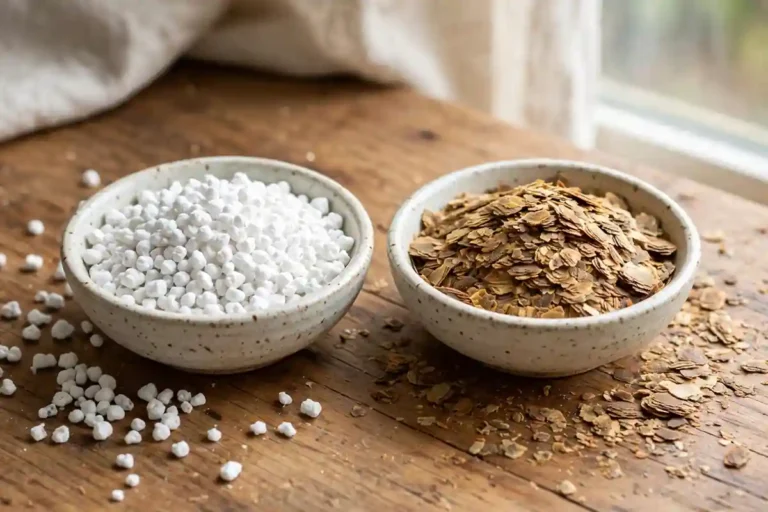
- Fertilizer types compared: liquid, slow-release, spikes, and organic
- How often to fertilize houseplants by plant type
- The seasonal fertilizing schedule: when to feed and when to stop
- How to fertilize step-by-step (the right way)
- Signs your plant is under-fertilized
- Over-fertilizing and fertilizer burn: signs and rescue steps
- 6 common fertilizing mistakes to avoid
- Organic fertilizer options
- FAQs
Why Potted Plants Run Out of Food
In nature, plants eat constantly. Fallen leaves decompose, soil microbes break down organic matter, and deep root systems tap into a vast underground nutrient bank. It’s a self-restocking pantry. A potted houseplant gets none of that.
A container holds a fixed, finite volume of soil — usually just a few quarts. Every time you water, soluble nutrients wash out through the drainage holes. This leaching is relentless: nitrogen, the nutrient plants use most, is especially mobile and disappears first. Within one to two months of potting up, most commercial potting mixes have exhausted the starter charge of fertilizer the manufacturer blended in. From that point on, your plant is living off a pantry that never gets restocked — unless you do it.
This is why even a plant in “fresh soil” can start looking hungry by mid-summer. Repotting does deliver a fresh supply of nutrients, which is one reason plants often surge with growth after moving to a bigger pot — but that boost fades within a couple of months too. Fertilizing isn’t an optional extra for houseplants. It’s the only way to replace what watering constantly removes.
There’s a second factor people miss: indoor light is weak. A houseplant in medium indoor light grows far more slowly than the same plant outdoors, which means it needs less fertilizer than the label’s “garden rate” suggests. Overfeeding a slow-growing indoor plant is one of the fastest ways to cause fertilizer burn. The golden rule of how often to fertilize houseplants starts here: feed the growth you actually have, not the growth you wish you had.
NPK Explained: What Those Three Numbers Mean
Every fertilizer label carries three numbers, like 20-20-20 or 10-10-10. These are the percentages by weight of the three primary macronutrients plants need most: nitrogen (N), phosphorus (P), and potassium (K). Understanding what each one does makes every other fertilizing decision easier.
Nitrogen (N) drives leafy, green, vegetative growth. It’s the nutrient behind lush foliage, and it’s the one houseplants consume fastest. When a plant is nitrogen-deficient, older leaves turn pale or yellow first (the plant moves nitrogen from old leaves to new growth), and new leaves come in small. Most foliage houseplants do best with a fertilizer that has plenty of nitrogen.
Phosphorus (P) supports root development, flowering, and fruiting. Bloom-boosting fertilizers are high in phosphorus — the classic example is a 15-30-15 formula marketed for flowering plants. For foliage houseplants that you never expect to bloom, extra phosphorus is mostly unnecessary, though it does no harm in balanced amounts.
Potassium (K) regulates overall plant vigor: water movement within tissues, disease resistance, and stress tolerance. Think of it as the plant’s immune-system and plumbing support in one.
Beyond NPK, plants need micronutrients — iron, magnesium, manganese, zinc, copper, boron, and molybdenum — in tiny amounts. A good houseplant fertilizer includes these (check the label for “micronutrients” or “trace elements”). Pale new leaves with dark green veins, for example, often signal iron deficiency rather than a nitrogen problem, and no amount of extra 20-20-20 will fix it if iron is what’s missing.
How do you choose? For foliage houseplants, a balanced fertilizer (equal or near-equal numbers, like 20-20-20 or 10-10-10) is the standard recommendation from university extension services. Clemson University’s Home & Garden Information Center, for instance, recommends a balanced fertilizer such as 20-20-20 for foliage plants and a higher-phosphorus formula like 15-30-15 for flowering plants — solid, research-backed guidance you can read in their indoor plant fertilizing guide. When in doubt, balanced is the safe default.
Fertilizer Types Compared: Liquid, Slow-Release, Spikes, and Organic
Not all fertilizers behave the same way, and the type you choose directly affects how often to fertilize houseplants. Here’s the honest breakdown:
| Type | How It Works | Pros | Cons | Best For |
|---|---|---|---|---|
| Liquid / water-soluble | Dissolves in water; roots absorb immediately | Fast results; full control over dose and timing; easy to dilute weak | Must reapply regularly; easy to overdo if mixed too strong | Most houseplants; beginners who want control |
| Slow-release granules | Coated pellets release nutrients over 3–6 months | Apply 1–2 times per year; very forgiving; no mixing | Can’t adjust mid-cycle; releases faster in heat; pricier upfront | Busy plant parents; outdoor containers; heavy feeders |
| Fertilizer spikes / tablets | Compressed nutrients pushed into soil | Convenient; no measuring | Uneven distribution — nutrients concentrate near the spike, which can burn nearby roots | Small collections; people who hate mixing |
| Organic (fish emulsion, seaweed, worm castings) | Natural materials broken down by soil microbes | Gentle; hard to burn plants; feeds soil biology | Slower results; fish emulsion smells for a day; can attract fungus gnats if overapplied | Anyone wanting a gentler, soil-first approach |
Liquid fertilizer is my default recommendation for most indoor gardeners. It gives you complete control: you can feed weakly and often, skip a plant that’s resting, or boost a heavy feeder mid-summer. The key is dilution (more on that below). Slow-release granules are the best “set it and forget it” option — one application in spring carries many plants through the whole growing season — but you sacrifice the ability to fine-tune.
One honest note about spikes: they work, but the concentrated zone around each spike can damage roots, and large pots often need several spikes to feed the whole root ball. If you use them, place them halfway between the stem and the pot edge, never jammed against the stem.
How Often to Fertilize Houseplants: The Real Answer by Plant Type
Here’s the framework. During the active growing season (roughly March through September for most US homes), using half-strength liquid fertilizer:
| Plant Type | Examples | Frequency (Growing Season) | Notes |
|---|---|---|---|
| Heavy feeders | Monstera, fiddle leaf fig, calathea, ferns, peace lily | Every 2 weeks | Fast growers that push big leaves; hungry all season |
| Average feeders | Pothos, philodendron, spider plant, dracaena, rubber plant | Every 3–4 weeks | The classic “monthly feeding” group |
| Light feeders | Snake plant, ZZ plant, cast iron plant | Every 6–8 weeks | Slow growers; overfeeding causes more harm than good |
| Succulents & cacti | Aloe vera, jade, echeveria | 2–3 times per season | Only while actively growing; use cactus fertilizer or half-strength balanced |
| Flowering houseplants | African violets, orchids, anthurium | Per type — often weakly-weekly | African violets and many orchids prefer constant very dilute feeding |
A few things worth knowing about these categories. Heavy feeders like monstera and fiddle leaf fig are building enormous leaves every few weeks in summer — that biomass has to come from somewhere, and in a pot it comes from your fertilizer bottle. If your monstera deliciosa is pushing out disappointingly small leaves despite good light, hunger is a prime suspect. Average feeders like pothos are the backbone of most collections and do beautifully on a simple monthly schedule. Snake plants and ZZ plants grow so slowly that frequent feeding just accumulates salts in the soil — every couple of months is plenty.
For succulents, restraint is everything. They evolved in poor soils and genuinely prefer it. Two or three light feedings during the growing season is enough; feeding a dormant succulent in winter is a classic way to trigger weak, stretched growth.
If you use slow-release granules instead of liquid, the frequency question mostly disappears: apply once in early spring (and optionally once more in midsummer for heavy feeders), and you’re done. Just remember that slow-release pellets dump nutrients faster in warm conditions, so a pot baking near a sunny window may exhaust its granules sooner than the label promises.
The Seasonal Fertilizing Schedule
Houseplants don’t grow at the same speed all year, so your fertilizing shouldn’t either. Light is the engine of growth, and in most US homes, usable indoor light drops dramatically from October through February. Less light means less growth, which means less appetite.
| Season | What’s Happening | Feeding Frequency | Notes |
|---|---|---|---|
| Spring (Mar–May) | Days lengthen; new growth starts | Begin feeding; ramp to full schedule by April | Wait until you see active new growth before the first feeding |
| Summer (Jun–Aug) | Peak growth | Full schedule (see table above) | This is when heavy feeders earn their name |
| Fall (Sep–Nov) | Growth slows as light fades | Taper: halve frequency, then stop by late fall | Last feeding ~6 weeks before your home’s “dark season” |
| Winter (Dec–Feb) | Most plants rest | Stop for most plants | See exceptions below |
The winter stop matters more than beginners expect. Fertilizing a resting plant doesn’t “keep it strong” — it deposits salts into soil where inactive roots can’t absorb them, setting up fertilizer burn and salt buildup. A white, crusty film on the soil surface in winter is often mineral salt, not mold (though the two are easy to confuse — if you’re unsure, our guide to white mold on houseplant soil shows how to tell them apart).
Exceptions to the winter stop: if you grow under strong grow lights (12+ hours daily) and your plants are actively pushing new leaves, keep feeding at a reduced rate — your “summer” never ended. Tropical plants in warm, bright Florida or Southern California homes may also grow year-round. And seedlings or recent propagations establishing roots benefit from very dilute feeding even in winter. The rule behind the rule: feed active growth, not the calendar.
How to Fertilize Houseplants: Step by Step
Knowing how often to fertilize houseplants is half the battle; the other half is doing it correctly. Follow these steps and you’ll avoid 95% of fertilizer problems:
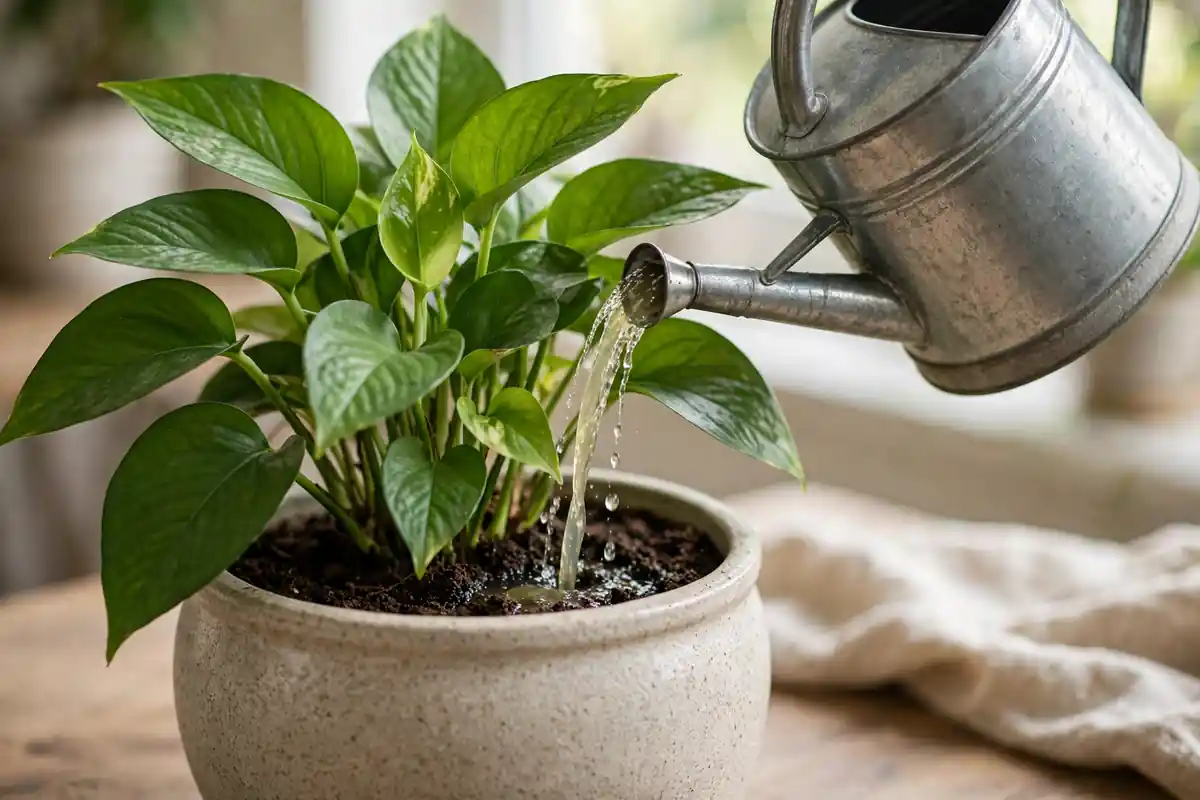
- Water first, fertilize second. Never apply fertilizer to dry soil. Dry roots absorb concentrated fertilizer solution too aggressively, which is the number-one cause of fertilizer burn. Water your plant normally, wait 30 minutes or so, then apply the diluted fertilizer. Think of it as feeding dessert after the main course, not on an empty stomach.
- Dilute to half the label rate. Indoor plants in modest light need less than the label’s general rate. If the package says one teaspoon per gallon, use half a teaspoon. You can always feed again in two weeks; you can’t un-burn roots. (An alternative approach endorsed by Clemson Extension: dilute to about one-tenth strength and use it at every watering during the growing season — the “weakly weekly” method. Either approach works; pick the one you’ll actually stick with.)
- Apply evenly until slight drainage. Pour the solution slowly over the whole soil surface so all roots get fed, not just one spot. Let a little run out the drainage holes — this also helps prevent salt accumulation.
- Empty the saucer. Never let your plant sit in fertilizer solution. Dump the saucer 15–20 minutes after watering. Sitting in nutrient soup invites both root damage and salt crust.
- Skip plants that shouldn’t be fed right now. Newly repotted (wait 4–6 weeks — fresh mix already has nutrients), dormant, stressed by pests or disease, or freshly moved to a new home (give it 2–4 weeks to settle). Fertilizer is for healthy, growing plants — it’s plant food, not plant medicine, and it won’t fix a plant that’s struggling for other reasons.
- Write it down. Seriously. A note on your phone — “fed monstera 6/1, pothos 6/1” — prevents both double-feeding and the “did I feed this?” guessing game. Your future self will thank you.
Signs Your Plant Is Under-Fertilized
Under-fertilizing is far more common than over-fertilizing, and its symptoms develop so gradually that most people blame something else. Watch for:
- Pale new growth. New leaves emerge lighter green than older ones, or the whole plant’s color looks washed out. Nitrogen deficiency shows in older leaves first (the plant cannibalizes them to feed new growth), so uniform paleness across old foliage is a classic hunger signal.
- Smaller-than-usual new leaves. A monstera pushing out leaves half the size of last year’s, despite the same light and water, is usually asking for food.
- Stalled growth in growing season. It’s June, light is good, water is right, and nothing is happening. Before assuming the worst, ask when you last fed it.
- Weak, leggy stems. Growth stretches toward light without filling out — sometimes this is purely a light issue, but a hungry plant stretches too.
- No flowers on flowering plants. An African violet that hasn’t bloomed in a year despite good care is often just underfed (or needs more light — check both).
The tricky part: these symptoms overlap with low light and watering issues. My diagnostic order is always light first, water second, food third. Fertilizer can’t compensate for a plant starving for light — feeding a dark-corner plant just adds salts to soil it can’t use. Fix the light, confirm the watering, then feed.
Over-Fertilizing and Fertilizer Burn: Signs and Rescue
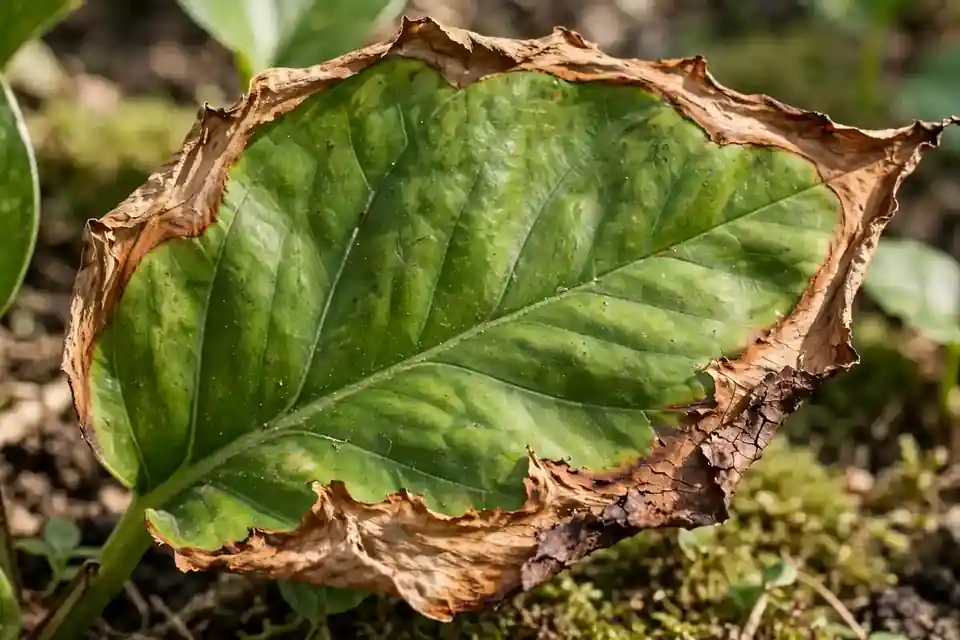
Fertilizer burn happens when soluble salts accumulate around roots faster than the plant can absorb them, literally pulling water out of root cells by osmosis. It’s dehydration caused by too much “food.” Here’s how to recognize and fix it:
Warning signs:
- Brown, crispy leaf edges and tips — the classic signature. Unlike underwatering (which usually crisps whole leaf margins uniformly), fertilizer burn often starts at the very tips and looks scorched.
- White crust on the soil surface or pot rim — accumulated mineral salts.
- Wilting despite moist soil — roots are damaged and can’t take up water even though it’s available.
- Sudden leaf drop after feeding, or a plant that declines right after you “gave it a boost.”
Rescue steps (do this promptly):
- Stop fertilizing immediately. No more food until the plant fully recovers — typically 4–6 weeks minimum.
- Flush the soil. Take the plant to a sink or tub and run room-temperature water through the pot — roughly four to five times the pot’s volume — letting it drain freely. This leaches excess salts out. For a 6-inch pot, that’s a lot of water; be thorough.
- Scrape off the crust. Remove any white salt crust from the soil surface and wipe the pot rim.
- Let it drain completely, then return the plant to its spot. Don’t water again until the top inch or two dries normally.
- Trim only fully dead tissue. Brown crispy tips won’t heal, but don’t cut into healthy green tissue — you’ll just create new wounds. Trim for looks once recovery is underway.
- Resume feeding at quarter-strength when you see healthy new growth, and only then.
Severely burned plants may need a full repot into fresh mix if flushing doesn’t help, but most recover with a good flush and patience. Prevention beats rescue every time: when in doubt, feed weaker and less often.
6 Common Fertilizing Mistakes to Avoid
- Fertilizing dry soil. Worth repeating because it’s the top cause of burn. Always water first.
- Feeding a stressed or dormant plant. A plant battling spider mites, recovering from repotting, or sulking after a move needs stability, not nutrients. Fertilizer forces growth the plant can’t support right now. Wait until you see healthy new growth.
- The “more is better” myth. Doubling the dose doesn’t double growth — it doubles salt concentration. Plants can only use what their light level supports; the excess just accumulates. If half-strength monthly works, full-strength weekly won’t work “better.”
- Using outdoor/garden rates indoors. Garden fertilizer instructions assume full sun and fast growth. Indoor light is a fraction of outdoor light, so indoor doses should be too. Always start at half the label rate for houseplants.
- Fertilizing on a rigid calendar instead of observing the plant. “First of every month” is fine as a reminder, but skip the feeding if the plant is dormant, stressed, or the soil is still wet from last time. The schedule serves the plant, not the other way around.
- Ignoring salt buildup. Even perfect feeding leaves some residue over time. Once or twice a year, give your plants a plain-water flush (no fertilizer that round) to wash accumulated salts out. Your plants’ roots will thank you — and you’ll see fewer mystery brown tips.
Organic Fertilizer Options for Houseplants
If synthetic fertilizers make you nervous, organic options work well — they just behave differently. Organic fertilizers need soil microbes to break them down into forms roots can absorb, so they act slower and more gently. That slowness is a feature: it’s very hard to burn a plant with organics.
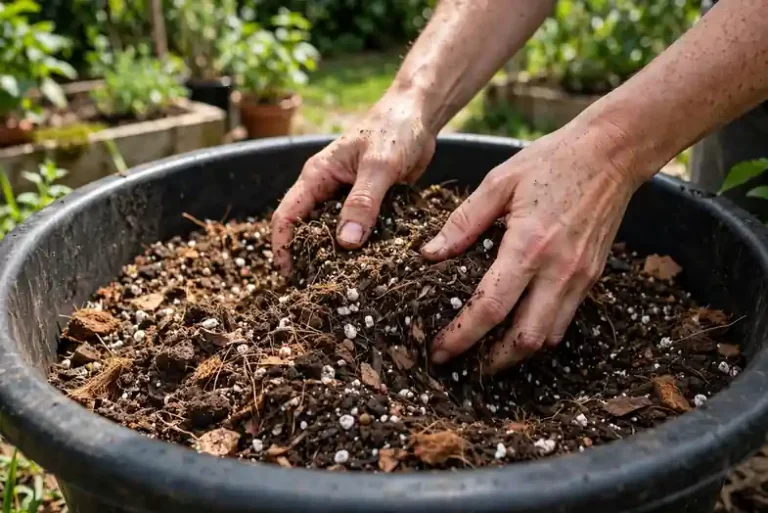
- Worm castings: my top organic pick for houseplants. Top-dress the soil with a half-inch layer in spring; every watering carries gentle nutrition down to the roots. No smell, no burn risk, and plants love them.
- Fish emulsion: effective and fast for an organic, but it smells like a dock for a day or two after application. Dilute well and use it when you can ventilate. Your plants won’t mind; your living room might.
- Seaweed/kelp extract: less about NPK and more about micronutrients and growth hormones that support root development and stress tolerance. Great as a supplement alongside a main fertilizer.
- Compost tea: brewed from finished compost; adds biology more than nutrients. Nice supplement, not a complete feed on its own.
One honest caveat: organic fertilizers can attract fungus gnats if overapplied, since gnats love the rich organic matter on the soil surface. If gnats appear after top-dressing, let the surface dry thoroughly between waterings and check our fungus gnat guide for backup. You can also combine approaches — slow-release synthetic granules as the base plus worm castings on top gives you the best of both worlds.
Frequently Asked Questions
For most houseplants: not at all. From roughly December through February, short days put most indoor plants into a resting state where they can’t use fertilizer — feeding them just accumulates salts in the soil. The exceptions are plants growing actively under strong grow lights, seedlings, and tropicals in warm bright homes that never slow down. If your plant is pushing new leaves in January, feed it lightly; if it’s sitting still, let it rest.
Yes, with adjustments. A balanced all-purpose garden fertilizer (like 10-10-10) works fine for houseplants if you dilute it to half the label rate or less — garden rates assume full sun and vigorous growth that indoor plants don’t have. Avoid weed-and-feed products or anything with herbicides, obviously. Dedicated houseplant fertilizers are simply pre-diluted for convenience, not magically different chemistry.
Wait 4–6 weeks. Fresh potting mix contains a starter charge of nutrients that carries the plant through the first month or two, and repotting already stresses roots — adding fertilizer on top risks burn on damaged root tissue. Let the plant settle, watch for new growth, then start feeding on your normal schedule.
Both work, and research-backed sources endorse both. The “weakly weekly” approach (very dilute fertilizer at every watering) gives the most even nutrient supply and virtually eliminates burn risk — but it demands consistency. The monthly half-strength approach is simpler to remember and works great for most people. Choose based on your habits: consistent waterers do well with weakly-weekly; everyone else should go monthly.
That’s likely fertilizer burn or salt buildup — the dose was too strong, it was applied to dry soil, or salts have accumulated over time. Flush the pot thoroughly with plain water (4–5 times the pot’s volume), scrape off any white crust, and hold off feeding for a month. When you resume, use half the previous strength and always water before fertilizing.
Barely. Succulents evolved in nutrient-poor soils and grow slowly, so 2–3 light feedings during the active growing season (spring through early fall) is plenty — use a cactus fertilizer or half-strength balanced liquid. Never fertilize a dormant succulent in winter; it encourages weak, stretched growth that’s prone to rot. When in doubt with succulents, skip it.
Unopened, most last for years. Once diluted in your watering can, use it within a day or two — mixed solution can grow algae or lose potency, and you don’t want to guess at the concentration later. Organic liquids (fish emulsion, compost tea) spoil fastest; if it smells rancid beyond its normal fishiness, mix a fresh batch. Dry granules and slow-release pellets last indefinitely if kept dry.
No — wait 2–4 weeks. Nursery plants are typically well-fed (sometimes overfed) before sale, and the move to your home is stressful enough without adding fertilizer. Let the plant acclimate to your light and watering routine first. When you see new growth starting, that’s your signal to begin your normal feeding schedule.
A balanced ratio like 20-20-20 or 10-10-10 is the standard, research-backed choice for foliage plants — it supplies everything in proportion. High-nitrogen formulas (like 30-10-10) suit heavy leaf-growers, while bloom boosters (15-30-15) are for flowering plants. Honestly, for most collections, one balanced fertilizer used correctly beats a shelf of specialty formulas used randomly.
Mostly no, with nuance. Banana water contains negligible potassium — you’d need an absurd quantity to match even a weak commercial feed, and the sugars can attract pests. Used coffee grounds are mildly acidic and fine as a small soil amendment, but they’re not a meaningful fertilizer. Eggshells add calcium very slowly. These DIY options aren’t harmful in moderation, but they’re not replacements for actual fertilizer. If you want organic, worm castings and fish emulsion deliver real nutrition.